

A New Type of Love Story
Why were all so Obsessed with Travis Kelce and Taylor Swift’s Relationship

It’s a love story, baby, just say….yes.
It’s official: on August 26th, 2025, Grammy-winning, platinum-selling artist and songwriter Taylor Swift took to Instagram to announce her engagement to Travis Kelce.
According to Jason Kelce, brother of Travis Kelce and co-host of their podcast New Heights, it is “the proposal heard around the world,” and honestly, that might be true.
So many single cis-hetero women have grown up watching Taylor Swift, I myself included. While I was a little late to the Swiftie train (I didn’t start listening to her until after her “darker” Reputation album was released), it is impossible to deny the impact Taylor has had, not only on the music industry but also as a role model for women everywhere.
Which has probably inspired her newest album, set to release on October 3rd, 2025, titled The Life of a Showgirl. This album, which will drop on Mean Girl’s Day (if you know, you know), was no doubt strategic on Taylor Swift’s part because she writes her music to center women’s experiences.

She writes about what she knows best: her own life, her own struggles with womanhood and femininity, systemic sexism, heartbreak, betrayal, and, yes, about love.
But let’s dive into the evolution of Taylor and why her experience is so relatable for women everywhere, and what we can learn from her about embracing womanhood, our strength, and, of course, finding love.
The Eras of Taylor
Taylor isn’t just a musical genius; it is clear to me, as someone who has studied the fields of psychology and women's studies for many years and worked in psychotherapy for over 10 years, that Taylor understands not only the human experience but also the feminine experience. Or rather, the psychological experience of being a woman in our modern society.
Just take her Eras Tour, for instance, the entire production consistently used a recurring house motif as her central stage design element.
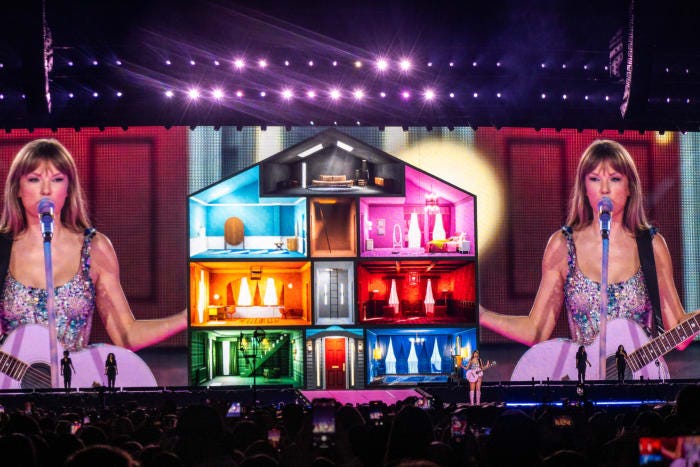
Now, I don’t know if Taylor Swift is familiar with Jung’s work for certain, but for someone who knows about Aristotle as well as so many other literary and philosophical references, and also referencing many of the psychological treatments used on women to treat “hysteria” in her 11th studio album, The Tortured Poets Department, I find very hard to believe that she hasn’t encountered Jung’s work in some form or fashion.
Moreover, the house archetype as a metaphor for the Self is directly taken from Jung’s work.
In Memories, Dreams, Reflections, Carl Jung describes how the archetype of a house serves as a metaphor for the Self and the totality of the psyche, uniting both conscious and unconscious aspects.
Specifically, Jung states that within the house, the upper floors represent the conscious, rational mind, which encompasses the present, logical thought, and also our persona, or the mask we wear in the outer world. The ground floor, therefore, represents our everyday life and lived experiences as we interact in our day-to-day lives. In the basement or cellar, we access our unconscious minds, our dreams, instincts, and repressed material, which encompasses the principle of the feminine that I write about on this blog. Finally, Jung also noted that the house contains hidden rooms or an attic, which might represent a forgotten aspect of the psyche or of the Self we must integrate once it has entered our awareness.
Now it is important to note that Taylor Swift’s house doesn’t follow Jung’s analogy, and perhaps this is because Jung wrote about his own individuation experience, which is based on his experiences as a male, and Taylor is a woman. Therefore, she is going to write about her own life’s journey, which differs significantly from men’s understanding of their own self-actualization process.
Therefore, as a scholar of feminine wisdom and the women’s self-actualization process, I can undoubtedly say that Taylor Swift’s house and her music are reflective of her own process of self-reclamation.
In her house, we see that her beginning floors represent her earlier work from her Debut and Speak Now albums. Thus, they are the foundation from which she has built herself and her musical empire. They represent her childhood self, or what we might call her maiden aspect. These albums reflect Taylor’s more innocent and youthful aspects, as most of her songs written during these albums consistently use fairy tales or storytelling to paint a picture of Taylor’s ideal life, which often involves a metaphorical handsome “prince” coming to profess his love to her. A classic light, feminine maiden motif.
As we move up the house, the second floor features rooms that represent her Fearless and Red albums. This is when Taylor’s music begins to take a more complex turn as she experiences love and heartache for the first time. With songs like “All Too Well” and “Red,” we as the audience can resonate with her feelings of betrayal and heartache, as many of us as women have also felt the same.
As we move higher up the house, we see rooms which depict her 1989 and Lover albums, and the songs here are much more adult in nature. The song “22” from her album 1989 is about separating herself from the approval of men and chasing love, to prioritize her female friendships and experience life on her own terms. With Lover, songs like “False God” and “Cruel Summer” were given, which show Taylor’s more “adult” side as she sings about love, sex, and complicated, messy relationships.
The top floor, or attic, is thought to be her album, Reputation, and down the center of the house, we see stairs that depict the rooms for Evermore and Folklore. These albums were significantly darker than Taylor’s other albums and reflect more of her crone or witchy aspects. In Reputation, she reclaims the image of the snake. A symbol, which, as I have discussed, is often associated with feminine power and wisdom. Moreover, given that Reputation was the last album Swift produced with Scooter Braun, it represents her departure from the ‘good girl’ or goddess archetype and her reclaiming her inner witch. Thus reflecting the dichotomy, I refer to as the Goddess-Witch Spectrum™, which is central for women to reconcile to move towards self-actualization and integration.
This progress of Taylor integrating her witch and goddess parts is reflected in the albums Evermore and Folklore, where we see Taylor revisit her past maiden aspects and ability to tell stories, but now with a new perspective. These albums are much darker, more complex, and her characters in her songs, like Betty, James, and Augustine, are flawed. Their messy love triangle reflects the complex dating patterns of modern women in our society. Moreover, these albums detail Taylor’s awakening process and how she attempts to navigate the complex male-dominated music industry with songs like “My Tears Ricochet” and “Peace.” Thus, these sister albums are Taylor’s process of integrating all aspects of herself, which are also reflected in her albums Midnights, which contained songs written throughout her career as a musician, and The Tortured Poets Department (TTPD), which detailed her messy break-up from Joe Alwyn and her long, complex situationship with her “bad-boy” lover, singer Matty Healy.
Metaphorically, these two men can represent the extremes of the masculine Taylor found herself attracted to. For example, Joe, no doubt represented her prince charming archetype, the knight in shining armor who impressed her intellectual and philosophical side, which allowed her to access a depth and complexity into her music that she might not have felt like she had permission to access otherwise, since she was typecast as being the “girl next door.” Yet, with Joe, it seems as though their relationship lacked passion, or at least romance, and that he was non-committal towards her, which we can see in songs like “Champagne Problems” and “You’re Losing Me.”
With Healy, he undoubtedly represented her “wild” side, the bad-boy Don Juan archetype who awakened her from her “good girl” shell to reclaim her inner beast. An archetype of a man, which I believe many women can relate to, and almost seems necessary for women to integrate their witch aspects, as I have written about here:
In TTPD, we get songs like “My Boy Only Breaks His Favorite Toys,” “Down Bad,” “loml,” and “Fortnight,” “The Prophecy,” and “Guilty as Sin,” all detailing her heartbreak and recovery. Yet, it is clear from these songs that through her relationship with Matty, though complex and difficult, Taylor learned how to integrate her own dark feminine aspects. The witch, which is ultimately the aspect I believe in women’s psyche, which they need to integrate the most to achieve self-actualization, which is perhaps why Reputation (another “witchy”) album is at the top of Taylor’s house in the Eras tour, to symbolize that is the core of who she is and therefore, what she has been working towards and trying to reclaim within herself.
This witch metaphor is also seen all throughout TTPD with songs like “Cassandra” and “Whose Afraid of Little Ole Me” indicating that Taylor no longer fears her dark feminine aspects. Instead, she embraces them as part of her character and herself.
I have no doubt that in her newest album, Taylor will revisit her goddess or light feminine aspects, as one would imagine a showgirl to represent. Thus, I imagine that Taylor is now in a place where she feels comfortable navigating the different “rooms” within her house/Self, which is perhaps why she has found love with Travis, as she has already learned to accept and love all parts of herself.
Anamnesis: Taylor’s Homecoming
The last track on TTPD is “The Manuscript,” a beautiful song that details how Taylor has used writing to process and overcome her trauma and heartache. To me, this song is perhaps the most symbolic of Taylor’s self-actualization process, a process I refer to as Anamnesis in my theory, I am constructing on women’s psycho-spiritual self-actualization process titled Yonic Theory™.
Anamnesis simply means “return to oneself,” which is why the self-actualization process for women differs from that of men. Men must seek out their Self, and they do that through making contact with the feminine, in both its light and dark aspects, through their relationships with women in their lives who represent their projected goddess and witch archetypes. Women, on the other hand, must learn to reconcile these parts within themselves, and they do that through encountering men in relationships who allow them to gain access to the hidden parts of themselves they have abandoned through their gender role socialization.
Swift sings about this in the song “Seven” on Folklore, where she sings about “hitting her peak at seven” and her hometown in Pennsylvania. In this song, she is remembering her core essence, who she was before her father, and the world forced her to take on the role of the goddess or the persona she adopted to survive. That is what the process of Anamnesis is all about at its core for women, deconstructing the patriarchal conditioning we adopt to survive in a “man’s world” and to finally come home to ourselves.

Finding Love: A New Type of Man
As I stated previously, it is no surprise to me that Taylor found love as she finally learned to integrate her witch aspect after processing her breakup with Matty Healy. The song “So High School” reflects Taylor's journey and her relationship with Travis Kelce, which feels light and serves as a reminder of how free she felt in her youth. Who she was before the music industry got a hold of her and transformed her life, before she underwent the process of Anamnesis and embarked on her own self-actualization journey.
It is the type of love we all dream about as women, but rarely find, because to find it, we must first reclaim the lost “eras” or parts of our lives. The goddess and the witch.
This also means we must confront our projects of the Prince Charming and Don Juan archetypes, as I wrote about here, to examine these aspects of ourselves and combat the myth that we were told as children — that a man will “complete” us. Just like no woman can “complete” a man, which is why the goddess archetype for men inevitably fails, no man can “complete” a woman.
All of us, men and women, have light and dark/masculine and feminine aspects. If we can not integrate all of these parts of ourselves well, then we can never truly see ourselves or another person for who they are.
Falling in love requires courage and vulnerability; it requires both people to show up – shadows and all.
Travis isn’t Taylor’s Prince Charming, and he isn’t her “bad boy”. He is himself and fully content with who he is, just like she is fully content with herself.
Travis knows that he is a goofball and doesn’t try to hide it. He understands he is a bro, through and through. A jock, a video-gaming-loving man, and Taylor doesn’t try to change that about him. She doesn’t try to turn him into someone he is not, just like he doesn’t try to make her fit his own projection of his “goddess.”
Instead, he loves her fully. He admires her wit, her humor, her passion, creativity, and dedication to her work. Rather than being intimidated by her intelligence or capital, he uplifts her. Praising her for her hard work and wanting to show her off to the world.
That is true love, and that is why we love them so much. They represent a new type of love that we all want that isn’t based on fairy tales. Both of them have shadows, both of them have lightness. They are both whole individuals on their own, and together they create something beautiful.
Moreover, their relationship is realistic for many modern women and men and gives them something to aspire to. The Pew Research Center notes that U.S. women are outpacing men in college within every major racial and ethnic group. In English? This means that more and more women are becoming “smarter” than their partners, at least in terms of holding a college degree.
We can already start to see the backlash of women having more access to education with the rise of “red pill” culture, but what if these men could be more like Travis? Meaning, instead of getting defensive in an attempt to reject women before they themselves get dismissed, they could loosen their grip on their masculine-based ego and allow themselves to accept that their wives, daughters, and girlfriends might have more education and experience than they do.
Or rather, their experiences and intelligence are just different!
Taylor doesn’t tell Travis how to catch a football; she just goes and supports him at his games, and she is delighted to be there. Conversely, Travis doesn’t try to take over and run Taylor’s music empire; he sits back, enjoys her shows, or even participates in them to show his support.
Neither one is superior; they both have their strengths and weaknesses, but they complement each other to support one another.
As a woman with three college degrees, I’ve accepted the fact that I will probably not marry a man with the same level of education as me, and to be honest, I am completely fine with that. I think many modern women are starting to realize this as well.
We are outpacing men within academic circles, and yet, we still find ourselves attracted to them. This means something has got to give. Either we stay single or compete with one another for scarce resources, which, let's be honest, only benefits those men who are at the “top” of the food chain, thus reinforcing patriarchal oppression for women. Or we change course.
We stop chasing “Prince Charming” or the “bad boy” and find our Travis. Or rather, let him naturally find his way to us, once we have reclaimed ourselves through the process of Anamnesis, to find wholeness within. In fact, this is the same process that Maureen Murdock discussed in her book The Heroine’s Journey when she references the “man with heart” and “woman of wisdom” (which honestly sounds a lot like Travis and Taylor).
Listen here as I unpack this process on my podcast.
Travis is the “man with heart” for Taylor, because his love for her is not based on what she can do for him or how she makes him look. It’s based on mutual respect and a desire to know her as a whole person. She, in return, is his “woman of wisdom” who helps expand his mind and explains English literature to him, exposing him to more “esoteric” teachings.
Which again, does not intimidate him; in fact, he welcomes it. Saying how attracted he is to her when she uses “big words” or “sounds so smart.”
Perhaps Taylor said it best on her post when she announced their engagement, “Your English teacher and your gym teacher are getting married.” Taylor and Travis both know who they are and how we see them, and they are giving hope to the rest of us that men and women can learn how to be in a relationship with one another where both parties are respected and isn’t based on some crumbling system of patriarchal love created by men who want to dominate and control women.
When I discovered the news yesterday about Travis and Taylor, I half-jokingly texted one of my friends and told her, “I believe in love again.” Yet, maybe that wasn’t a joke.
There is something about Travis and Taylor that inspires me to have hope and be open to love. To remember who I am and my own complex journey of finding my way back home to myself, and that maybe I don’t need Prince Charming or a Don Juan, bad boy to make me feel whole.
I already am whole, and I want someone who is whole in themselves as well. Even if that means, it won’t fit the “traditional” dynamics we are told to want as women. Which is why we can all relate to Taylor and her love journey, because ultimately we see ourselves in her.
If you enjoyed this post and want to learn more about my Goddess-Witch Spectrum™ on-demand course, I am offering a 26% discount code in honor of Taylor and Travis’ engagement (Code: TAYLOR26). To purchase the course, visit my website by clicking the link below, and feel free to check out my other courses and content available to access!

Congrats to the happy couple!
OX
Your Dark Fairy Godmother
Resources:
Jung, C. G. (1963). Memories, dreams, reflections (A. Jaffé, Ed.). Pantheon Books.
Murdock, M. (1990). The heroine’s journey: Woman’s quest for wholeness. Shambhala.
Not prince charming, not the bad boy, but the man with heart for the woman with wisdom. Compelling capture of how Taylor's journey has resonated with so many of us!