

It’s officially August, which means we are entering the end of the summer season.
Here in the South, that means preparing for football season, Halloween, and pulling out all our autumnal-themed sweaters, even though it is 100 degrees Fahrenheit outside while we wait patiently for all the fall-themed seasonal goodies to drop.

 Tiktok failed to load.
Enable 3rd party cookies or use another browser
Yet, despite the lack of cooler weather we typically experience in my neck of the woods (aside from a random cold front in October or November), the fall and subsequent winter season tend to be the times of the year that I most look forward to.
Which is probably in part why I decided to schedule my dissertation defense on Halloween to commemorate this season and what it means to me.
Embracing the Autumn of One’s Life
Unlike the more spring- and summer-themed holidays (like 4th of July, Easter, May Day/Memorial Day/the Summer Solstice, etc.), which denote feelings of renewal and new beginnings, along with opportunities for travel and expansion, the fall- and winter-themed holidays tend to be more subdued in nature.
During this time of the year, we are often encouraged to turn inwards, to reconnect with our loved ones, visit friends and family members for the holidays, and, in many cultures, honor the spirits of those who have come before us, such as the practice of Día de Los Muertos across parts of Texas and Mexico as well as the Pagan/Celtic tradition of Samhain which aligns with the end of the harvest season in Europe and thus thanking Mother Earth for providing us with her bounty to keep us warm throughout the winter season.
Thus, Autumn reflects a turning point in the calendar year, much like how the transition from spring to summer reflects the archetypal process of the maiden becoming the mother; and the mother transforming into the crone as fall becomes winter.
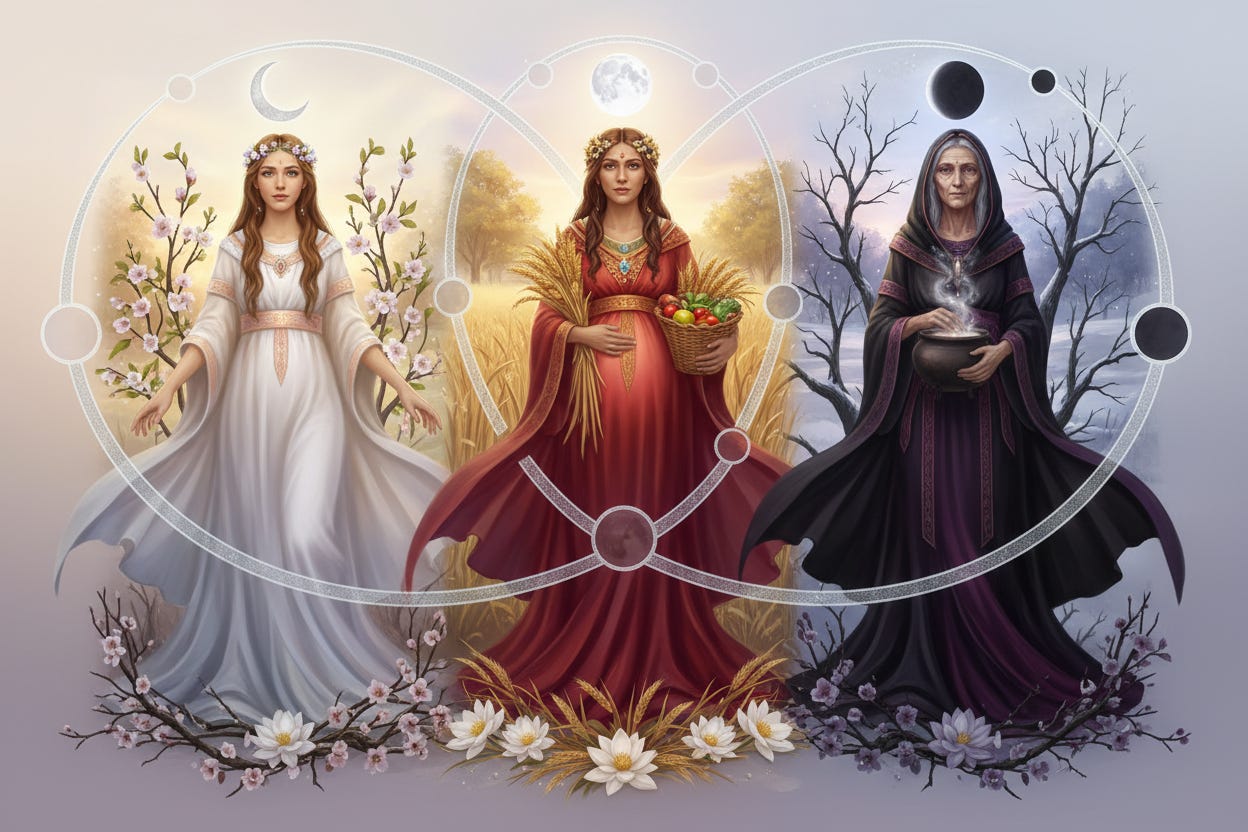
Image taken from mysticryst.com
Thus, if we use this metaphor of the cycle of the seasons and apply it to women’s self-actualization process, it is when women are faced with the realization that we are leaving one phase (i.e. transitioning from Maiden to Mother or Mother to Crone) and thus closer to entering the autumn season of our lives that we begin to reflect and turn inwards, which inevitably brings up the importance of choices.
Plath’s Fig Tree
Recently I referenced author Sylvia Plath’s fig tree analogy in my post regarding the construction of my Two of Pentacles card for my Yonic Tarot deck, but in truth this passage is taken from her book The Bell Jar, which is based on her own semi-autobiographical experience of working at Mademoiselle magazine in the 1950s and draws from her history of depression and mental illness for which she was hospitialized at 20 years old for attempting to take her own life.
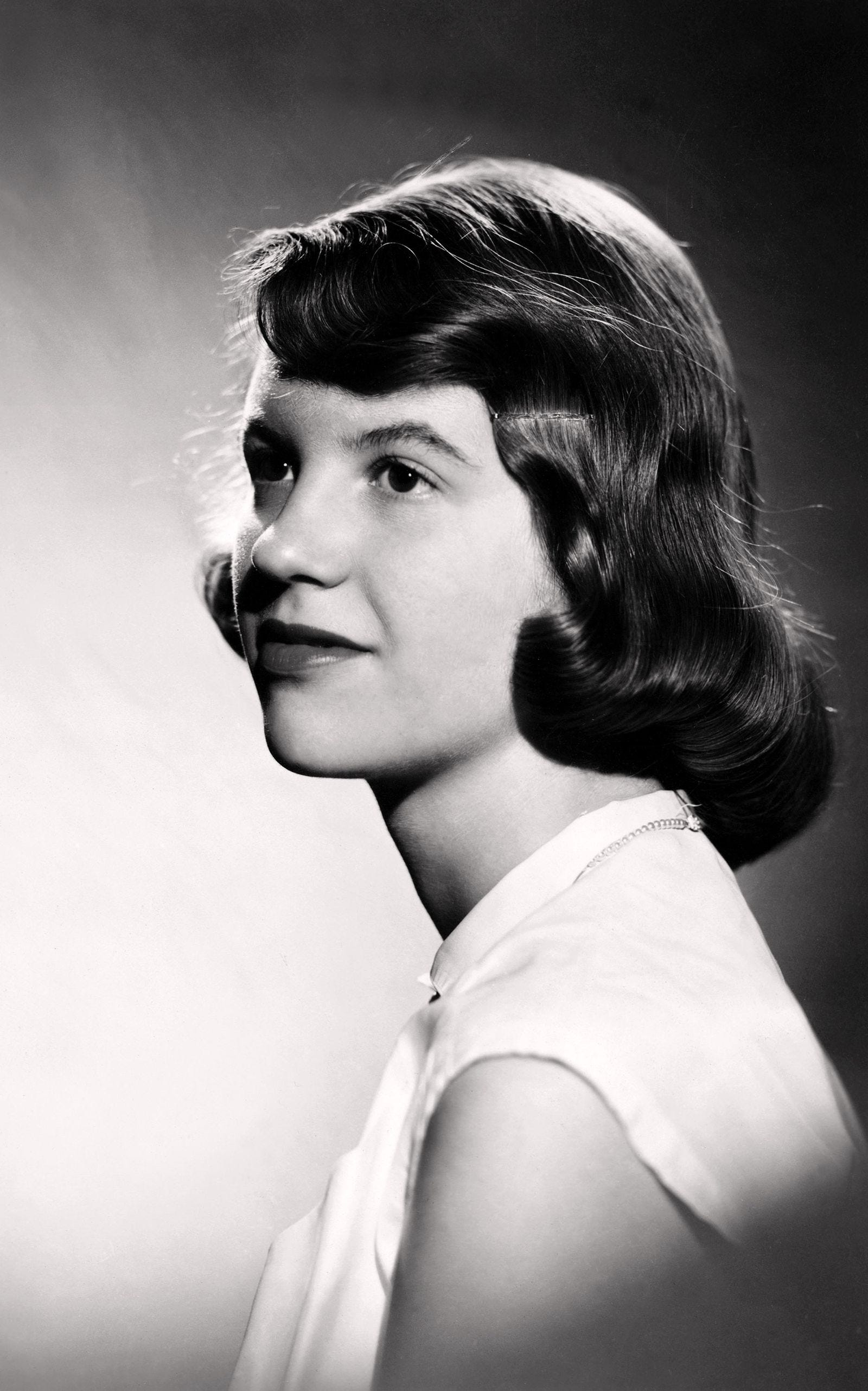
Image of Plath
While tragically Plath would indeed take her own life less than a month after the Bell Jar was published in 1963, in the book, Plath’s character Esther Greenwood, whose story mimics much of Plath’s real-life descent into madness, describes the analogy of a fig tree and how it reflects the pressure she feels as a young woman in college attempting to navigate her life choices as she moves into adulthood.
“I saw my life branching out before me like the green fig tree in the story. From the tip of every branch, like a fat purple fig, a wonderful future beckoned and winked. One fig was a husband and a happy home and children, and another fig was a famous poet and another fig was a brilliant professor, and another fig was Ee Gee, the amazing editor, and another fig was Europe and Africa and South America, and another fig was Constantin and Socrates and Attila and a pack of other lovers with queer names and offbeat professions, and another fig was an Olympic lady crew champion, and beyond and above these figs were many more figs I couldn’t quite make out. I saw myself sitting in the crotch of this fig tree, starving to death, just because I couldn’t make up my mind which of the figs I would choose. I wanted each and every one of them, but choosing one meant losing all the rest, and, as I sat there, unable to decide, the figs began to wrinkle and go black, and, one by one, they plopped to the ground at my feet.”
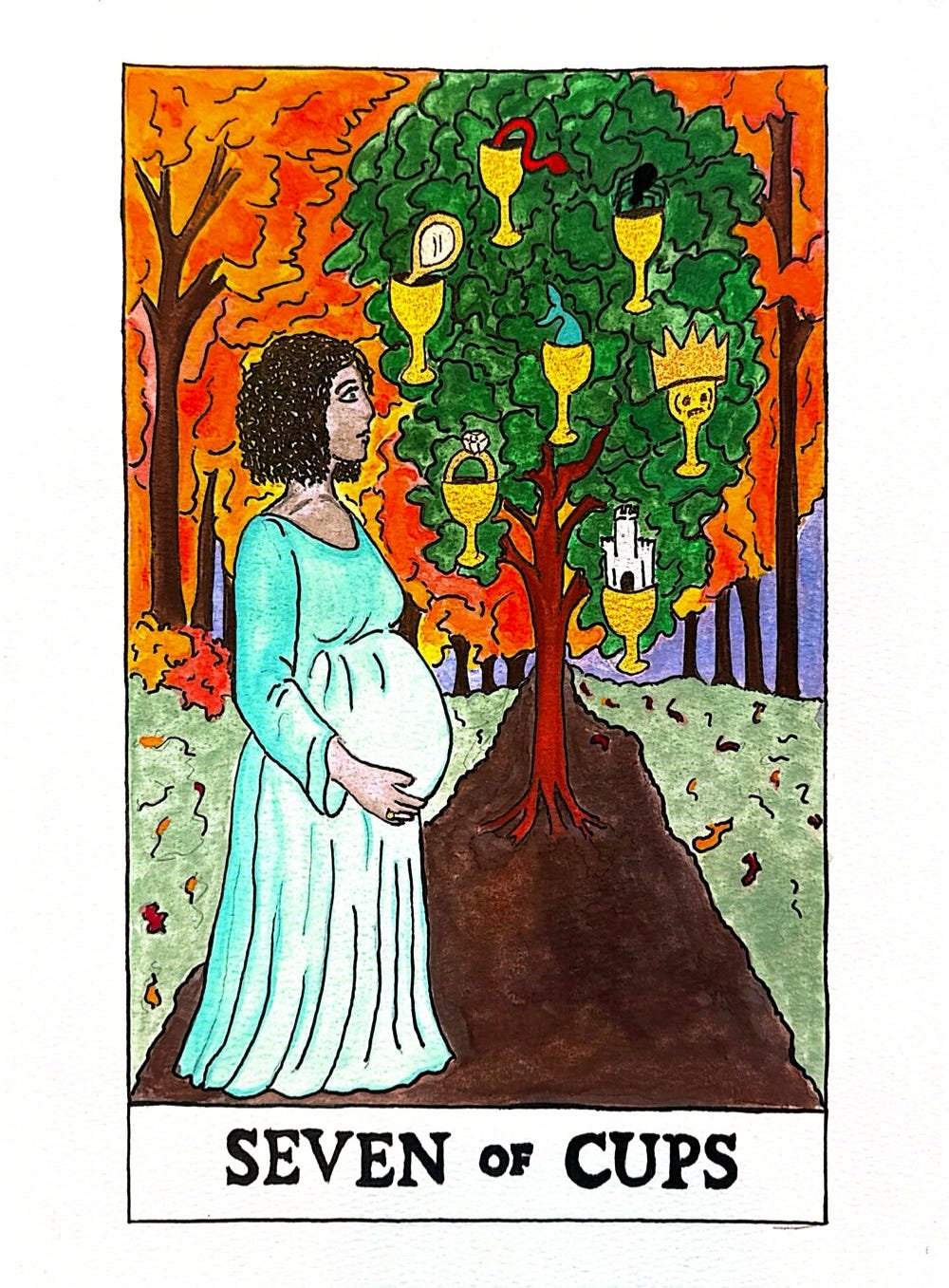
It was this imagery of the fig tree and the overwhelming paralysis that Esther feels upon looking at it that directly inspired the construction of my Seven of Cups card for my Yonic Tarot deck.
© M. Robichaux, 2026, Authentic Living, LLC
To support the creation of my deck and its future publication, please consider making a donation through my ko-fi account here:
In the card’s image, we can see that the leaves of the trees in the background of the forest, which our heroine walks in, are all beginning to change. Thus, their brilliant autumnal hues reflect the changing of these seasons and the turning of the tides, as the heroine herself is in a visible state of transition, as she is quite pregnant and therefore entering the mother phase of her life.
In the story arc of this particular suit for my deck, I imagined this woman walking along the forest, reflecting on her early life experiences, only to be stopped by an evergreen fig tree in her path. Which, in some ways, might reflect the very same tree often referenced in the story of the Garden of Eden in the Christian myth of Adam and Eve, as they both represent the importance of choice.
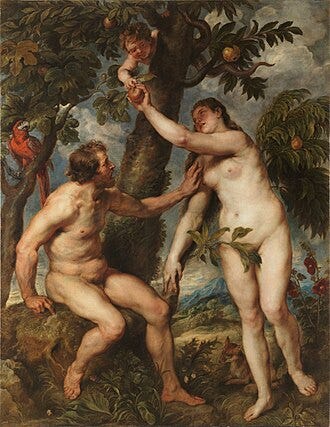
Painting by Peter Paul Rubens
It is here that the heroine, much like all of us, must confront her choices in life and which metaphorical “cup” she will choose next.
Will she choose a more traditional path, such as the cup with the diamond ring, which perhaps symbolizes marriage and commitment, or the one with the castle, which for her may represent the solid structure of home, career, or perhaps a foundation she wants to build in herself?
Or will she choose to focus instead on her beauty and maintaining her youth, as reflected in the cup holding a mirror? As women are frequently pressured at younger and younger ages to get Botox, injections, and alter their bodies in an attempt to delay the transition into the autumn of their lives. Yet, it is important to note that this tool of vanity can conversely be used for self-reflection if wielded correctly.
Or does she choose a more creative or spiritual path? As reflective of the cup with the mermaid’s tail, which perhaps is reflective of some creative endeavor she wishes to pursue or a forgotten aspect of herself from her youth she has yet to reclaim?
Along a similar vein, the heroine might also choose the cup with the snake, which could lead to the shedding of her old self through the process of Kundalini Awakening? A process which some scholars argue might mimic Adam and Eve’s decision to eat the forbidden fruit, resulting in a newfound sense of enlightenment and self-awareness.
And therefore, if she is surrendering to the unknown, should she just choose the cup with the spider, and accept her fate that she is just one string connected to a much larger web of life far beyond her understanding?
Or finally, does she choose the path expected of her? The cup with the gold crown, which will guarantee her the most recognition and achievement in the external realm of the conscious? And therefore is often the hardest path to resist, as it is so often positively rewarded and is easy to maintain as the “status quo.”
Regardless of the path she chooses, just like Plath’s character Esther in The Bell Jar, there is a sense of knowing within her that by choosing one path, she is inherently saying “no” to another.
Because by choosing to focus on one or perhaps, if she is lucky, two of the cups on her metaphorical fig tree, she must be willing to let some of the cups go.
But before she can accept her choice, she must grieve the potential of these possibilities and versions of herself she will never get to know in this lifetime.
Choices, Divination and Grief
As I’ve been creating my tarot deck, a thought I’ve been sitting with over the last couple of weeks is that tarot, or really any form of divination, is inherently about choices.
The “future” we ask a reader to predict for us when they throw cards is less about this process being set in stone, and more about our own internal process of coming to a decision we know we must make.
Should I go back to school or not?
Should I change my career path or not?
Should I have a baby or not?
Should I marry my partner/girlfriend/boyfriend or not?
Should I end my marriage/relationship/situationship or not?
These questions are often less about following the “right” path and more often reveal something deeper about ourselves.
They reveal who we are, what we value, and the parts that demand to be integrated within us.
For example, by leaving a difficult marriage or career path, one might have to accept that they no longer have anything to distract or prevent them from doing the thing they’ve always dreamed about, yet often fear the most.
Or perhaps, by having a child, we have to face our fears of getting older, becoming a parent, and working through our own complex relationships with our external parental figures and how they have shaped us internally.
In other words, these questions are rarely about the surface-level choice, since often I find that most individuals have an inner telos or “call” to what they authentically need to pursue, if only they are able to embrace the autumn of their lives and turn inwards to listen.
Instead, what occurs in these readings is working through the grief of having to make a choice. Of accepting that the mythical fig tree with all the cups spread out in front of us is just that – a myth.
As I said in my last post on the Two of Pentacles referenced above, the myth of “having it all” isn’t possible, and inevitably one of the cups we attempt to chase will come at a cost. Thus, there will be times when one has to adjust expectations or make sacrifices, because life requires all of us, men and women alike, to make trade-offs. One is not meant to do it all and do it all perfectly, because if that were the case, there would never be a need to make a choice and the fig tree would remain filled with metaphorical figs and cups to keep us satisfied forever.
But we do not live forever, and so we can not remain tied to the evergreen summer of our lives.
Thus, it is our choices that force us to decide who we are and what is important to us.
They serve as a reminder that we can not “have our cake and eat it too” and that the more we try to keep our cups/options open, the more we will miss out on actually living our lives because it takes great effort to try to maintain all the cups on the metaphorical fig tree of life.
Eventually, we must choose a cup, or life will choose for us.
And the more we resist feeling the grief and potential regret that comes with making a choice, the more likely it is that we will end up with a choice which does not satisfy us. That leaves us hungry and wishing we had done more or had picked a different path for ourselves.
Thus, for individuals, and especially women becoming aware of their transition from the maiden to mother/mother to crone phase, the trick is not to avoid the Seven of Cups, but instead to sit with it and to grieve the inevitability of facing the autumn and eventual winter of one’s life. Just as Plath and her character Esther had to do as well.
Thus, to truly process and move through the Seven of Cups, one must be willing to sit with each of the metaphorical cups of their lives and ask themselves, “Can I live without this and still be true to myself?
Overcoming the Fear of Regret
Often when conducting readings for others, or providing intuitive guidance, I will have my clients ask me about ways to avoid feeling regret.
Should I save my eggs now, just in case I want a child later?
What if I get married and I end up missing out on someone better?
What if I leave my career and I end up hating it?
It’s often the game of “what ifs” that keep us trapped, unable to move forward.
Yet, here is the truth: You are going to inevitably experience regret at some point in your life. Even if your choice was the “right” one.
Regret isn’t what we should fear; it’s simply an emotion to let us know what is important to us. Instead, what we should fear is betrayal of ourselves.
In fact, regret can be our biggest teacher in many ways, because it is often when we are finally able to hold space and process our feelings of regret for our past choices that we can move through it and start to clarify what is truly important to us.
It is very common for women who choose to remain childless to have small moments of regret when surrounded by their friends and family members who choose to have children. And yet, these women can still be happy with their choice.
Conversely, but often less discussed, but still equally important, there are women who make wonderful mothers and are delighted by their children, who may experience occasional feelings of regret for not being able to enjoy more of their singlehood or spend more time in their careers.
Plenty of married individuals and couples I’ve worked with discussed their “fear of missing out” or the occasional moments of regret they experience with regard to being unable to casually date or pursue a meaningless fling. Yet, despite this awareness, they still choose to remain faithful to their partners because they believe that the alternative would not be as satisfying long-term, or the connection they have built with their partner feels too valuable to risk.
And the same is true for individuals who choose to remain “open” in their relationships or single.
As all of these options have their pros and cons, which we must individually sort through.
This is why we must grieve the choices we make and take the time to honor the potential they hold.
For choosing to truly live one’s life with conviction requires that an individual make an active choice, which is what Plath’s Fig Tree reminds us of.
In fact, as her analogy reminds us, the biggest regret one can make is not making the “wrong” choice, but rather not making a choice at all and thus being at the mercy of whatever fate has left for them.
This is because in choosing to follow the path of least resistance, or what appears “easiest,” or sometimes most “socially acceptable,” we inevitably miss out on knowing parts of ourselves.
Which is ultimately the greatest gift we can give ourselves.
Thus, the Seven of Cups and Plath’s Fig Tree analogy remind us that choice is inevitable in life and the more we embrace it, the more we can prepare for the eventual autumn of our lives with pride and conviction of who we are and the paths we took along the way to get there.
OX
Your Dark Fairy Godmother
If you would like to learn more about Dr. Roby’s courses on her Yonic Theory approach, check out the resources below:
If you would like to donate to her Yonic Tarot deck creation fund, please do so through her ko-fi account: