
Dear Counselor: Maybe you’re not Burnt Out. Maybe you just Outgrew the Role of the “Wounded Healer”
Lessons from Chiron

I’m not sure who might need to read this blog post, or perhaps, maybe this post is purely self-indulgent on my part as I am navigating my decision to take an extended sabbatical from providing direct one-on-one psychotherapy. Nevertheless, if I have learned anything from being in a healing profession for the last 10+ years, we heal ourselves through sharing our stories. That storytelling is, at its core, therapeutic, regardless of whether that fits Western therapy’s definition of “healing” because stories require us to do two things: 1. To own our vulnerability, our strengths, our weaknesses, and to bear our souls to others; and 2. Communication. For a story to be told, one must either speak it, write it, draw it, paint it, dance it, or communicate it in some way that allows others to witness it. It's in the witnessing that we actually heal.
The experience of feeling witnessed allows us to decide whether to stay in our story or create a new one. Often, in my work as a psychotherapist or even giving a tarot reading or Reiki session, it always amazes me that clients will intuitively know the outcome of their story even before we have begun the healing process. I often refer to this as “intuition” in session or Carl Jung’s concept of Telos. Telos is a Greek word which means "end," "purpose," or "goal." Thus, Jung, being a lover of philosophy and the humanities, was inspired by Aristotle’s writings on this concept and how he posited that within all organic matter, there is a natural drive toward our highest evolution.
For example, the acorn knows its ultimate purpose is to become an oak tree.

Tree of Life, Charleston, SC
It knows that even though it seems like such an impossible feat for a tiny object like the acorn to complete, it must strive towards its highest good. Even if that means it must root itself in harsh rocky soil that perhaps has been malnourished by the earth or destroyed by concrete sidewalks and cityscapes. No matter its environment, the acorn still has to try. It has to have faith that it will root, blossom, grow, and become beautiful, complete, and whole. The same is true for us as humans.
As a Reiki Master, one of the first things you learn during Reiki Attunement is that the word Reiki actually holds the key to this practice. Reiki is a combination of two Japanese words, Rei = meaning “one’s highest self or soul” and Ki = meaning “vital energy or ‘life force,” i.e., the non-visible life-force energy that flows through all of us. In other words, Reiki works because the practitioner uses their ki (life force energy) to stimulate their client’s ki, allowing their own subconscious, intuitive wisdom to arise within their body through the seven chakras to bring enlightenment. Or said another way, this movement of ki and unblocking of the chakra system allows an individual to connect to their Rei or soul essence.
That soul essence is where we find our Telos.
Finding my Telos
Growing up, I was always drawn to the spiritual, mystical, philosophical, and “taboo” topics in life. Since my grandmother first introduced me to astrology as a young child, I have read everything about it and become obsessed with it ever since. Not much of a fan of fiction (which I still tend to shy away from), I poured myself into history books and philosophical texts. When I did read fiction, it was usually in the form of myths or books like “Jacob’s Room” by Virginia Woolf, which had a clear feminist or political undertone to them. Thus, they were designed to make the reader think and question the societal conventions at the time of their publication. In other words, I was drawn to questioning the system. A trait that often got me into trouble throughout my youth.
Society as a whole tends not to like individuals who question the system. They feel like rouge agents, hell-bent on destroying everything that feels familiar to us. We fear the chaos that would come from the collapse of the structures our forefathers and foremothers built for us. Those ivory towers, family legacies, and government systems that tell us who we should be, how we should behave, and most importantly, what we should want out of life.
And yet, our Telos shows us that, eventually, we must tear down those systems, rules, and structures to find who we truly are. Our Telos is here to remind us that there is no way to avoid getting to know ourselves.
Want to keep reading? Please consider using the link below to pledge your support to my Substack.
The Wounded Healer
Being a lover of both astrology and Greek mythology and how these two systems will often overlap with one another, it should come as no surprise that I deeply resonate with the story of Chiron. In the myth, Chiron is a centaur, but unlike his wild brethren, he is kind, wise, and skilled at healing and medicine. In other words, he is a natural healer. This makes him different from the other centaurs, an outsider. Just many “natural healers” might feel different from their family members or peers growing up. They may see the world differently and be drawn to philosophy, art, healing practices, or spirituality because they see the world differently, and they are supposed to.
To be fair, Chiron is different than his peers. He is the son of Cronus (A Titan and the father of Zeus) and Philyra (a sea nymph). Thus, he is quite literally a bridge between the heavens (or what we might call the world of the Gods/conscious wisdom) and the world of the sea (the world of the unconscious, the feminine wisdom he acquired through his mother). Thus, he is caught in between.

As the story evolves, one day, the hero, Hercules, visits Chiron and accidentally shoots him with a poisoned arrow dipped in the venom of the Hydra. This reference to a Hydra, a snake-like creature, is interesting from an archaeological perspective, given that during this time (pre-Hellenistic), in other parts of the world, snakes were often associated with Goddess worshipping practices and transformation. Moreover, we can see the influence of the snake archetype in the practice of Kundalini, where the Snake Goddess in the form of the Hindu goddess Shakti awakens one’s unconscious wisdom at the base of their spine and rises through the seven chakras. Thus, perhaps, the Snake is a metaphor for the feminine wisdom of Telos. The unconscious, intuitive part of us, which, after being stimulated, pushes towards our highest good. Just like in the practice of Reiki and just like Chiron needed for him to evolve.
To further connect the concept of Telos to Reiki, the story of Chiron, and the practice of Kundalini, After Chiron is struck with Hercules’ arrow, he does not die from his wound because he is a half-God and, therefore, immortal. However, his immortal abilities keep him trapped in agonizing pain since he cannot die, yet he does not possess the full god-like qualities to heal himself. Thus, he becomes the “wounded healer,” forever trapped to help others on their journeys of healing yet never being able to free himself from his own pain and torture.
This is the trap that natural healers will often fall into. They receive immortal-like recognition for their healing abilities. Their natural empathy, compassion, and “healing auras”, only to become fused with that role. Therefore, being a healer not only becomes their “ego” or self-concept, but it also becomes their cage.
Thus, as they heal others, they begin to become aware of their own wounding. The places where they were neglected, overlooked, and abandoned. The relationships or dynamics where their needs weren’t met or how they willingly took on others' pain, because of the role they were placed in.
Often, it is hard to leave this role because the healer may live the “immortality” it gives them. It might make them feel seen when perhaps that was something missing in their childhood experiences. It may feel validating to know that one’s gifts did have value, even if others did not see them. They might not want to lose the feeling of “being needed” because it is a way for them to live on forever, just like Chiron.
“Being needed” is often a way to avoid our own mortality. If we believe that all our ego needs is to take care of others, well then we never have to think about our own needs. We never have to confront the truth that we will eventually die, just like everyone else. That we are not actually mighty immortal centers like Chiron elevated to a “God-like” status. We have to accept our own humanness, our own selfishness, our own wounds, which shows us the places we need to heal and the parts of us we lost along the way.
Giving up Immortality (Death of the Ego)
In astrology, it is said that your Chiron placement holds the key to your freedom, and yet it is also your deepest wound. My Chiron happens to be in my 2nd house in Leo, and while I am sure everyone’s Chiron placement is particularly painful for them and their own personal story of healing, I can attest that my wound has been personally quite painful. As a Pisces sun, who has her Libra moon in the 5th house (the house of Leo), having a wound in such a creative and self-expressive sign as Leo has always been challenging for me.
I mentioned my love of spirituality, philosophy, and storytelling as a child, and while yes, all of those things continue to interest me even to this day, what I love more than anything is being creative. I love dancing, I love drawing, painting, and writing, and I have always thought I was horrible at all of those things. (Ok perhaps not horrible, but not quite talented.) Most of all, what I love is sharing my nerdy interests with others. Storytelling, writing blog posts, discussing depth psychology and the healing practices of the feminine.
And yet, those practices, which are objectively more spiritual than many current Western forms of psychotherapy, are often dismissed, repressed, ignored, or quite literally belittled.
So, for an individual with this wound around creativity in her 2nd house (connected to finances, resources, stability, and safety (i.e. the house of Taurus). It is harrowing because while my soul says “create,” my mind tells me, “that is not stable.” Which for a person who has so many creative zodiacal aspects in her chart (Moon in Libra in the 5th house, Sun in Pisces, and Venus, Mars, and Saturn in the 8th house), telling myself not to be creative because it isn’t “practical” is like telling a fish not to drink water.
I live and breathe creativity. Not because I want to, but because I have to. I don’t know how to be any other way, and yet my Chiron wound in the past has prevented me from exploring this option because “what if I am not successful?” “What if it doesn’t work out?” This, coupled with my own wounding in childhood, where my creative interests were belittled, paired with generational trauma I inherited around needing to be able to be “self-sufficient,” made it hard for me to feel like I could let my creativity flourish. So instead, I found a career path that felt safe. That felt comfortable. That would allow me to stay in my comfort zone and live in my immortal ego. I became a counselor and a wounded healer.
And I loved this role for a very long time. Always the healer and the “good listener” in my family, I was excellent at this role, not in a vain way, but as a natural capability. As a cancer rising, I intuitively have a way of picking up on the undercurrents of others. I am caring and compassionate, and emotional intelligence and psychology come naturally to me. Moreover, I enjoy and want to make others feel at ease and heard because I know exactly what it is like to not feel heard, AND there is much more to me than my healer identity. But for a long time, my ego wouldn’t let me see that.
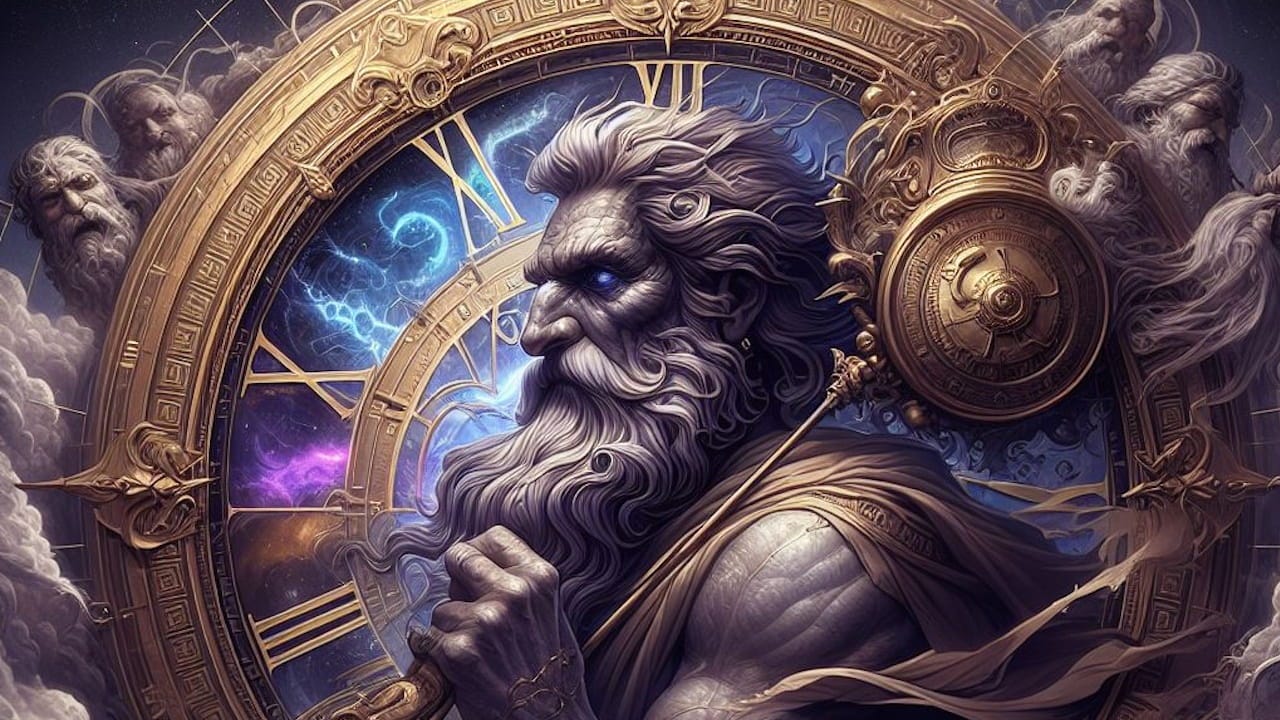
Image of Cronus artist unknown.
In Defense of the Ego
I’m currently writing a book on a model of women’s psycho-spiritual self-actualization process (or individuation) from a feminist-depth psychotherapy perspective. In it, one of the concepts I discuss is the concept of Cronus (father of Chiron), who I view as an embodiment of the masculine principle. Thus, he emphasizes time, structure, and stability. Now, I recognize I am not the only scholar to think of Cronus this way, and many other writers and theorists have also linked Cronus to time (for example, Jung), but I bring him up because I believe that it is through Cronus that we develop our egos. In other words, because you and I exist here, right now, at this moment in time, in this generation, in this socio-political landscape, we have to develop a solid structure for us to navigate the system we have been placed in. That structure is the ego because we live in a patriarchal or masculine world, so therefore, the ego typically reflects the values of Cronus or the masculine.
And we do need this ego. Without it, we would not be able to survive into our early adulthood before our Saturn returns take place, which is when we begin to question the system our brains (psyche) have created for us. For some of us, this might happen sooner, particularly if we have experienced trauma or hardship, and yet for others, due to pressure to comply with the systems in place or having a lack of resources, we might not have this awakening until later. For others, they may never be able to let their egos go in this lifetime or be too afraid to do so. Yet the ego is what tries to make us immortal because it reflects the archetype of Cronus, the God who tried to outrun death himself by eating his children. Thus, our egos try to do the same – they try to protect us from the dark, the feminine, the snake coming up from the ocean or underground, which reminds us that we will die and we have to make our peace with that.
And when that happens, we shift into what Jung called the shadow. We shift to having to look at our wounds, the unconscious parts of us that we abandoned. The feminine parts we cut off in favor of the masculine. The rejection of our creative complicities, our emotions, our feelings, our sexuality, and self-expression. The parts of us that never felt ok to love fully, and where our Telos is.
We house our Telos in the feminine, subconscious parts of ourselves. Not in the masculine egos we create like so many of us trick ourselves into believing. This is why when you shuffle a deck of tarot cards, your question, while the language might be important to you, doesn’t really matter from an objective perspective. Because inherently, a part of you subconsciously and intuitively already knows your destiny. The cards just give you a pictorial representation of what you already know.
It is destiny that is driving you forward. The part of you that knows you will die and the only true way to have meaning on this earth is surrendering to your Telos. To surrender to your fate, to the feminine wisdom inside of you, and integrating it to become whole.
Surrender
While Chiron was able to help many individuals through his pain, he eventually grew tired of carrying the burden of others wounding while masking his own. In the myth, he travels around helping others, trying to seek healing for himself until he eventually meets Prometheus, who was chained up and tortured by Zeus for having given fire (enlightenment) to humanity. Realizing that the only way he can help Prometheus is to exchange himself in his place, Chiron trades his immortality for Prometheus’ release. The ultimate self-sacrifice of his ego. He gives up the “wounded healer” role, which kept him immortal, but in pain. Thus through embracing his own humanity (death), he is finally free of his role.
As he does this, Zeus takes pity on him. Finally, ending his suffering, allowing him to die physically. Yet upon his death, Zeus decides to transform Chiron into a constellation in the sky so that others can admire his wisdom and compassion and learn from his story. Thus, in an odd way, Chiron does become immortal, but not through healing, but through owning his story. A core essence remains even after his ego has passed. Thus, through the release of his ego, he is able to find peace.
Ok Lovely Story…but How Does this Relate to Counseling?
What Chiron represents in our zodiac charts are the places in our psyche where we have to lean into our pain in order to heal. It also represents where we must metaphorically “die” to release ourselves. Where we have to look death in the face and meet our shadow, the feminine snake within. Once we confront her, we have to say, “I don’t know what will be on the other side of this, and yet, I have to do it anyway.” It’s about releasing the control and restriction of Cronus and embracing a more feminine way of being with yourself.
Surrendering to the pain and instead of trying to fight it, fix it, judge it, or change it, allowing it to change you and make you more human, instead of choosing to remain “God-like” out of self-protection. And in an odd way, that’s the paradox. By embracing it, and honoring the wound, you stop letting yourself believe that you need to be “better” or “fully healed” before you can live. Which actually frees you to live more fully.
In other words, this doesn’t mean that you will be perfect or “pain-free” it means that you will be able to tolerate and fight through the pain. That you will find meaning, and by owning the wound, and in an odd way, you will actually be able to help others.
By facing your Chiron wound, you stop abandoning yourself. You are no longer running from the thing that wounded you. You walk with it, and the wound then becomes your greatest gift. It becomes your wisdom.
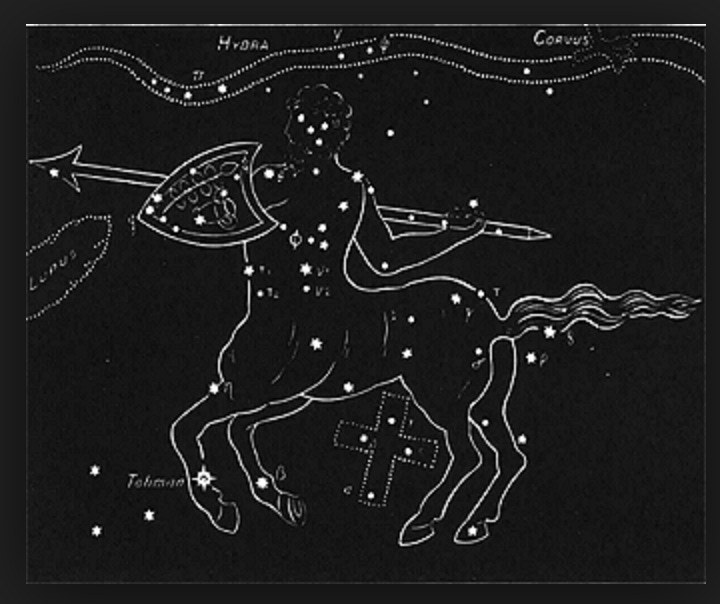
Chiron Constellation
It becomes the thing you leave behind. The constellation in the sky. The guide or story for others to follow. The legacy of healing that outlives you and inspires others, not through self-sacrifice, but through owning your journey.
Leaving the Role of the Wounded Healer Behind
The title of this post labeled “Dear Counselor: Maybe you’re not Burnt Out. Maybe you just Outgrew the Role of the “Wounded Healer,” is truly a love letter to myself and permission for me to step out of the “wounded healer” role.
I’ve gone back and forth over the past two years since starting my dissertation process in Spring 2023 about whether or not I really wanted to leave the counseling profession or if I am just “burnt out”. Which is ironic, given that my initial research topic in counseling was burnout. (Wounded healer strikes again.) Yet, if I am being honest with myself, I knew there were signs that I didn’t want to stay in this field long before then.
Let me be clear about something here. Just because I don’t personally find fulfillment in Western therapy does not mean it is inherently bad. There are still wonderful, amazing clinicians who do find this work and this approach to be fulfilling. I love that they derive so much meaning from their work with clients, and I used to feel that same level of fulfillment…and yet, there was always a part of me that wanted more…
A part of me that wanted to write. A part of me that wanted to teach or to make a podcast. A part of me wanted to create art and my own tarot deck. A part of me that didn’t just want to do individual work but wanted to help women on a collective level through courses, lectures, or through being in a leadership position.
Yet I was afraid. I was afraid of being seen, of expressing my creativity, and of taking up space.
So, for me, this means not hiding myself anymore and not pouring into things that take my focus away from these creative endeavors. But it was a FIGHT. A full-blown battle with myself, which I fought long and hard. Going back and forth on if I could do both. Be in a traditional counselor role and have time to pursue my creative projects. And I did attempt to balance both for a long time, but I couldn’t ignore the ache in my heart any longer. Like Chiron, I needed to sacrifice my ego, my “counselor identity,” to be able to heal myself. I had to be willing to face a metaphorical death.
Again, I want to stress that this is MY experience of counseling. It’s my story of how I am making peace with taking an indefinite sabbatical from seeing individual clients, which I have started notifying my current clients of. I say “indefinite sabbatical” because I do plan to keep my supervision license as I do enjoy teaching and training new therapists, and I still very much believe in my research on feminine forms of healing. Which I believe can expand the field of psychotherapy that has become too limited from operating in a Western model of healing for too long.
However, while engaging in direct client care was a core part of my journey towards becoming who I am today, and I wouldn’t have traded my experience for anything. This role (much like a relationship with an ex-lover), which used to bring me so much joy, has run its course.
I am aware of the toll holding emotional space for others has taken out of me and how sitting in a chair 10 + hours a day contributes greatly to my lower back pain. How the stress of this job and the emotional labor it requires can often lead to chronic health conditions, which I, and too many counselors I personally know, have been diagnosed with. How this job can be so stressful for mothers when they choose to have children, because there is no safety net for a lot of therapists. There are no group healthcare options available to counselors in private practice and no tax breaks for being in a helping profession. No baseline salary to cover basic necessities, like licensure fees and malpractice insurance. No affordable childcare options. No dental. No sick leave. And if someone does work at a clinic where benefits are available, then they usually have demanding caseloads and are grossly overpaid.
And what we know is that individuals who can’t afford healthcare and/or childcare or their basic needs are more likely to experience chronic health conditions. This is also especially true for women and Black and Brown individuals, who are already in marginalized positions in society. This means the more fiscal barriers they experience, the more likely their health is going to get worse, which will also cost them more money. In other words, counselors and therapists who don’t make enough money to cover their most basic human needs are at increased risk of developing chronic health conditions that they cannot afford, thus going further into debt.
If that statement sounds harsh, it is because it is. Let me not sugarcoat it for you.
I am deciding to transition out of individual counseling, not because I am burned out or because I didn’t enjoy my clients. I loved working with them. I simply refuse to put my health and happiness at risk anymore for a system that no longer works for me. Which is not me saying that the system can’t work for some individuals, but I am saying that perhaps it wouldn’t hurt to take a helpful critique of it for the majority of helping professionals.
Now, I’m sure a counselor reading this in a privileged position (perhaps even one of my old professors) might be quick to blame me. Saying that I could have charged more for my sessions, or seen more clients, or I could find a way to focus on my creative pursuits while also maintaining my caseload. All that might be true; however, I would also ask that person to consider their support system and what resources they have that allow them to continue to work in the field. Do they have a supportive partner who makes more money than they do so that they can reduce their client caseload and have time to write? Did their parents pay for their schooling, or do they have additional student loan debt they need to pay off? Did they encounter microaggressions throughout their training experiences around their gender expression, sexuality, cultural background, physical body size, and/or the color of their skin? Were they already in the role of the “wounded healer” long before they entered the profession, or have they never experienced trauma? How has their childhood wounding shaped their belief system, and are they still hanging onto the belief that maybe they can outrun their own fear of death by always being in the healer position?
Thus, I wonder if we got it all wrong in the counseling and subsequent mental health professions… We always tell our clients that we are supposed to “work ourselves out of a job,” but what if that saying goes both ways?
Maybe the truth is that we are not only supposed to help our clients learn the tools they need to have greater autonomy in their own lives, so they don’t need us…Perhaps we, as healers, are also supposed to grow from our work and eventually transition out of this role at some point. Maybe, just like Chiron, we have to be willing to let go of our “helper” egos and become a new version of ourselves.
Reframing Leaving
About a month ago, I was finishing up a massage and Reiki session with my own massage therapist/reiki healer, when she disclosed to me that she would be closing her practice in August. We chatted briefly about her transition, what she had planned next, and about our joint struggles as business owners. I then congratulated her on this transition, and we parted ways. Yet, I couldn’t stop thinking about something she said on my drive home.
She told me that most massage therapists only have a “shelf-life” of 5 to 10 years, and that she had been practicing for roughly 15. From her perspective, she had a “good run,” and there was a sense of gratitude in her voice. Sure, she was acknowledging the hardship of running her practice, the toll that being a healer had taken on her joints and body, but there was also a sense of completion. Her journey of being a healer was coming to a close, and she could look back with a sense of pride and accomplishment on everything she achieved during that time.
It was a beautiful sentiment, one that I rarely hear in the counseling world. Which got me wondering why is it that we don’t approach counseling the same way?
If we think of healing as a relationship, which we are told to do through our graduate training programs, then it would be reasonable to believe that not only would the client change as a result of their work with a therapist, but that therapist would innately experience some change or self-reflection as well. I want to be clear that I am not discussing countertransference here or crossing ethical boundaries such as having an intimate relationship with a client. What I’m describing is the natural process of watching someone you’ve built a relationship with grow and become a more evolved and embodied version of themselves, which will naturally inspire us to do the same.
As healers and therapists, we watch this evolution time and time again. We hold the sacred space and give parts of ourselves to our clients so that they can become fully actualized. We accept all their light and dark parts, their egos, their shadows, and hold space for their unconscious wisdom to arise so that they can move toward their Telos or Rei. We are Chiron, using our own pain to hold space and help them heal, and yet we never allow ourselves to go after what it is that we want.
It's only human to see someone you’ve put so much time, dedication, and energy into helping heal, fully step into their power, and want that same feeling for yourself. That isn’t you being selfish; that is you letting go of your ego, your idea of yourself as the “wounded healer,” and being able to move on. It’s releasing your ties to your own immortality, the part of you that says, “I need to be the healer forever.” “What will my clients do without me?” “Who will I be if I am not the ‘the helper.” Or the internal narrative that tells you that your needs aren’t as important as your clients.
It's allowing you to realize that you are, in fact, human, and perhaps you, just like your client, don’t always have to be healing. That you can accept yourself as you are, all the light and dark parts of you.
Thus, I argue that maybe the truth about burnout for therapists and healers is that we aren’t meant to do this work forever, and that is ok. It's not a moral failing of our character, and it doesn’t have to be a source of shame. It can just be a natural.
Like the acorn becoming the oak tree. Chiron moving from the “wounded healer” to the constellation. It’s just a natural evolution. A cycle that, like all things in life, must come to completion.
Perhaps if we saw it that way, we could better prepare healers/counselors too. Instead of shaming them and scaring them about the dangers of burnout, perhaps we could just see it as an indicator that perhaps someone is beginning to transition out of their “healer phase.” Perhaps the “shelf-life” of the therapist is much shorter than we initially thought, and it isn’t going to follow Western notions of stability. That maybe most counselors will transition out of direct client care around 5 or 10 years, and that is totally ok! Some individuals might transition sooner and some stay in the field as lifelong therapists who never tire of direct work. There is no “right” answer, only what works for you.
Some of those individuals, like me, may choose to stay with one foot in the field, but in a different capacity. As a lecturer, a supervisor, and an educator in order to advocate for incoming therapists and shift the structures of the profession. Yet others may want to do something entirely different, and that is ok, too. Some individuals, may wish to write and create as I have expressed. Others might want to get married or focus on their family. Others might even wish to travel the world and vlog about their experiences as one of my good counselors’ friends decided to do, not so long ago.
My point is, we all have a Telos, healers and clients alike. It isn’t fair that we block our own growth as healers, and I think that the mental health professions have yet to understand this. We need the freedom to be ourselves, just like we give our clients the freedom to be themselves. When we become healers, it forces us to confront our wounds, and we should. We should be able to heal ourselves, and maybe when we finally reach a point of feeling whole and healed through our work with clients, we move on.
And honestly, I think that is rather beautiful. Like Chiron choosing to take Prometheus’ place, perhaps the lesson for the wound healer to learn is that they are ultimately their biggest “client” which they need to heal.

Chiron artist unknown
In closing, similar to what my massage therapists shared with me, I hope that I have been able to express my gratitude and appreciation for my clients and my role as a counselor in this blog. I believe there are many wonderful aspects about being a healer. It is a role that I have taken so much pride and joy in, and I will always cherish my experiences with my clients and carry them with me.
With that being said, the always rebellious part of me still believes we can do a better job supporting counselors as they navigate their careers. As a counselor educator, I argue that we need to advocate for group health insurance through professional organizations and reduce the cost of tuition since many counselors may not make it to the 10-year mark. Thus, it feels disproportionate to be in debt for 20 or 30 years if the average length an individual stays in the profession is less than half of that amount of time. While these may not yet be feasible options, I believe we need to start having a conversation about it within the mental health professions. We need to realize there are things we can do to help ease this process and make the mental health field more supportive for therapists.
Thus, it may be time for old, fixed notions of the “healer” to be replaced with a more human-centered (dare I say “feminine”) model. A model that benefits both the client and the therapist. And much like the snake or the Hydra-dipped arrow, which forced Chiron to confront his own ego, allows for us to evolve so that we can be reborn.
OX
Your Dark Fairy Godmother