

Did We Learn Nothing from Harlow and his Monkeys?
Why Artificial Wombs Are Destined to Fail

This past week, the news broke that a Chinese tech firm is in the lead to create the world’s first “gestation robot”. According to Kaiwa Technology, they have developed a robot with a humanoid design featuring an artificial womb that can carry a fetus through ten months of gestation and deliver a baby.
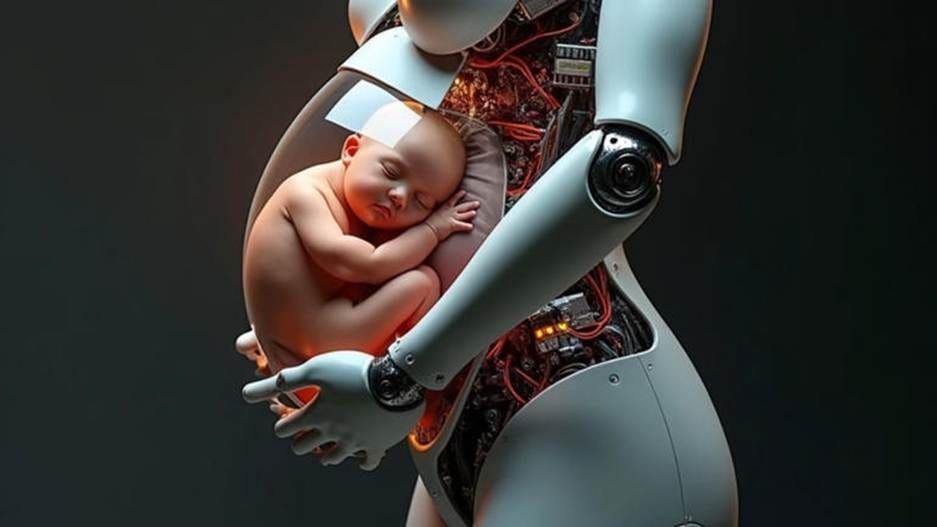
Image from MSN
While this design is no doubt an impressive feat in terms of scientific development, as someone who has taken over 10 courses in developmental psychology and attachment, along with 10+ years of counseling experience, I tell you with 99% certainty that an artificial womb is the stupidest fucking shit male scientists have ever created (and they’ve had a lot of fucking dumb ideas).
Mind you, that 150 years ago, these would have been the male scientists using vibrators to make women cum and calling it “hysteria.”
Clearly, these men know nothing about the feminine experience, or the womb for that matter, so why do they think this is such a good idea?
One word. Misogyny.
The more men can pathologize women’s experience (i.e. hysteria) or turn it into a scientific experiment, the more they can engage in the defense mechanism of intellectualization. This means they can avoid not only the humanity of women, but also their own human aspects in the process. They can trick themselves into believing they have evolved beyond the “wild beast” of our ancestors, but any woman who has ever given birth or witnessed the process of raising a child knows the real truth.
That we have not evolved from our ape ancestors as nearly as much as we have tricked ourselves into believing, and the science of attachment proves this fact time and time again. We require the comfort and warmth of our mothers, the maternal, the feminine, not only to survive, but to thrive.
The Study of Attachment: Harlow and His Monkeys
Harry Harlow was an American psychologist, researcher, and pioneer of attachment theory.
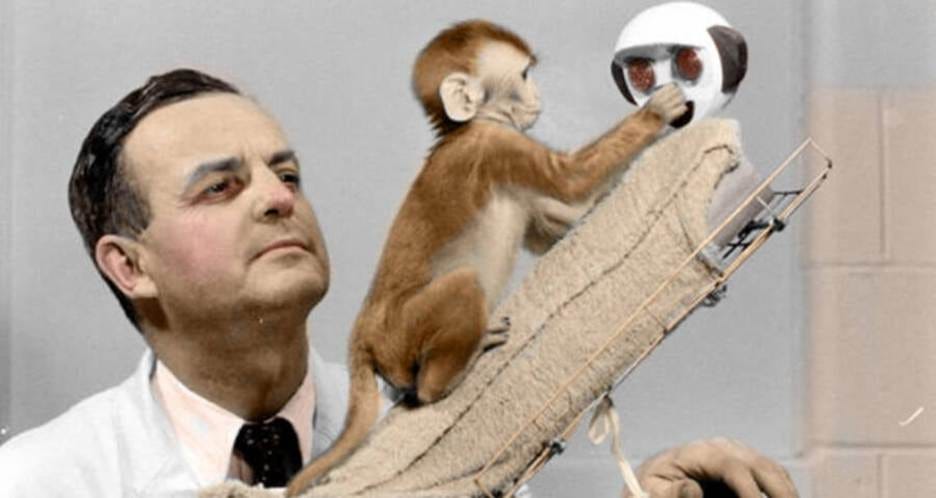
Harlow and his Monkey
At the University of Wisconsin–Madison, Harlow studied the feeding patterns of infant rhesus monkeys who were separated from their biological mothers at birth and subsequently raised with two surrogate "mothers.”
His studies, which are often referred to within the psychological community as "surrogate mother" experiments, were published in his 1958 paper titled The Nature of Love at the American Psychological Association. From his results, he discovered something quite fascinating.
Namely, that the young monkeys would forgo access to food in favor of being with the surrogate mother, who provided them with warmth and nurturance.
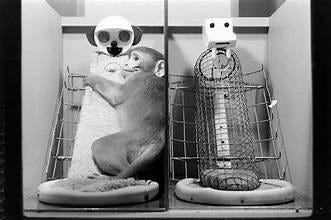
Cloth “mother” pictured left, and the wire “mother” with milk pictured right.
In his studies, conducted during the 1950s and 1960s, he used a wire mesh “mother” that provided only milk/food for the infant monkeys, as compared to a second cloth “mother” that provided warmth and comfort. What he discovered was that while the infant monkey would go to the wire mother to acquire milk as needed, the majority of the time the infant monkey clung to his “cloth” mother for comfort and warmth, indicating that maternal affection and companionship were more important than food for the monkey.
These results challenged the prevailing notion of behaviorists at the time, which was the dominant theory preferred by psychotherapists. Similar to how “evidence-based theories” have become so popular among therapists today in favor of more relational approaches.
Yet what Harlow found was that attachment (i.e. the maternal bond between a mother and child) was not solely based on access to food as many behaviorists believed, but rather the sense of emotional comfort and security (or “contact comfort”) one receives from their primary caregiver.
Moreover, Harlow also noted that the more time the monkeys spend in isolation or away from their mothers, the more they develop severe psychological symptoms—such as rocking back and forth or self-clutching in an attempt to self-soothe. Thus, Harlow posited that early social and maternal interaction between mother and child was crucial for healthy psychological development.
If that was too much scientific gibberish, let me make it plain and simple:
Without having access to the comfort or warmth of their mothers, the monkeys, like human children, showed delayed cognitive and social development as well as severe trauma responses.
Therefore, if we use AI wombs, which would essentially be the wire mother in this scenario….the symptoms and behaviors Harlow witnessed in his rhesus monkeys will most likely be echoed by human children as well….and that should fucking terrify everyone.
An artificial womb might create the right “host” environment, just like Harlow’s wire mesh “mother” provided food for the monkey, but that alone is not enough to sustain a child.
Children need love, they need affection, and they benefit from hearing their mother’s voice in the womb. The psychological benefits of engaging in skin-to-skin contact and hearing the heartbeat of their mother or primary caregiver have been consistently proven in numerous studies. Take that away, and like Harlow’s monkeys, a child will starve emotionally, and emotionally starved children often grow up to be emotionally undeveloped adults.
In a world that is so divided already, one would think that perhaps what we could all benefit from is a little more nurturance in the world. However, that nurturance can only come from another human, because a robot cannot empathize with its child; it cannot artificially create that protective “mama bear” instinct.
It’s a little ironic, but true, that perhaps the thing that can save humanity the most right now is not AI or an artificial womb, but a reclamation of our animal instincts.
No doubt Sigmund Freud is laughing at all of us with a cigar and a hard-on from his grave…
Embracing our Animal Nature
We are often quick to demonize our animal instincts, yet those mammalian qualities are what have sustained our species' life on the planet. Humans are social creatures, just like apes and monkeys, which is why they are often used in attachment studies. Moreover, ape mothers, like human mothers, frequently breastfeed and nurture their young, for many months or years before they leave the nest. This type of attachment is crucial for an individual’s development and understanding of social norms and behaviors.
Being part of a “clan” ensures a greater chance of survival because mothers can rely on other female apes to take care of their young if something were to happen to them, and vice versa. Women in ape societies protect one another, and there is an understanding of the importance of honoring this feminine wisdom.
In our modern society, we do not protect women, and instead of honoring their ability to create life and nurture our future generations, we shame women or treat them like “host bodies,” as Florida House Speaker José Oliva repeatedly referred to women during an interview last week.
If women were truly just “host bodies,” then a robot with an artificial womb would replace us without any problems, but we aren’t host bodies…we aren’t even close.
We are fucking amazing HUMAN BEINGS. Literally goddesses on this earth who also understand the alchemy of embracing our witchy “mama bear” instincts when the need arises. Spend 20 minutes with any new mom, and she is on high alert, constantly scanning the environment for threats to her newborn.
There is a reason the lionesses did most of the hunting as opposed to the male lion. When it comes to nature, the feminine is the clear winner, and human males would benefit from heeding that reminder.
To reduce women down to their wombs, indicates not only stupidity on men’s part, but a lack of respect for nature. Which, as many Eco-feminists have pointed out, is a reflection of misogyny which has fucked up our planet almost to the point of beyond repair.
We don’t respect women, that much has been made clear since the overturn of Roe V. Wade, but we also don’t respect nature. We don’t respect and honor our own animal instincts, which we attempt to deny or suppress through being “good church going Christians” or replacing God with AI.
AI or a male-centered God will never understand the feminine condition, because the feminine condition is where we all come from. We are born with the help of a woman and her magical womb, which is the portal between life and death. Women are often the ones who take care of the sick, the ill, the dying, without them we lose our humanity.
Without women, we will become like Harlow’s monkeys, isolated, scared, and frightened, and personally, that is no society I wish to live in.
OX
Your Dark Fairy Godmother
Interested in learning more about the Goddess-Witch Spectrum? Check out this on-demand course here:
Resources:
Harlow, H. F. (1958). The nature of love. American Psychologist, 13(12), 673–685. https://doi.org/10.1037/h0047884