

Falling from Grace
Blake Lively vs. Justin Baldoni and Why Society Still Hates Women

Unless you lived under a rock in Summer of 2024 it would have been hard to miss the overt smear campaign against the actress Blake Lively during her promotion of the film It Ends With Us. This smear campaign centered on the narrative that Lively and her actor husband, Ryan Reynolds, were essentially trying to undermine the creative leadership of the director and Lively’s lead co-actor, Justin Baldoni, during the movie's filming. Conversely, during this time, Baldoni portrayed himself as trying to remove himself from the narrative, which he did so by focusing on spreading awareness of Domestic Violence or Intimate Partner Violence (IPV), which was the mission of Colleen Hoover’s original book with the same title.
While Baldoni’s effort to refocus the narrative on DV awareness and violence against women would appear to be a noble and chivalrous cause in the eyes of the public, it seems that perhaps his reasoning behind this tactic was not so altruistic.
*Warning: DV and IPV Warning Signs are discussed in this post*
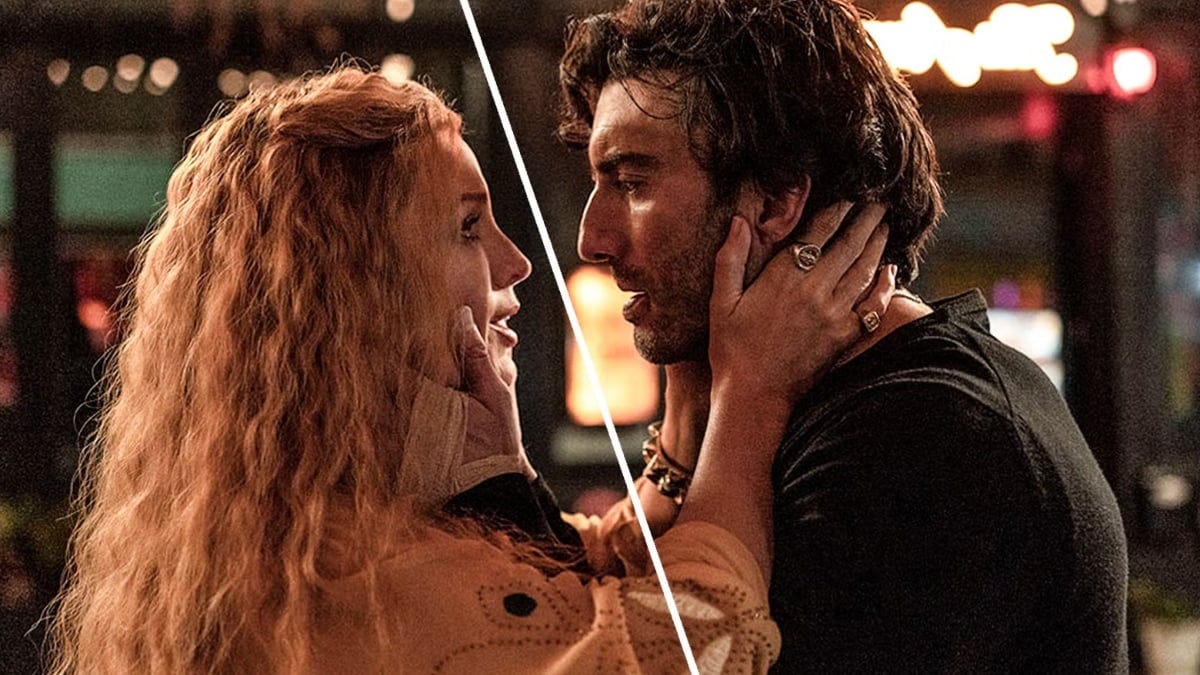
Less than a week ago, it was announced that Lively is suing Baldoni, not only for the sexual harassment she encountered while on set, but she also alleges that he launched a publicity campaign to tarnish her reputation. To briefly gloss over the acquisitions that Lively has made against Baldoni, which you can read here. Lively states that Baldoni made inappropriate comments about her appearance, asked her trainer to help her lose weight, and demanded that she be nude in scenes that did not call for her to be unclothed. Moreover, she describes him as being aggressive during their kissing scene and that he frequently invaded her privacy and personal space while she was in vulnerable positions (such as changing or walking into her trailer unannounced). In addition, on set, Lively states that Baldoni and another man frequently discussed their “porn addiction” and past sexual experiences, therefore while this behavior was perhaps not directly targeted at Lively, it most definitely created a hostile and sexist work environment in a movie that ironically covered a very sensitive topic for women.
Moreover, in addition to this toxic and overt misogynistic work environment, Lively is alleging Baldoni created, she also claims that Baldoni hired Jennifer Abel of PR firm RWA Communications and Melissa Nathan of The Agency Group PR to damage her reputation.
An article by Newsweek, which obtained records of some of the texts between Abel, Nathan, and Baldoni, shows just how damaging and calculated this campaign was.
Many of these texts show that there was a deliberate attempt to not only make Lively look bad in the eyes of the public to discredit her reputation. Many of these texts are particularly Ominous as one from Nathan demonstrates that says "You know we can bury anyone." This is followed by others, which indicate that both Nathan and Abel knew that writing this information down would hurt Baldoni and that they needed to not have a paper trail. But perhaps the most damaging and sad text exchange between these two women who conspired to bring down another woman is this one:
As Quoted directed from Newsweek:
“Nathan tells Abel that social media posts in favor of Baldoni and against Lively are ‘really really ramping up,’ to which Abel replies: ‘It's actually sad because it just shows you have people really want to hate on women."
This last text, in particular, not only gives Lively substantial proof of the smear campaign that was used against her, but it also reveals a much darker truth. We don’t want women to succeed in our society. We might put them on pedestals and love them from afar, but we will instantly and viciously tear them down from that platform if given the opportunity to do so.
Same Shit: Different Day
This is yet another example of the notorious Madonna-Whore complex. We love it when women are “good girls” and are on top, but the second they speak up for themselves or set boundaries we tear them right back down. And no one does this better than an angry man who has been called out for his bad behavior. You see what Baldoni’s behavior shows us (Which no doubt shows his own internalized Madonna-Whore complex given his porn addiction and talk of sexual conquests on set.) is that it is very easy for men to portray themselves as the hero in almost any scenario.
All men need to do to look like the “good guy” is focus attention away from themselves and on a group of individuals or another group of women who seem less fortunate. AKA: The sympathy vote. Men are easily believable in our society, so they don’t have to try very hard to be the good guy. Women, on the other hand, have it much harder. Especially if those women are successful or perhaps are more empowered. It’s easy for us, as a society to think that women who are unprivileged or “fragile” deserve our sympathy. This story is as old as time, men (and society) like women who stay disconnected from their power because they are easier to control. These women are easier to dominate and therefore tend to be more compliant. Women can’t know their worth if they are too busy relying on a man for survival.
In a strange, ironic turn of events (almost comical if you sense of dark humor like me), this is exactly what It End With Us is trying to warn young women about.
In the film, Lively portrays the heroine, Lily Bloom, and Baldoni plays her abusive romantic partner, Ryle Kincaid. The film shows us just how the cycle of DV works through gaslighting, emotional manipulation, physical abuse, SA and other forms of abuse. Yet all of these behaviors center around one ultimate goal, which is to make the survivor or victim feel small in comparison to her partner. It’s about control and domination, not love.
The Duluth Model
As a psychotherapist who has worked with a number of trauma and abuse survivors (and is a survivor herself), I know the Power and Control Wheel like the back of my hand. The Power and Control Wheel was the brainchild of Ellen Pence, a sociologist and activist, which became a cornerstone of the Duluth Model. The Duluth Model (developed by the Domestic Abuse Intervention Project in Duluth, Minnesota) is a framework for understanding and addressing domestic violence that looks not only at the individual warning signs or factors that contribute to DV but also at the broader societal factors/institutions that perpetuate these behaviors as well. Initially, the model focused on heterosexual and cis-gender couples, but this model has since been updated to include LGTQ couples as well. You can access this model and more information about DV through their website.
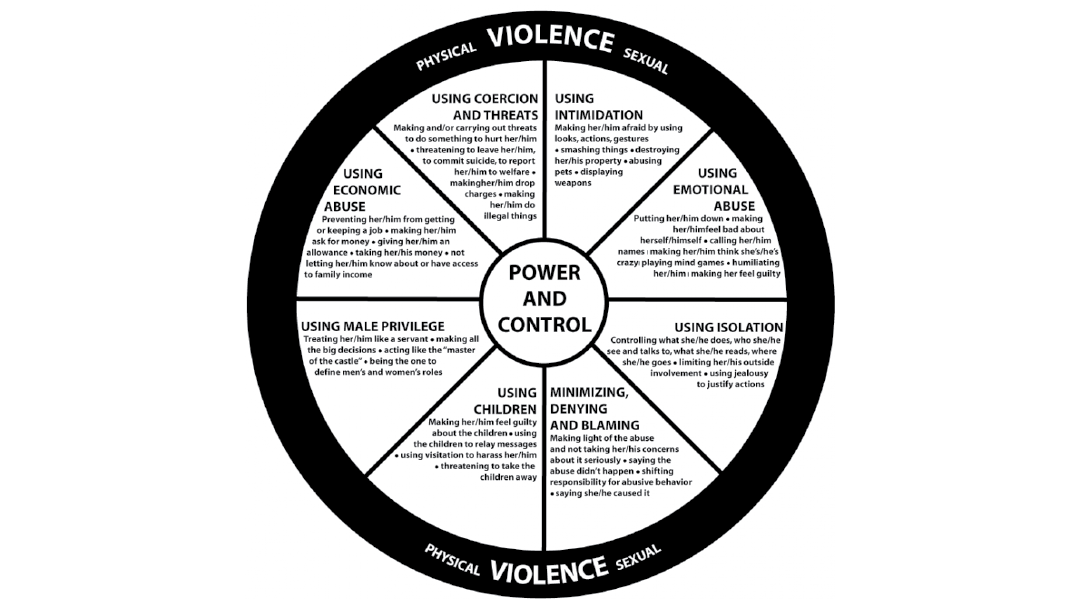
Credit: The Duluth Model
This model, created in the early 1980s, has been widely influential in shaping domestic violence interventions, but its main contribution to the field of counseling and social work is the Power and Control Wheel. This tool indicated 8 behaviors that contribute to the cycle of violence many women experience in abusive relationships, which are:
Using intimidation
Emotional abuse
Isolation
Minimizing, denying, and blaming
Using children (family member, friends, etc.)
Economic abuse (financial abuse)
Coercion and threats
Male privilege (specific to gender-based abuse)
Notice how this list, while used to recognize the signs of DV in women, does not actually include physical or sexual violence. That is because relational abuse is so much more than just physical or sexual abuse, and in fact, those behaviors tend to come at later points in the relationship once a relationship of power and control on behalf of the abuser has been established.
For the sake of brevity, I have decided to keep this blog short, and therefore, I will not be covering all of these factors. (Though let me know in the comments if you would like me too for future posts!) The one I will talk about today is Male Privilege.
Male Privilege
It might seem a bit odd if you are unfamiliar with the cycles of DV for this category to be included, but trust me, this is no mistake, and unfortunately, Baldoni’s behavior shows us not much has changed from the 1980s (or even prior). It is a fact that women are more at risk of experiencing DV than men, not that the opposite hasn't occurred, and in same-sex couples, the rates of DV tend to be higher. However, I would argue that even though rates of DV might be higher in same-sex couples, much of the reason for this can be linked to patriarchy and White Supremacy and how individuals who are oppressed by the dominant social group (I.e. white cis-men men) will oppress others due to their feelings of anger and disempowerment.
That is because, at its core, DV is about something many men within patriarchal societies learn to value as part of their manhood. Power and control. Because patriarchy has a very narrow definition of what “manhood” actually is. Therefore, the behavior Baldoni displayed to Lively and others while filming and after shows his internalized misogyny, which perpetuates the notion that being a “man” is about helping women who are in positions of disempowerment and that if a woman ever gets too high-up or close to being on the same status as a man (i.e. she has self-agency), you must tear her down or use intimidation, coercion, or treats to keep her in-line.
And who better than to do this for you than other women?
Falling from Grace: Women on Women Crime
While I will be the first to admit I did not love the “grab your friends” and “wear your florals” marketing tactic Lively and her co-stars used to market a movie that discussed very serious themes, I do not think there was an intent on her or her marketing teams part for this to be interpreted by the mass public as dismissing the impacts of DV. It was just a poor marketing choice.
Lively made a mistake, as all humans do. Yet that was enough for women to rip her to shreds which Baldoni profited from. Many women online labeled Lively as insensitive and even called her a “mean girl.” Personally, I remember an astrologer on TikTok even using her birth chart to explain her fall from grace as if this could have been predicted or indicated that she truly was mean and callous underneath it all. While I strongly question the ethics of these astrologers who engage in this type of shaming by using an individual’s chart to rationale why they are being mistreated since astrology is meant to help individuals understand and integrate both their light and dark aspects in order to achieve greater self-awareness. I use this example to highlight how easy it was for this individual (also a woman) to find a way to blame Lively for flying too close to the sun.
As women, we learn to be in competition with one another at a very young age. We learn to hate all things feminine because patriarchy teaches us to do so, we learn to value men’s words above our own, and mostly, we learn how to disempower and decenter not only ourselves but other women as well. So, if another woman is in full control of herself, we have to tear her down whenever she does something wrong. Because that is the unsaid “girl code” we all learned so long ago.
“It's actually sad because it just shows you have people really want to hate on women."
I don’t know about you, but when I read those words, a chill ran through my spine because we haven’t evolved. I think it’s time we ask ourselves how is that we are so willing to believe a man over a woman every time? Baldoni, to my knowledge, has not received nearly as much backlash as Lively despite his behavior being objectively worse. And we see this time and time again, Bill Clinton and Monica Lewinsky, Justin Timberlake with Brittney Spears and Janet Jackson, and even with our soon-to-be president. It doesn’t seem like we want to hold men accountable, but women will always be kindling at the stake for the metaphorical fire the patriarchy has built.
The question is are you willing to continue to throw your sisters to the flames only to realize that you might be next?
XO
Your Dark Fairy Godmother
Resources
Newsweek Article - https://www.newsweek.com/blake-lively-lawsuit-justin-baldoni-it-ends-us-film-set-sexual-harassment-2005630
The Duluth Model Website - https://www.theduluthmodel.org/