

From Priestess, to Witch, to Therapist
How the Profession of Psychotherapy was Founded on Stolen Feminine Wisdom

In response to the new “Big Beautiful Bill” ruling, which will classify therapists and healthcare workers as “non-professional” effective July 1st, 2026, I have written an article that outlines how the guise of “professionalism” has always been used to strip women and female healers of roles as leaders and wisdom keepers of the feminine.
As a sneak peek, I’ve included the first few pages of my article for my subscribers to read for free. To purchase the full article or get access to full The Yonic Journal™, click the link below: visit my journal’s website at www.yonictheory.org.
This article would not be possible without the support of my subscribers! Therefore, if you have not already done so, please consider subscribing to my Substack to continue supporting my research and stay up to date on forthcoming articles!
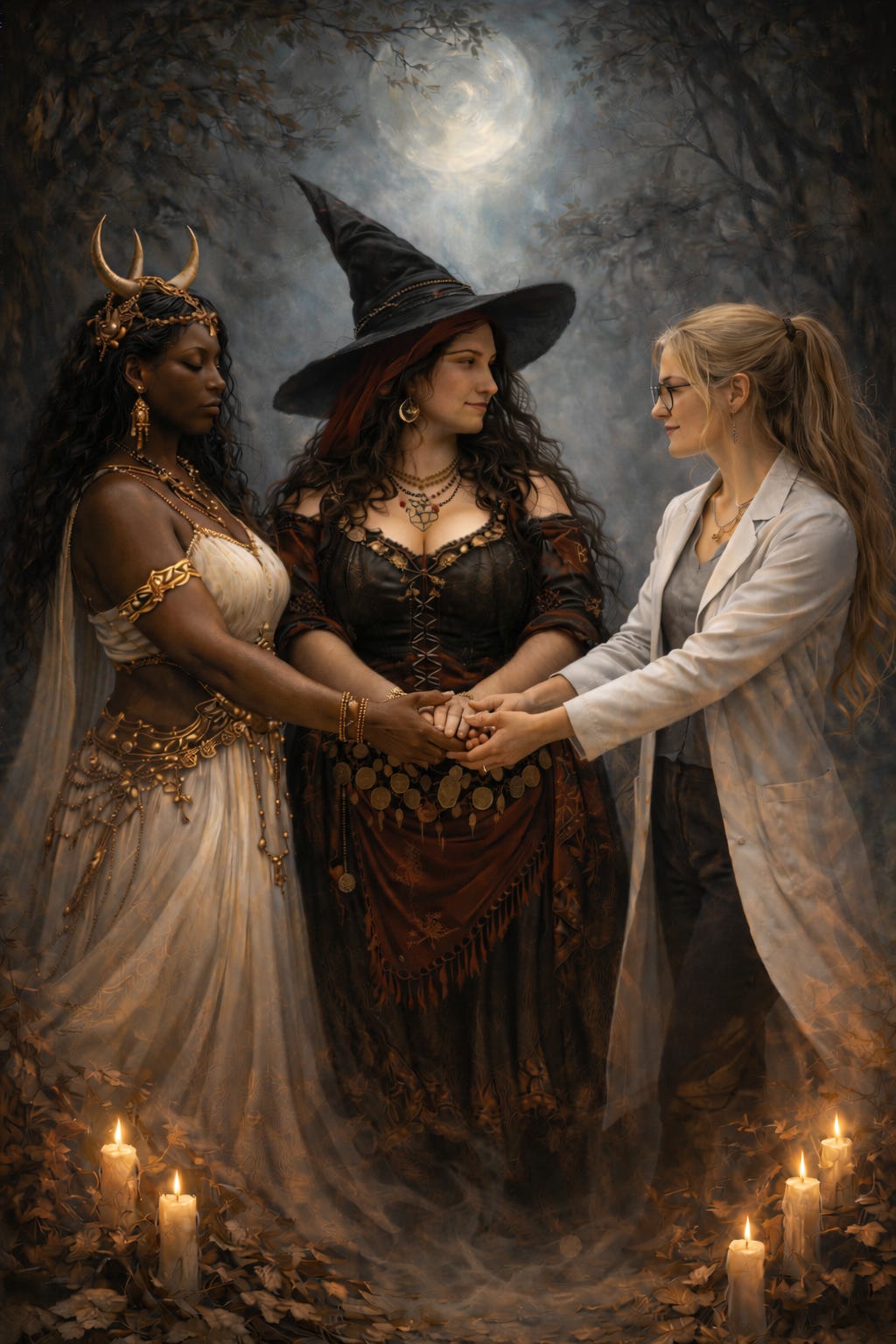
AI generated image
From Priestess, to Witch, to Therapist: How the Profession of Psychotherapy was Founded on Stolen Feminine Wisdom
For many years, Psychology, Nursing, Counseling, Social Work, and many other “helping professionals” have sought to “legitimize” themselves to gain more “professional” capital. One example of this practice, specifically in the field of psychotherapy, is the Council for Accreditation of Counseling & Related Educational Programs (CACREP), which was established in 1981. Mascari and Webber (2013) argued that CACREP standards would allow counselors greater portability of licensure and increase counselor education program standards for evaluating counselors-in-training, thereby enhancing the profession by creating a more uniform curriculum. Therefore, perhaps the most considerable shift that occurred as a direct result of CACREP was the proposed 2016 standards, which required all counselor education master’s programs to increase their program hour requirements to 60 hours (roughly 3 years) and added the core competencies, which emphasized training new counselors to use more evidence-based forms of treatment (Merlin et. al, 2017). In addition to these changes, programs were required to standardize their evaluation of students and to monitor for potential signs of professional “impairment” that could reflect poorly on the profession and adversely affect clients. Therefore, one of CACREP’s main goals was to improve the counseling profession’s reputation and make it more “legitimate” in the eyes of the public. Additionally, this emphasis on “professionalism” hoped to provide another benefit for co-counselors in order to allow them to build and receive higher reimbursement rates from their clients’ insurance companies. Thus, with good intentions and the hope of advancing the profession, many counseling programs began adopting these standards in 2014 to meet compliance requirements by 2016.
To put this into perspective, this means that the counseling profession had roughly 10 years of these new “professional” standards in place before the passing of President Donald J. Trump’s One Big Beautiful Bill Act which has redefined “professional degrees,” and now effectively excludes many healthcare providers as “non-professional,” including the fields of Counseling and Psychology (Behavioral Health Business, 2025). Therefore, President Trump, with a single bill, has effectively erased more than 30 years of work by professional organizations such as CACREP and others to gain public recognition and respect for these fields. Which begs the question: was the effort that went into standardizing these healthcare fields truly “worth it” if, in less than a year of Trump’s second term in office, he has effectively disparaged the professional reputations these providers have worked so hard to achieve?
Moreover, what does it say about U.S. society as a whole and its government if they no longer consider these fields as “professional”? Or perhaps the passing of this new law, which is set to take effect on July 1st, 2026, reveals a more profound misogynistic truth, which is that many individuals, especially government officials (primarily made up of men), have never considered these fields “professional” to begin with. Thus, it appears that “professional” has become the new term to suppress industries such as Psychology, Counseling, Nursing, and Education, which are primarily dominated by women (WHO, 2024), therefore effectively creating a new “Witch Craze” of sorts on healthcare workers.
To read the full article, click on the link below to purchase.
Or check out my podcast episode on it, which just dropped!
OX
Your Dark Fairy Godmother
Suggested Citation:
Robichaux, M. (2026). From priestess, to witch, to therapist: How the profession of psychotherapy was founded on stolen feminine wisdom. The Yonic Journal, 2(1), 1-40.