
Glinda: Friend or Foe?
Villain Pick-Me Girl or Victim of the Maiden Complex?

To no one’s surprise, Wicked: Part One has become the highest-grossing movie based on a Broadway musical in the United States. However, despite the movie’s obvious appeal and beloved characters, many individuals on TikTok and other social media platforms have taken up arms with Glinda’s character, asserting that she is Oz's “real villain” and a “pick-me girl”.
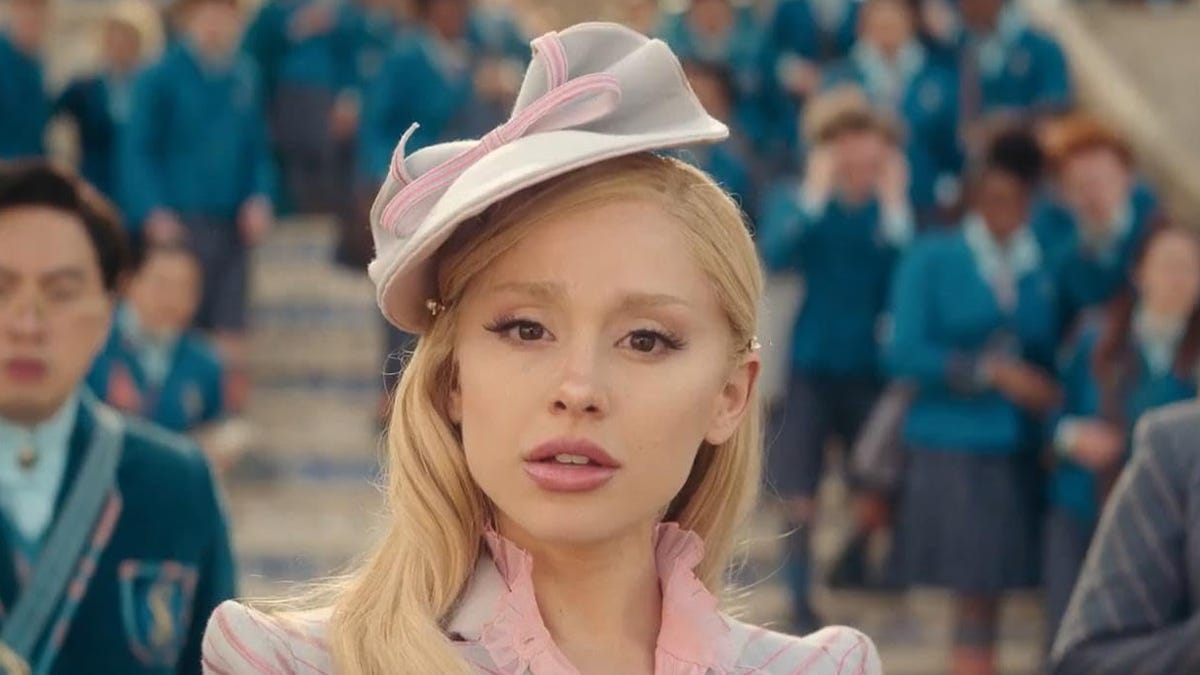
Credit: Wicked: Part One (2024)
*WARNING: SPOILERS AHEAD*
The Story of Wicked
Wicked is the musical origin story of the land of Oz prior to Dorothy’s arrival. It is based on L. Frank Baum's beloved book The Wonderful Wizard of Oz (1900), which was adapted into film in 1939 as the iconic movie The Wizard of Oz, directed by Victor Fleming. The musical Wicked was based on the book Wicked: The Life and Times of the Wicked Witch of the West (1995) by Gregory Maguire, which is a retelling of the story of the Wizard of Oz from the perspective of Elphaba, the Wicked Witch of the West. From both the musical and the Wicked book’s perspective, Elphaba is mislabeled as a “villain” by the people of Oz due to her green skin and “radical” beliefs regarding justice and advocacy for animal rights. She defines the “all great a powerful wizard” who, from an in-depth psychology perspective, represents an archetypal father figure who upholds traditional standards and values, much like what we would see reflected in our modern-day patriarchal society. It is clear that Maguire wrote his book to be a critique of the political and racial injustices reflected within American culture, specifically towards marginalized groups of individuals, which is represented by the Wizard’s plan to strip the animals of their ability to speak and live freely, treating them as inferior beings and enslaving them. (Stripping a whole group of individuals' rights to body autonomy and self-agency, does that sound familiar to anyone?)
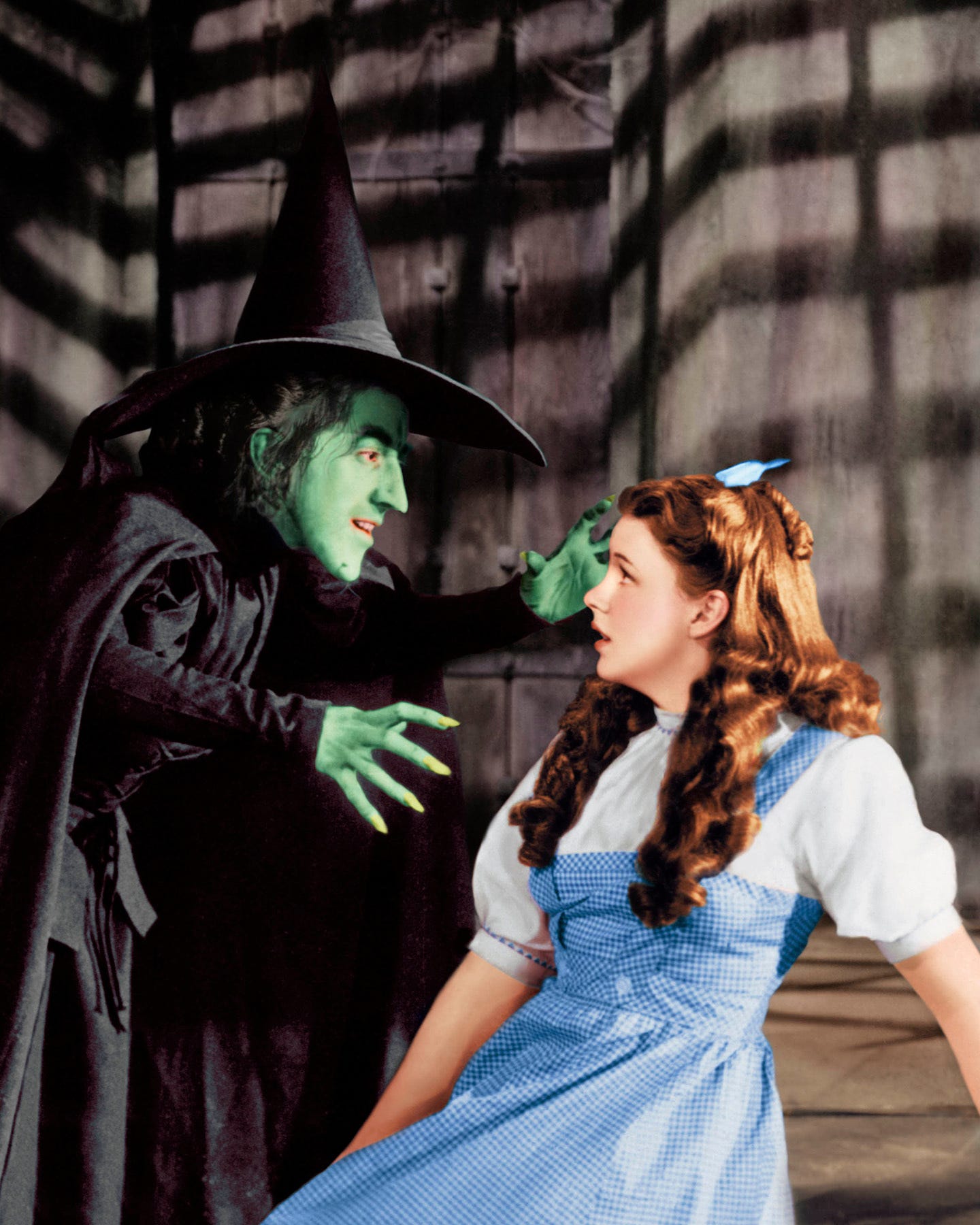
Credit: The Wizard of Oz (1939) The Wicked Witch of the West (Elphaba) and Dorothy.
Once Elphaba discovers the Wizard’s plot, she is disillusioned and outraged and refuses to help him or the powers at be fulfill their wicked plan to silence and control animals for their own gain (like Dr. Dillamond and the flying monkeys). The first act of the musical and the movie ends with Elphaba freeing the flying monkeys and taking flight on her broom after singing the iconic show-stopping song “Defying Gravity” from the musical. It is a song that is all about embracing the power of transformation, self-agency, and freeing oneself from limiting restrictions.
However, before Elphaba chooses to follow a path of authenticity, she and the character Glinda (or “G(a)linda”) have a fight during which the two enemies turned friends decide to part ways after Elphaba refuses to follow Glinda’s advice for her to comply with the Wizard’s plan for her own safety and self-benefit. After Elphaba leaves the Wizard and Madame Morrible (a once mentor and benevolent figure toward Elphaba turned manipulator) decide to take Glinda under their wing and turn her into a sort of “icon” or propaganda showgirl archetype by labeling her the “Glinda the Good” and scapegoating Elphaba into a “wicked witch” by comparison.
Glinda’s choice to stay in the Wizard's good graces and benefit from her loyalty to his evil plan has led a number of fans of the movie to call her a “villain” or “pick-me” girl on TikTok or other social media platforms.
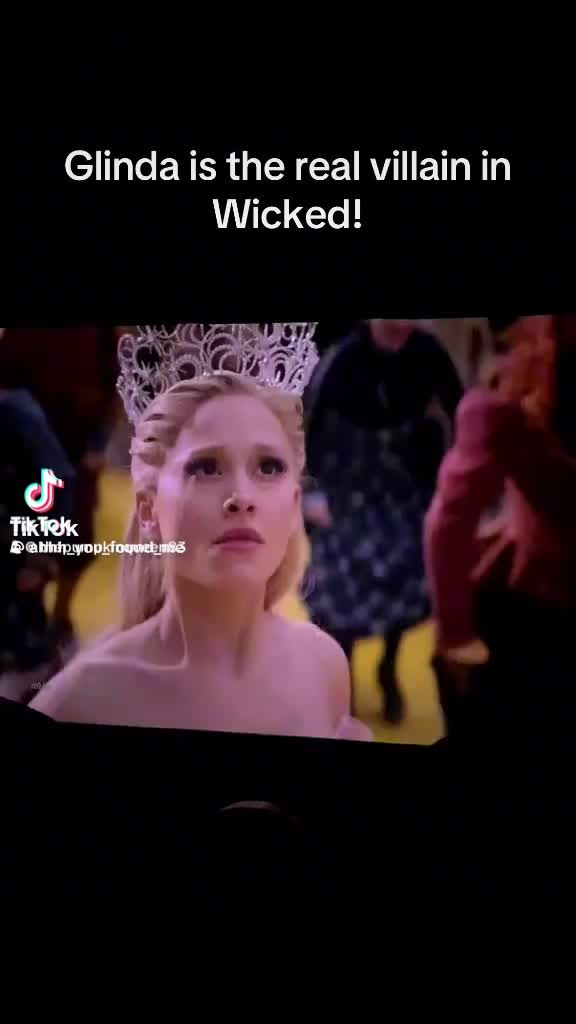
 Tiktok failed to load.
Enable 3rd party cookies or use another browser
Credit: @thepumpkinqueen83
However, a threads post by @leegrey_ points out that many of us have played the role of Glinda in our lives because rather than risk justice or equality for others, we will often end up choosing the path of least resistance or the path that we think will benefit us the most.
So I pose this question for you, reader…Is Glinda truly the “villain,” as we might want to label her, or is she a reflection of the “good girl” or maiden complex many of us women have come to internalize through living in a patriarchal society?
Who is the Real Glinda?
If the audience wants to truly understand Glinda’s motivations, they need only to listen to her character’s most well-known song, “popular”.
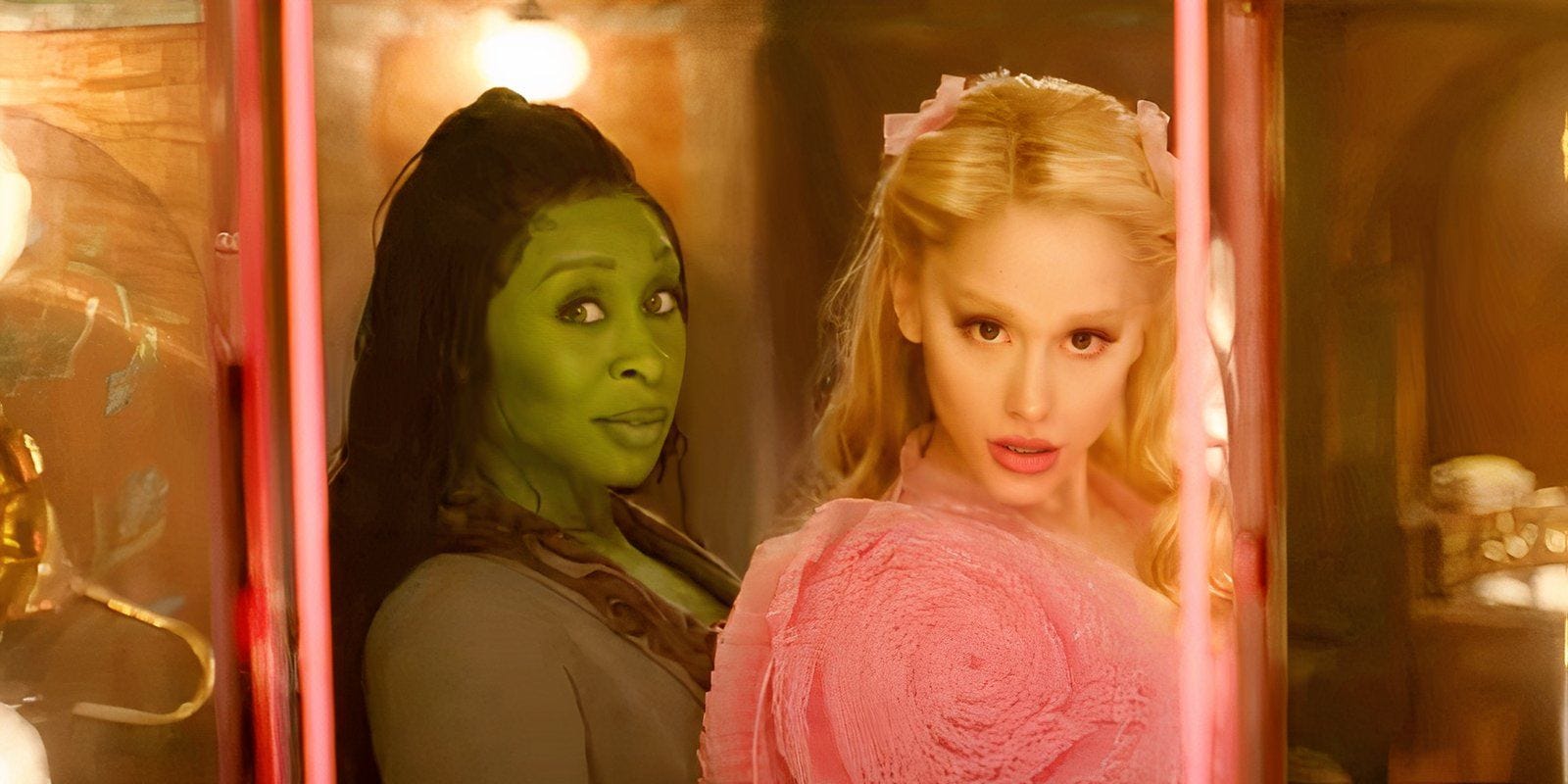
Just by looking at the lyrics, we can see Glinda’s desire to befriend and makeover Elphaba comes from selfish motivations. At first, when we are introduced to Glinda, she appears vain, vaped, and hell-bent on being seen as “good” and likable in the eyes of others. She is jealous at Elphaba’s natural talent for magic, (which she is having difficulty mastering as a witch) and can not understand why professors like Madame Morrible are giving Elphaba so much attention over her. This causes her to act passive-aggressively towards her roommate Elphaba and attempt to embarrass her by giving her “poor” fashion advice or other acts of relational aggression, which she employs with ease. However, when Glinda’s plans backfire, and she sees that Elphaba is actually admired by others, specifically Fiyero, Glinda’s love interest, she decides to change course and befriend her. Thus this frenemy relationship is built on Glinda’s desire to be seen as good for her own self-gain, rather than her desire to form a true intimate and reciprocal friendship.
Credit: Wicked: Part One (2024)
The song starts out with Glinda specifically referring to Elphaba as a “project”, which already places her in a position of superiority. As the song continues, Glinda makes reference to how wonderful she is, helping those “less fortunate than [her]” believing that she knows exactly what they need, which is of course to be popular and liked by others.
She sings:
I'll teach you the proper ploys
When you talk to boys
Little ways to flirt and flounce
I'll show you what shoes to wear
How to fix your hair
Everything that really counts
In other words, what Glinda is really teaching Elphaba how to be is appeasing to other people, specifically men, through patriarchal notions of femininity or what we might refer to as the “light feminine” (more on that later). As the song continues, Glinda says this message more explicitly:
When I see depressing creatures
With unprepossessing features
I remind them on their own behalf
To think of celebrated heads of state or
Specially great communicators
Did they have brains or knowledge?
Don't make me laugh!
They were popular! Please -
It's all about popular!
It's not about aptitude
It's the way you're viewed
This last stanza, in particular, truly shows the internalized patriarchal values Glinda has internalized. These values reflect masculine ways of being, such as the focus on status, power, and achievement—all things that Glinda has internalized to mean she is “good.” However, these achievements are fleeting because they focus on gaining approval from others rather than Glinda valuing her own self-assessment of herself. Thus she must constantly be in a state of scheming and looking for her next “win” in order to not lose this validation.
This is made explicitly clear in the last line of her song when she sings:
You'll be popular -
Just not as quite as popular
As me!
Revealing the true motivation behind her desire to help Elphaba, to make herself look better to her love interest, Fiyero, who, of course, represents the masculine approval Glinda feels forced to seek out.
The “Pick-Me” and the Maiden
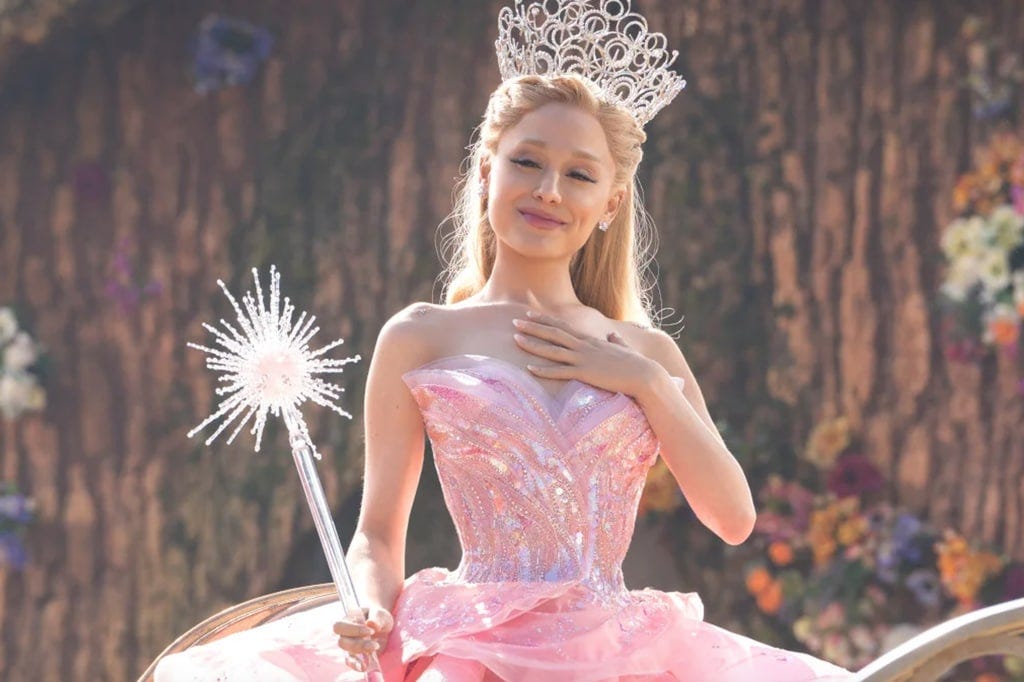
As I said at the beginning of this post, many people have labeled Glinda a “pick-me,” but what exactly is a pick-me girl? A pick-me girl is a woman (typically a young girl in her early teens or early 20s) who tears down other women and adopts masculine traits to appear like “one of the boys” or gain approval from men. Specifically, the hallmark feature of this woman is that she sees other women as competition rather than her friends. Thus, she has rejected her own femininity or her feminine attributes not validated by society (wearing noticeable makeup, emotional expression, vulnerability) in order to make herself more likable in the eyes of men and others. This is where the maiden archetype comes into play.
Credit: Wicked: Part One (2024)
In depth psychology, the maiden archetype can be seen as a woman who has not yet gained full agency over her own self-expression or autonomy. This woman will often seek out others' approval first before relying on her own intuition or wisdom for guidance. Thus, this leads her to act in ways that emphasize others' reactions towards her behavior as a form of social approval (whether that is through her parents, men, or society’s standards) rather than develop her own sense of self.
One example of this archetype with the myth of Persephone and her abduction by Hades who was the daughter of Demeter, the goddess of the harvest and fertility. A brief synopsis of the story is that Persephone was under the watchful eye of her mother and, therefore, had no chance to develop her own autonomy. Hades then takes her into the underworld as his bride against her will. This is a metaphor for Persephone, who represents the light feminine (focused on being kind, nice, good, and appeasing to others), embrace of her dark feminine aspects (wild, untamed, assertive, etc.). Therefore, before she can ascend back to earth to visit her mother, she must learn to integrate her dark feminine aspects, which she does through eating the seeds of the pomegranates, which many depth psychotherapists believe is a metaphor for losing her virginity. Meaning that she has taken ownership of her sexuality and self-agency (the dark feminine), which allows her to officially separate herself from her mother.
Glinda, on the other hand, is not in this stage of her development, and thus the character Elphaba reflects the dark feminine aspect that Glinda herself needs to incorporate. Elphaba is assertive, strong, and not afraid to be herself or stand up for what she thinks is right. She learned to find agency in herself once her father rejected her for the color of her skin since she did not comply with his standards of what he felt his daughter “should be.” Therefore, Elphaba, who was already rejected by male standards of approval at a young age, was forced to embrace her dark feminine aspects, which is made even more evident when she decides to reject the Wizard’s proposal.
However, Glinda, never having the chance to reconcile the dark feminine attributes within herself, cannot imagine who she would be without the approval of the Wizard or the systems she has clung to out of familiarity. Thus, in this way, she is stuck in her maiden form. She is always looking for the prince to save her, being “good” for others, and in her worst moments, choosing to scapegoat her friend in order to create a harmful narrative against her. Her fear of rejection keeps her trapped, and while, yes, in many ways, this makes her a “villain,” it is also a reminder for all of us to consider how this role has impacted women’s self-agency within our modern culture.
Credit: Wicked: The Musical (source unknown)
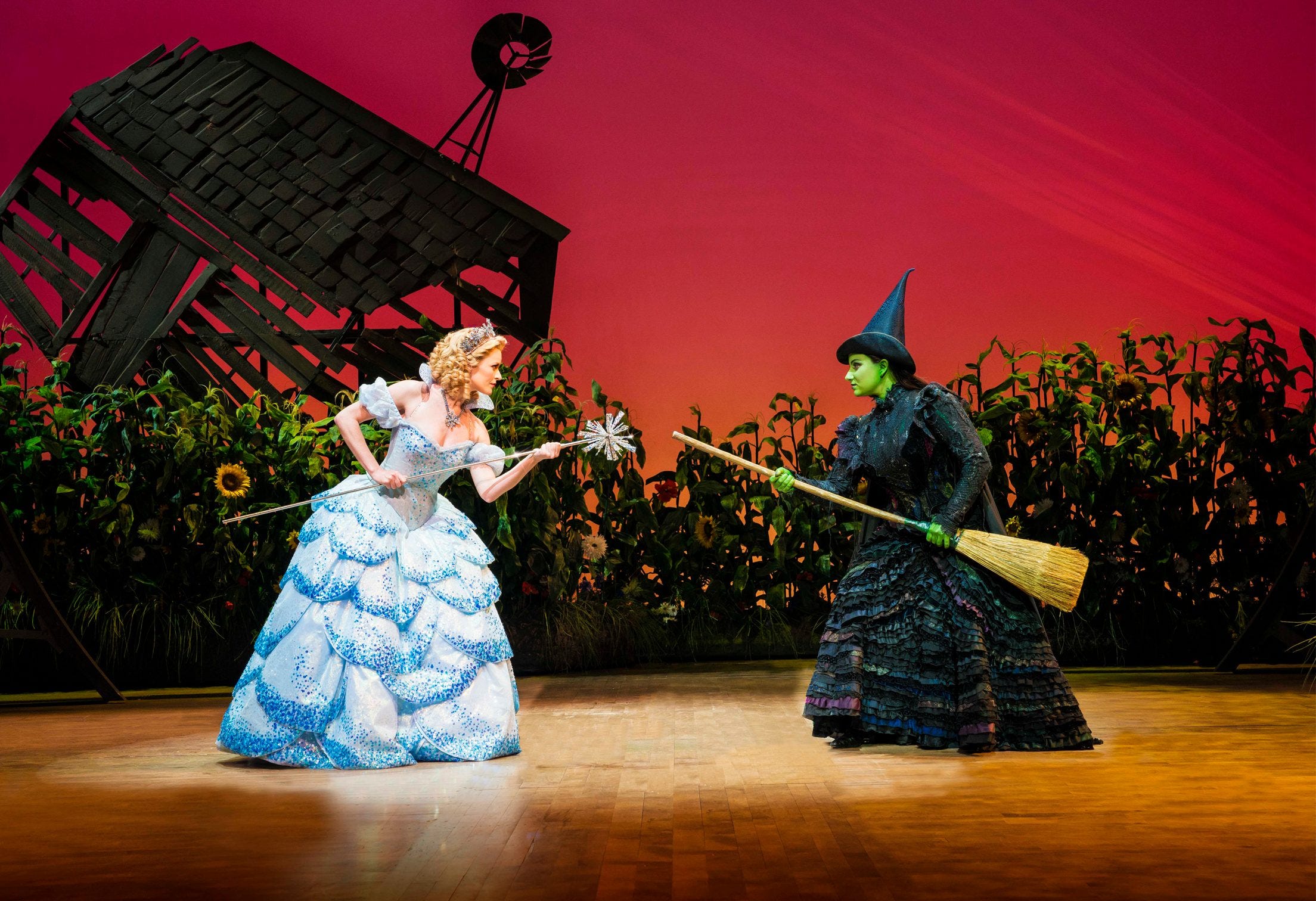
If there is any lesson we can learn from Wicked, it is that often, the “villain” is the one who doesn’t have the approval of mainstream society. Can we really blame Glinda for being a “villain” when so many women have felt trapped in the maiden role of centuries to avoid being outcasted, rejected, or in some cases even murdered for being called a “wicked witch”? When we zoom out, perhaps we can understand why Glinda, those yes, her actions were self-serving, felt the need to protect herself. Again, I am not condoning this behavior, but instead I am making an argument that all women, (and for that matter all people), need to learn how to reconcile their dark and light aspects, no matter their gender.
Because rarely is the line between “good” and “wicked” ever clear.
XO
The Dark Fairy Godmother
Feel free to share your thoughts on this post below and follow me for more feminist-depth content!
Resources:
https://deadline.com/2024/11/wicked-box-office-record-broadway-musical-1236190290/
Baum, L. F. (1900). The wonderful wizard of Oz. George M. Hill Company.
Maguire, G. (1995). Wicked: The life and times of the wicked witch of the West. ReganBooks.
Fleming, V. (Director). (1939). The Wizard of Oz [Film]. Metro-Goldwyn-Mayer.
Chu, J. M. (Director). (2024). Wicked: Part One [Film]. Universal Pictures.