

Look! Mommy, Mommy!
Understanding our Desire to be Seen by Mother

Recently, I matched with a man on a dating app (Hinge), and he asked me a seemingly innocent question via a voice message: “If you could go back to two time periods in history, what would they be and why?” Naturally, I said I wanted to witness Cleopatra VII rule from start to finish and to attend Sabina Spielrein’s presentation of her article Destruction as the Cause of Coming Into Being at Freud’s home in Vienna. Which, honestly, should come as no shock to anyone who reads this blog.
It was his response that caught me off guard.
Not only in his voice response, did he not bother to ask why I was interested in these two time periods in history, or either of these women. Instead, he just stated that he would like to see the “rise and fall of the Roman Empire” (shocking for a man - I know) and the moment of his birth so he could “watch the shift in his mother’s eyes when she realized she was now his mother.”
*Excuses self to go throw up*

Within a few seconds of hearing that response, I promptly unmatched him.
Now, some of you might read that response and think it’s not that bad or perhaps even sweet for a man to say about his mother. And that is the problem.
This is because we are so used to men centering themselves in every aspect of life that men themselves don’t even realize they are doing it.
While it is natural for us as humans to want to know how we make an impact on others, there was something about the way he worded his response that indicated to me that this individual was still very much in what psychotherapist Jean Piaget would define as his Preoperational Stage of thinking with regard to his cognitive development.
As the name implies, in this stage, which is roughly between 2-7 years old (the same age range as Erikson’s Trust vs. Mistrust stage), children begin to speak and think symbolically, but struggle with perspective-taking, which leads to a preoccupation with their primary caregiver and a developmental normal level of egocentrism.
At this point, children see themselves as the center of the universe and have difficulty understanding why their caregivers (i.e., mothers) cannot constantly center them.
An example of this would be when a child’s mother goes to the bathroom to relieve herself, and within 5 seconds, her children are banging down the door trying to access her.

Again, I want to stress that the preoccupation with one’s mother or primary caregiver at this stage is very healthy and normal. Despite Western notions of individualism, we as humans are dependent on one another, specifically in our early childhood years and later adulthood, as we are less self-reliant at those ages.
The problem is that in our modern society, it seems like women are graduating from this stage and men are not.
As my Hinge match expressed, he didn’t want to see his mother give birth so he could empathize with her experience or consider how she might have felt. He wanted to see the moment of his birth through his own frame of reference.
“The moment in my mother’s eyes when she realized she was MY mother.”
His desire to go back and relieve this moment had nothing to do with his mother; in every sense of the word, he saw her as an extension of what I refer to in my Yonic Theory™ as the Veil function. An embodiment of the light or “good” feminine qualities within himself, which he most likely projects onto other women in his life in order to reinforce his light masculine Ego function.
But how did this come to be, and why are so many men like this in our modern dating world?
To answer that we need a bit of a history lesson…
Cartesianism is a philosophical tradition derived from the writings of the French philosopher René Descartes, who was inspired by – you guessed it - many Greek and Roman male philosophers, dating back to the rise of the Holy Roman Empire.

Thus, it would appear that when it comes to understanding men, all paths do in fact lead back to Rome…
Descartes is probably most well known for his quote “cogito, ergo, sum,” which in Latin translates to “I think, therefore I am.” Thus, Descartes argues that only “truth” can one be certain of one’s knowledge of one’s own existence, which comes from the realization that one exists and is capable of complex human thought, which aligns very well with Piaget’s Preoperational Stage of thinking and what I refer to in my Yonic Theory™ as the Ego function.
And again, we need this knowledge; we need to understand that we are our own unique beings, that our stories and lived experiences matter. This is developmental, normal, and healthy…to a point…
A couple of years ago, I saw a TikTok video of a young woman stating she did not feel the need to take Ketamine because she “experienced ‘ego death’ and empathy alone in her bedroom at 13.”
And while this video could be considered comical, it does reveal a deep and important truth regarding the ways cisgender men and women are socialized.
I would argue that, on average, most women move out of Piaget’s Preoperational Stage much more quickly than their male siblings and peers.
This is because, as I discuss in my Yonic Theory™, women are expected to center men and thus become fused with their Veil function, which praises women for their empathy and “light feminine” qualities. Therefore, women often don’t need an outside substance to metaphorically “kill” the Ego function, since often they are prevented from even fully forming one to begin with.
As a psychotherapist, I have heard so many stories of women learning it was “rude” to ask for their needs to be met, or being given caretaking responsibilities as young as 5, 6, or 7. Meaning that they did not get to remain in Piaget’s Preoperational Stage for very long before moving on to the higher levels of their cognitive development.
Yet appears that cis-gender men do not have this same gender socialization. They instead idealize the Cartesian notion of the Self: that if I think it, it must be “truth” and therefore correct.
This type of thinking, while healthy to a degree to build a strong Ego function so that the Self doesn’t collapse in the face of threat, can make it difficult to see other points of view. Namely, the ability to empathize with others, and specifically those of the opposite gender.
Which brings me back to my Hinge date…
His statement about wanting to “see the shift in his mother’s eyes” was not about empathizing with her or wanting to understand how difficult the process of childbirth is. It was all about “Does mommy see me, and therefore do I exist?” And this is why I argue that we have the Veil function along with the dark masculine (Daemon) and dark feminine (Aura) functions of the Self in my Yonic Theory™.
We need to know we are seen by others, because in truth, we come from a mother, and thus the true Self was never meant to be independent of that.
The problem is, we become so attached to our Ego function that we only want to view others as pseudo-mirrors or “Veils” that reinforce our lightness and thus center us accordingly.
But when that happens, we end up with leaders who act like overgrown toddlers, sitting on their Golden thrones waiting for their mothers to validate them.

And perhaps no other field reinforces this notion of the Cartesian self more than the very field of psychology or psychotherapy, which loves to give mothers (and therefore women) a bad reputation.
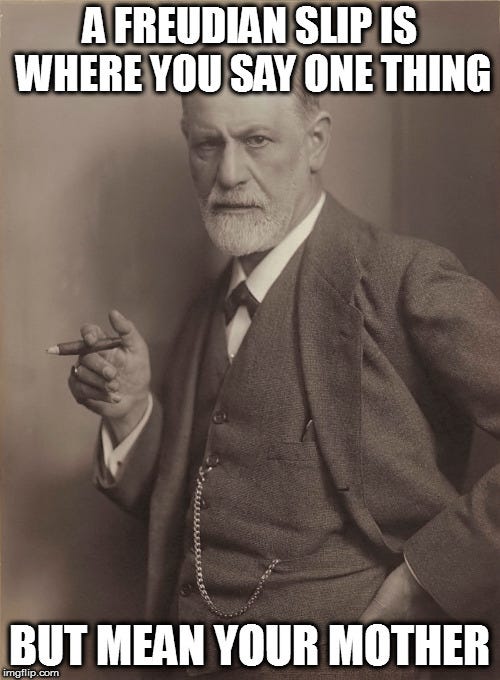
Moreover, our modern training for therapists, the way we teach individuals to provide counseling or psychotherapy to clients, is all about reinforcing the Ego function.
While it is important to note that this process is generally helpful at the beginning of therapy to strengthen the client’s Ego so they can self-reflect, if a therapist is only addressing the “light” aspects of one’s psyche, it can actually cause individuals to become stuck, which can, in turn, make them more self-obsessed.
Thus, they might feel the need to become dependent on their therapists, or may, in turn, even find themselves madonnizing them as their pseudo mother figures, or in some cases, even falling in love with them.
And this is particularly concerning since most therapists are women, and thus this unpaid emotional labor is often expected, or even demanded by the systems and agencies which employ them, causing therapists in turn to further foreclose on their Veil functions in order to center the experiences of their clients, yet rarely ever do they receive this same type of support.
And while I do believe that the mother archetype can be helpful in a therapeutic context, which I myself have used with clients, and many female folk/Indigenous healers used throughout history to foster corrective attachment experiences. What is lacking in our current mental health system is systems of support for healers.
We are missing clear boundaries, legal protection, and financial compensation for this emotional labor, which requires therapists and women, especially, to give so much of themselves for very little in return.
This is because we fail to acknowledge that the role of a mother is no easy task; even the process of giving birth is extremely painful. Often, women are in labor for over 8-10 hours, with no food, little sleep, and thus by the time they give birth, they are utterly exhausted.
Therefore, it seems quite vain and silly for me to think that after all that labor, a woman’s sole priority would be to look at their child and view him as the center of her entire world and universe.
Yet women are conditioned to say just that.
And while yes, staring at one’s child for the first time is a rewarding experience in and of itself, which I can only compare to how I felt when I published my theory for the first time, women are much more than the creations they “birth”.
They need time to rest, to recharge, to take care of themselves. For the men in their lives to look at them and say, “here let me help you, because you just did something so difficult and so hard, which I can not do.”
But that requires men, and all of us, to move out of our Ego functions and see women and healers as more than the “mother” archetypes they wear, that reinforce our un-integrated Veil functions.
It requires a new way of thinking about the Self, one that is interconnected and not so separate as Descartes believed.
A way of thinking that reminds us that women are humans too, and that our parents and the people we love in our lives existed before us, and that there will be people we love that we encounter in life who will exist after us as well.
OX
Your Dark Fairy Godmother
If you enjoyed this article, please consider supporting my work by purchasing a paid subscription or donating to my Tarot deck creation fund below.
To learn more about my Yonic Theory approach or how to reconcile your own goddess-witch spectrum check out my on-demand courses through my practice website for purchase: