

Musical Tarot: The Tower and Thank You by Alanis Morissette
Finding Healing After Destruction: Lessons from Hurricane Beryl

I was driving to my therapy office in Houston yesterday morning after Hurricane Beryl made landfall this week. At this time, over 1 million people in Houston and the surrounding areas still do not have power, water, or a combination of the two. CenterPoint Energy, which has a monopoly on the energy hub of Texas, has projected that it might take up to a week or longer for some areas (those typically associated with lower-income and ethnic minority families) to restore power. Once again, highlighting the disadvantages between the upper and lower classes in many cities across the United States.
So, as I was driving to work, stopping at every busted traffic light and noticing all the down trees and power lines (all of which felt very Tower-like), it happened that fate would play Alanis Morissette’s “Thank You” on my Spotify. As I listened to Morissette’s words, it struck me how perfectly this song describes the Tarot card The Tower.
At that moment, I had an idea for a new Substack blog, where I will attempt to pair musical numbers with different cards from the Tarot. Since this is my first post, I’m not sure fully how this blog will take shape or form, but for now, let's begin with my first song and card of this series: Thank You and the Tower.
The Tower Card
The Tower Card in Tarot is typically a card that evokes a strong emotional reaction in most individuals when they come across it in a reading. As a Tarot Practitioner and Intuitive Healer, this is something I pay special attention to. My training as a psychotherapist informs me that when we get closer to the root of a client’s suffering or the conflict, they are experiencing in their inner or outer world, the more it can feel like the imagery of the Tower card.
For example, if we know that our partner may not be able to fulfill our emotional, relational, or even physical needs, we may try to avoid this topic in session to avoid the recognition that perhaps it is us who is unhappy and wants to leave the relationship. Any seasoned therapist knows that clients (whether it is in the context of psychotherapy, a tarot reading, or a reiki session) will often talk around the issue that is bothering them before they are ready to face what is genuinely causing them distress. While the process might feel unnecessary from a Western frame of reference, it is precisely this circular process that is needed for clients to feel safe in order for them to let their Tower fall.
This is because The Tower in Tarot represents the structures in our lives (whether external or internal) that need to be torn down and torn apart to facilitate our healing. On a systemic level, this can include such systems as late-stage capitalism, which we are beginning to see the adverse effects of in real-time. This also includes things such as systemic racism, sexism, and other forms of oppression that keep individuals trapped and running the “rat-race”. On an individual level, this can be a family system, a hostile work environment, a romantic relationship, or a friendship that is abusive, controlling, or limits our growth and potential.
However, while The Tower can reflect these external systems, the influence of these structures often go hand in hand with our own negative thoughts and self-defeating beliefs, which need to be torn down and replaced in order to break out of the systems that keep us trapped.
From a psychological perspective, we can view the Tower as a sort of “protective part” using the lens of Internal Family Systems (IFS) or even a psychodynamic approach. The Tower was created by ourselves and the systems in our lives to keep us “safe” by providing a sense of structure to conform to in order to feel like we have a sense of grounding and security in the world. The Tower is that job that has become so infused with our identity that even though we know we hate coming in to work every day, we cannot give it up because who would we be without it? Or The Tower can be that codependent relationship with our partner, parent, child, friend or family member that we’ve come to rely so heavily on for support, completely neglecting our own needs and agency in the process. The Tower can also be an idea. The myth of the “American Dream” is the idea that if we work hard enough or push ourselves a little more, we can “beat the game,” only to realize that the game has been rigged from the start.
All of these are just examples of how the Tower can show up in someone’s life, and there are many interpretations to this card so you might only resonate with a few of these examples or none at all. It is important to remember that just like any Tarot reading, what The Tower means to YOU and the structures in your life will be different from another person’s experience of the same card. However, what The Tower does teach us is that there is beauty in the breakdown. That there is a chance to rebuild among the rumble, but only if we experience the rumble first.
This is something shame expert Brené Brown discusses in her book Rising Strong. In her book, she discusses the process of the rumble and how one must sit in the uncomfortable feeling of grief, loss, sadness, anger, and yes, sometimes shame before one can pick up the pieces of themselves and start anew. Sitting in the rumble is not for the faint of heart. Challenging the systems that kept us feeling safe for so long is hard work. Scary work! It’s no wonder that many of us might feel tempted to give up when this happens.
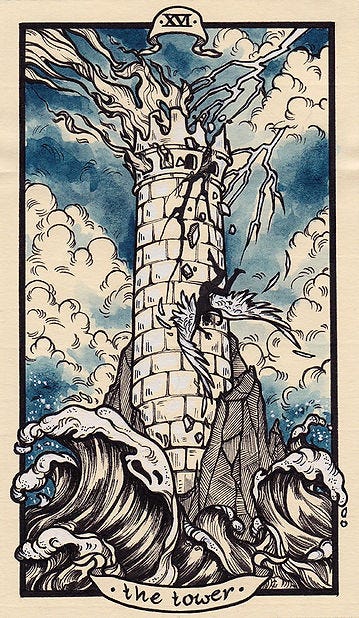
Artist Fyodor Pavlov’s depiction of the Tower card
Just like the images of the people falling out of the Tower in Pamela Coleman-Smith’s drawings in the original Smith-Waite Tarot deck or in the angel falling from the sky in Fyodor Pavlov’s depiction of the Tower shown above we can feel like we are falling to our metaphorical (or sometimes it feels very real) death when we encounter the Tower card.
I personally love Pavlov’s image of the Tower because, to me, the angel falling almost represents a sort of “fall from grace.” As the eldest daughter and recovering perfectionist who works with women who struggle with perfectionism, anxiety, and just overall feelings of pressure to be a “good girl,” this image speaks to how one might feel when they are not able to uphold the heavy mantle of perfectionism any longer. Perfectionism, just like any system, is centered around making oneself small and likable to conform to the expectations of others to keep us “safe.”
We may fear what people might think of us if we truly let ourselves be free of the Tower. How could we not? As human beings, we have a natural desire to want to belong which sometimes causes us to hide parts of ourselves. Yet in some ways, that is exactly what the Tower teaches us to do. To not comply or stay within the systems that harm us whether those are internally or externally based, but to let ourselves jump out of the Tower, being free to reclaim our true selves.
Connecting the Tower to Alanis Morissette’s Thank You
So, let's break the Tower card concept down even further using the song Thank You by Alanis Morissette, which she and Glen Ballard co-wrote and released on October 12, 1998.
The song begins with a simple melody that feels almost dreamlike as if one has awoken from a bad nightmare.
Morissette’s haunting beautiful voice begins to sing:
How 'bout getting off of these antibiotics
How 'bout stopping eating when I'm full up
How 'bout them transparent dangling carrots
How 'bout that ever elusive kudo
After the massive success of her album "Jagged Little Pill," Morissette took a break from the intense pressures of fame to embark on a journey of self-discovery and healing. During her travels, she visited India, where she reported that she discovered many spiritual and personal insights through her exposure to Indian culture and non-Western forms of healing. Therefore the song reflects her gratitude and the newfound perspective on life she gained after this experience.
During this first stanza, Morissette references some of her own self-destructive habits, which, like the structures of the Tower card, kept her sick and ill, physically, emotionally, and mentally. It could be interpreted that the “dangling carrots” and “ever elusive kudo” Morissette references might be the things that keep many of us trapped in a capitalistic, patriarchal society, which focuses on perfectionism, prestige, and power as a way to solidify one’s worth. This pursuit of perfection is well documented to lead to things such as addiction, binging and purging behaviors, negative self-esteem, anxiety, depression, and yes, even physical conditions. This is even further highlighted by Morissette’s reveal of her struggles with eating and with her health in her lyrics. Thus, at the start of this song, she is in the very process of her Tower beginning to crumble.
From there Morissette jumps into the chorus:
Thank you India
Thank you terror
Thank you disillusionment
Thank you frailty
Thank you consequence
Thank you, thank you silence
When reflecting on Thank You, Morissette reported that she was inspired to write the song after she realized that she had never allowed herself to slow down in her life. So, when looking at the words used in the chorus, it is clear that what Morissette is feeling is something most Tarot professionals would refer to as a “Tower moment”. Tower moments occur in typically very sudden ways when everything around us suddenly appears to crash down. We feel terror, fear, and anger, but most of all, we tend to feel disillusioned. We feel disillusioned that the system, job, career, relationship, self-concept, ego, or whatever it may have failed us. That didn’t, in fact, keep us safe, and thus, we have to look at the consequences of our actions and feel the feelings we have been avoiding. Thus, Morissette accepts the silence that comes with the defeat of her Tower and lets go of it which we see in the next verse.
How 'bout me not blaming you for everything
How 'bout me enjoying the moment for once
How 'bout how good it feels to finally forgive you
How 'bout grieving it all one at a time
As the song continues, Morissette shows the listener that she is becoming more and more comfortable with the breakdown of her Tower. Oftentimes, the hardest part of moving through the Tower is forgiving others, and what is even more challenging is forgiving ourselves. Letting go of the blame, shame, and guilt for not only the things done to us by others or that we have done in return or accepted from others because of our own feelings of hurt. Letting go of these protective walls is not easy. With that process comes grief and grieving of the parts of us we could have been or who we “should have” been. Plus it may include grieving relationships and past cycles in our lives that we know have to come to a close.
After another round of the chorus, Morissette jumps in to the bridge:
The moment I let go of it
Was the moment I got more than I could handle
The moment I jumped off of it
Was the moment I touched down
During this part of the song, Morissette discusses how she held so tightly to a concept and that the moment she “let go of it” was actually the moment she found peace. How many of us do this in our own lives? We hold out hope for the dream job. The dream partner/relationship. The dream wedding. The dream family. Only to end up chasing what feels like an impossible goal. This idea that life will somehow be idyllic and good once we have the thing we want is sold to us at a young age. It is in part why we struggle to let the Tower fall because, as the famous author Virginia Woolf said, “It is far harder to kill a phantom than it is a reality.”
In the last verse of the song, Morissette gives us an idea of how to move forward:
How 'bout no longer being masochistic
How 'bout remembering your divinity
How 'bout unabashedly bawling your eyes out
How 'bout not equating death with stopping
When you listen to the song, you will notice a stark shift in the music after Morisette says the phrase, “How 'bout remembering your divinity”. I have to believe this is done on purpose to highlight this phrase. If you are familiar with Tarot the card that comes after the Tower is the Star (see below). The Star card in Tarot is meant to represent our true Authentic Self (This is why I use the eight-sided star in my logo.) In a sense, the Star is the divine part us that we reclaim once the Tower has fallen. It is the part of ourselves untouched by trauma, pain, hurt, and loss. Our inner child desperately seeking a home within us.
Thus, as the Tower falls and we feel our feelings of grief in the rumble. We learn that the fall of these systems and structures we have created for ourselves, though they might be a metaphorical death, offers us a chance to be reborn into who we truly are.
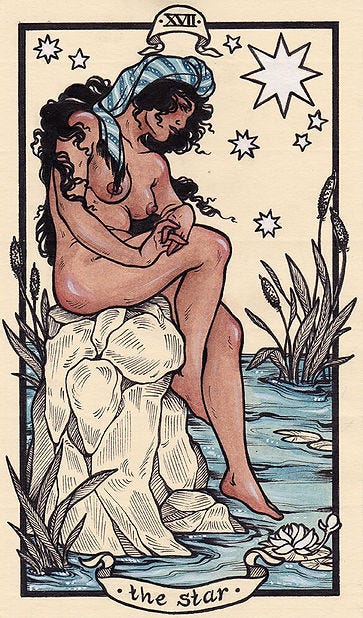
Artist Fyodor Pavlov’s depiction of the Star card
After this verse, she jumps back into the chorus, except it is a little different this time:
Thank you India
Thank you providence
Thank you disillusionment
Thank you nothingness
Thank you clarity
Thank you, thank you silence
In this section, Morissette replaced the words “frailty” with “nothingness” and “consequence” with “clarity.” I like to think that she did this deliberately because it shows how a simple reframe can change the meaning of an experience for us. In accepting nothingness, we can come to terms with our own frailty and our own humaneness, and thus, we can realize that these systems (also created by humans) are flawed. Therefore, we can realize that the systems that we are working so hard to uphold actually don't hold much value unless we decide to give value to them. In addition, her choice to replace the word “consequence” with “clarity” is a way of reframing our past actions to view them as moments of learning and growth rather than a “mistake” or “bad choice.” Thus, by recognizing our past actions and their consequences, along with our feelings of hurt and regret, we can gain clarity on what is important to us moving forward.
With that, the song Thank You comes to a close. Thus, Morissette has led her listener metaphorically through the Tower card and into the Star, where one can start to rebuild themselves and reconnect to their divine essence.
To me, during this time of increased natural disasters and oppression of women, LGBTQ+ individuals, and Black, Brown, and Indigenous populations, now more than ever, we need to learn how to embrace the lessons of the Tower collectively. We have known about global warming for 10+ years and we need to make systemic changes to save our planet. The old systems are no longer working for us. While it may feel nostalgic to hold onto the traditions of the past, we are entering a new era where there needs to be more equality and respect for all individuals, regardless of sex, gender, sexuality, or the color of their skin. People need to feel like they have agency over their bodies and freedom to make the reproductive and healthcare choices that are right for them. We all need to remember our own power and our divinity and heal so that we can move forward.
So, what are your thoughts on this song and the Tower card? Feel free to mention them in comments. Also what songs feel most Tower-like for you? I’d love to hear your thoughts or if you have ideas for other songs and cards that you want me to do!
With love and light,
Michelle (AKA: Dark Fairy Godmother)
If you would like to learn more about the services offer, you can visit my website here:
If you would like to subscribe to my Stubstack click here:
Resources:
Brené Brown’s book Rising Strong - https://brenebrown.com/book/rising-strong/
Fyodor Pavlov Tarot - https://www.usgamesinc.com/fyodor-pavlov-tarot
Lyrics and Information about Morissette Taken from Genuis Music through Spotify.
I love this analysis. “Thank you” is one of my favorite Morrisette songs. I appreciate the parallels between the self and the social orders. Great read.