

Polyvagal Theory, Old Kings, and the Battle for Academic Recognition

There is a story from Celtic Mythology about the Oak and Holly King, which I’ve been sitting with over the last couple of weeks now that therapy-tok is ablaze with debates about Stephen Porges’ Polyvagal theory and whether it should still be used by therapists.

The myth, which English writer and student of Celtology Robert Graves wrote about in his book The White Goddess, compares the stories of many Celtic figures, which Graves argues were later absorbed into Roman and Christian myths during the western colonization of Ireland, Wales, and Scotland, to the story of the Holly/Oak King.
Yet it is important to understand that within modern interpretations of this myth, the two kings are actually viewed as brothers, and from a psychological perspective, they can be viewed as two extremes of the other. The Persona and Shadow, as psychoanalyst Carl Jung might describe them, or, from my Yonic Theory approach, aspects of the dark and light masculine function, or Daemon and Ego function.

Thus, this myth and similar stories were used by the Celts to explain the changing of the seasons. From Spring/Summer to Winter/Fall, and can be viewed as a metaphor for the shifting in power between the two metaphorical “kings”.
The Holly King, who rules over the waning days during the sun’s shortest period of the year, is said to defeat and kill the Oak King on the night of the summer solstice (i.e. the longest day of the year), thus establishing his rule for the second half of the year. Conversely, it is on the winter solstice that the Oak King then rises from the dead or is “reborn” to defeat the Holly Oak, bringing back the return of the sun.
And so on and so forth as the “New King” replaces the “Old King” and vice versa, which we can see echoed in many Celtic myths and even in the myth of the Egyptian Goddess Isis and her husband/son consort Osiris/Horus.
In other words, it is an endless cycle of each one “killing” the other to establish their rule, which is an archetypal masculine process as old as time itself, and I believe the same is true for our “Kings” or “Gods” within the field of psychotherapy and modern academia.
The Killing of the Old Gods: Polyvagal Theory and Bottom-Up Processing Models
Recently, as I mentioned above, there has been a lot of buzz around the “debunking” of Porges’ Polyvagal Theory (PVT) and Bessel van der Kolk’s seminal book The Body Keeps the Score.
Any while, yes, it is important that we acknowledge that science has advanced and that as technology has progressed, we can now study the impacts of trauma on the brain AND the body to understand the neuroscience behind trauma and effective treatment protocols, I am cautious about completely throwing the “baby out with the bathwater” for either of these two theoretical approaches.
But before I get into that, let’s break down what the definition of theory actually is…
The word theory traces back to the Latin word (theōria) and even further back to Ancient Greek theōria or θεωρία), which means “to contemplate, speculate, look at, or view an object or phenomenon.”
Therefore, for those of us who seem to have forgotten the scientific principles taught to us in our freshman science courses, a theory by its very nature is fluid and can be disproven, and yet can still bear merit within the academic and scientific community.
This is because scientific and academic theories are grounded in empirical data, which is often documented over long periods of time by researchers or theorists long before publishing their results; thus, at its core, a coherent system of ideas or principles to explain an observed phenomenon on a broad scale.
Which is a fancy way of saying a theory is an advanced educated guess and should never be accepted as pure “truth.”
A theory, by the very definition of the word, should always be treated as a provisional model, as even the most robust theories should be open to being revised, refined, or even replaced if new, contradictory data emerges.
Yet, we seem to have a hard time holding space for this fluidity within our modern society and within the field of psychotherapy and academia in general, with its cut-throat emphasis on competition and obsession with status and prestige.
And I say this as someone who 1) holds a PhD and is currently teaching in academia, and 2) has created their own theoretical framework based upon years of clinical observation of their female clients’ lived experiences.
Therefore, as a researcher, I can directly speak to the ways in which the construction of the theory is not only a tremendous amount of work, but it also requires a painstaking amount of research. Comparing your hypothesis against other researchers, what they have done, where their theories have fallen short, and identifying the “holes” you hope that theory will be able to address.
It takes YEARS to formulate a solid theoretical approach and even more years after its construction to refine and edit it to ensure its longevity.
Yet in modern academia, the one significant resource all researchers (including myself) appear to be missing is time itself. Instead, what we face is the constant demands of the “publish or perish” mindset, which leads to an unhealthy sense of competition among academics or what can be viewed as a resurgence of the “New vs. Old King” phenomenon.
This has only been made worse under our current administration, which has led to an increased number of faculty and departments across the nation losing funding or employment in response to these more humanitarian or “liberal arts” disciplines being seen as “controversial” or harder to “prove” from a quantitative empirical perspective.
Thus, as more and more academics struggle to find stable employment, many find themselves taking adjunct teaching roles far below their pay grade or subsequently leaving their disciplines entirely in search of more stable sources of income as full-professor positions become quite scarce.
And here is the thing about that scarcity mindset: not only does it breed more competition so that academics become paranoid of their colleagues, thus causing them to feel as though they must “defeat” their competition for these highly coveted roles. Scarcity mindset also promotes more individualistic thinking, or rather our Ego functions get placed in the driver’s seat, and thus people typically end up doing desperate things when they feel the urge to secure funding or full-time employment, which means they can (even if out of their awareness) be prone to making large sweeping statements and presenting them as full-hearted “truths” before truly taking the time to check their assumptions or biases or if research contradicts/validates their claims.
And often this is done while simultaneously tearing down another theory, which has become their new “groundbreaking” research, as they believe they are replacing the “Old Kings” whose rule has come to an end.
Which is what I believe we are observing with regard to this most recent trend, with how individuals in the field (in what appears to be a sudden, almost overnight shift) are now discrediting Porges’ theory and the work of Bessel van der Kolk.
Oh How the Mighty Fall
While I understand that there are several allegations against van der Kolk regarding the ways he created a hostile work environment, including bullying his own staff members at the Justice Resource Institute, as well as his comments on war in Gaza, for which he later issued an formal apology for, I would also like to play devils advocate and remind everyone of something that is quite uncomfortable for individuals (especially in the felid of psychotherapy) to hold space for.
Namely, that the great theorists and researchers in our field are in fact human…and therefore they are capable of making mistakes and falling victim to their own hubris.
Or perhaps to state this more explicitly, for someone to acquire the level of influence and status that van der Kolk, Freud, Jung, Porges, or even Albert Einstein, and many other researchers have obtained within their respective fields, an individual must have at least a moderate to severe amount of narcissism and that narcissism can (and most likely will) get the better of them at some point.
Yes, you read that right…let me explain.
First and foremost, not all narcissism is bad; more and more research is being published on the impacts of healthy narcissism and how a lack of narcissism within an individual can lead to echoism or extreme fawning-like behaviors which prevent individuals from forming what I refer to in my theory as a healthy Ego function because they become fused with their light feminine Veil aspects.
Therefore, I argue that to even have the gumption to publish one’s theory takes a certain amount of healthy narcissism to begin with, which should not be seen as pathological in nature, since I do believe that at their core, all these men felt that their theories would be helpful to their human brethren, as I firmly believed when publishing my Yonic Theory approach will hopefully be helpful for my fellow sistren as well.
Secondly, while this narcissism can be helpful in regard to individuals having a healthy level of pride to come up with new advancements, it can also just as easily become unchecked if an individual’s Ego function is not successfully allowing for the other functions of the Self to be properly integrated.
And since we know society has a tendency to conflate the ideas of great men, this creates the prime condition for researchers to develop “God complexes,” which academia happens to be the perfect breeding ground for due to its inherent values of competition and externally based validation.
Thus, in truth, while I might receive pushback for stating this, van der Kolk’s allegations are not all that shocking to me, as I have met many academic professors during my time as a graduate student who were also prone to creating “hostile work environments,” one of which I even filed a Title IX report against.
Moreover, while not excusing his behavior, I think it is important to acknowledge that his actions are probably tame compared to the “Old Kings” who came before him, as Jung had many allegations of female patients accusing him of seducing them and multiple affairs with his wife, as I have discussed before. Moreover, Freud’s overt sexist and misogynistic undertones were present in the very foundations of his theory and in his own mistreatment of his housemaid, whom he subjected to having her sleep in a broom closet at his home because she did “not have the gumption” enough to ask for her own room.
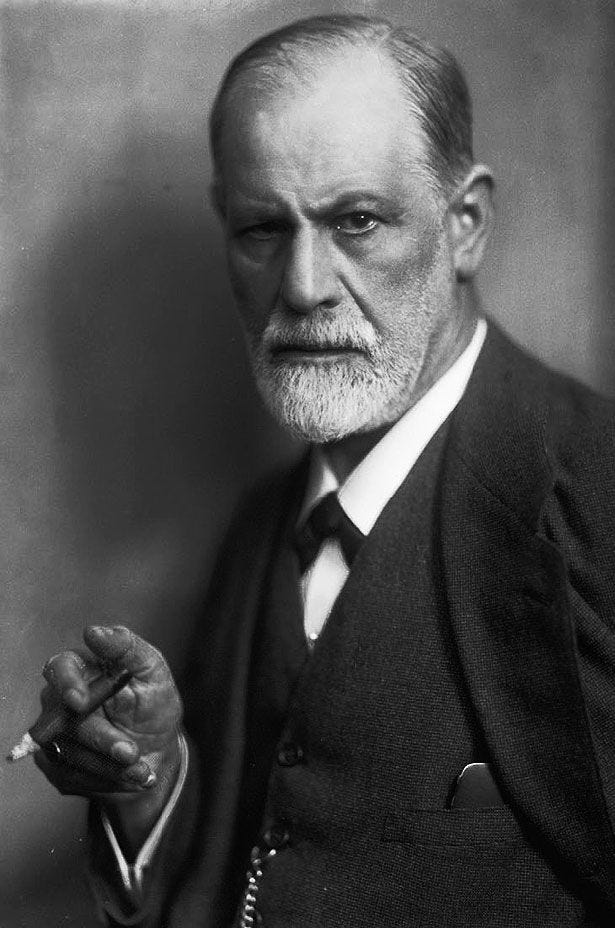
Sigmund Freud
Not to mention Einstein and his numerous affairs as well…
I share all of this to say… that it is probably very likely that the hostile environment van der Kolk created may have been the result of his own academic hazing, as academia is prone to exploit the free and underpaid labor of graduate students. Thus, when we consider how Porges and van der Kolk created their theoretical approaches whilst in the confines of the ivory tower of academia, it is important for us as consumers of their research to recognize that these men, while brilliant in many regards, were (and are) human and thus, they are prone to experience the follies of their hubris, which the competitive environment of academia exploits.
As all of us can become vulnerable to if placed in a similar environment.
The New Gods of Psychotherapy: Same Dogma, Different Day
I really had to refrain from using another euphemism in the title of this heading, but I’m sure I’ve given enough content clues to imply that whatever new theories or “evidence-based frameworks” are being published by respective academic journals are simply a rebranding of sorts of what has come before.
Moreover, this is not the first time we’ve seen stark shifts of the changing from the old to new “Kings” within the field of psychotherapy.
For example…
When psychotherapy first began in the late 1800s/early 1900s, it was primarily dominated by psychodynamic or depth-based approaches (i.e. Freud and Jung).
Then, in the 1930s/40s, behaviorism began to rise as a more “objective and scientific” view of the human psyche due to the high rates of PTSD from WWI and later WWII.
Yet, this view of reducing human behavior down to simply biology received backlash after some time, and thus, in the 1960s, the field saw the rise of more humanistic approaches such as Carl Rogers’ Person-Centered theory and Gestalt Theory as clinicians began to take a more compassionate, human-centered approach to treatment, which was likely influenced by the social activism of the 1960s and 70s.
Yet, as the “peace and love” revolution came to an end, so too did these old kings, replaced by a resurgence of more behavior-based approaches, such as Dialectical Behavioral Therapy, ACT, and CBT, which remained popular from roughly the 1980s through the 2000s. (Though it should be noted that CBT technically began around the 1970s, yet it did not become popular until insurance companies began funding research on it for clinical trials.)
And finally, in the late 2000s through our current era, we saw the rise in body-based or somatic approaches. Van der Kolk’s research, Porges’ Polyvagal Theory, and Levine’s Somatic Experiencing…but now it would appear that their reign is also coming to an end.
Meet the New Boss…
My reason for sharing this timeline is to simply demonstrate how fickle the field of psychotherapy truly is.
Psychotherapists, theorists, and researchers today are so quick to dismiss the wisdom of the past and establish ourselves as the “New Kings” that we forget that nothing ever truly exists in silos.
That each new theory that is created is the result of another theory or combination of theories that have come before it. Which is something I have tried to be explicitly transparent about in the construction of my own theoretical approach.
Thus while, specifically, Porges’ Polyvagal Theory may have gotten some things wrong, with regard to the dorsal vagus nerve function or his conception of the “reptilian vs mammalian” brain, I believe it is equally if not more important to acknowledge that Porges’ theory provided language for clients to understand the effects of the parasympathetic and sympathetic nervous system on the body and how those two responses can lead to the fight/flight and specifically freezing trauma response which for women, the importance of can not be understanded in helping them understanding their own bodily reactions in the face of threating situations in which escape or fighting one’s way out of a situation is not a viable option.

Was his theory perfect? No, but you know what? Albert Einstein thought that quantum mechanics was a hoax, and yet we still credit him for his theory of relativity, which many researchers have built their theoretical foundations off of within the field of physics.
And we see this trend in the field of psychotherapy as well.
Old theories get a rebranding or “face lift” when the pendulum swings back. When the field eventually goes from favoring highly cognitive, reason-based approaches to more intuitive relational approaches and vice versa.
Thus, this whole debate regarding van der Kolk and Porges’ work is simply just a shift in the changing of the courts between the new and old King, the mythic battle of the Holly and Oak Kings playing out once more.
Or to put it in more of an animalistic understanding, using one of my nephew’s favorite movies, it’s King Kong vs. Godzilla since we can never truly escape these mythical battles and their influence on us.

And as I observe this “shifting of guard” from where I stand with my yonic theory approach, which I have decided to keep in a grimoire format and away from the formal ivory tower of academia so that it can grow over time and adjust as it needs to, it makes me wonder about how, if I am lucky enough to make an impact with my theory as these men did, I too will be eventually “casted down” in favor of a new “king” or “queen”.
Since I too have gotten caught up in the competitive spirit of academia and found myself attempting to cast down much of Jung’s and Freud’s theoretical contributions early on in the construction of my approach. Yet, now having completed the initial structure and foundation of my approach, I now see both of these men and their work not as competition, but as peers and fellow researchers with a much more compassionate lens.
Knowing that, like them or even Porges and van der Kolk, I am also prone to my own hubris, I will inevitably be proven wrong or held up for scrutiny, which no doubt many people who have stumbled upon this blog or my Yonic Journal have already thought of.
And maybe this is just the nature of things, since often rebellion tends to be a necessary part of the growth process – as Jung himself had to destroy his old idol (Freud) to rebuild himself and his theory.
Yet, with that being said, I do think it is important to point out how the very nature of academia itself seems to reinforce this dynamic. Thus, perhaps the best thing any of us can hope for as theorists or researchers is that our work contributes enough to one’s field to be remembered or perhaps spark a deeper understanding of oneself or a phenomenon. A remnant that can go on to help other researchers, therapists, clients, and the greater humanity that can hopefully outweigh all the things we got “wrong.”
Which ultimately don’t we all wish to remember for our greatest contributions as opposed to our biggest flaws anyways?
OX
Your Dark Fairy Godmother
If you would like to learn more about Dr. Roby’s courses on her Yonic Theory approach, check out the resources below:
If you would like to donate to her Yonic Tarot deck creation fund, please do so through her ko-fi account: