

Sedlec Ossuary
The "Bone Church" and the Metaphor of the Womb

Throughout Europe, there exist many so-called “bone churches,” and during my trip to the Czech Republic or Czechia, I visited one of these morbid yet fascinating historical sites. Specifically, Sedlec Ossuary, a Catholic church located in the quaint Czech town of Kutná Hora, about an hour outside of Prague.
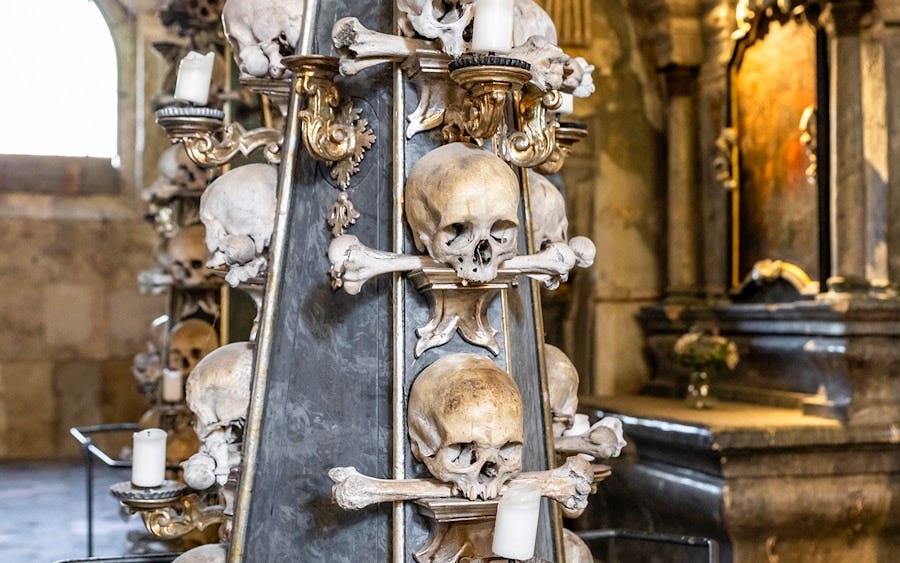
Now it should be noted that the Czech Republic and neighboring countries (Slovakia, Hungary, etc.) have a long history of paganism, which dates back to pre-Christian times, but reminders of these practices can still be found in many of their folk healing traditions (such as dying and decorating of eggshells during Easter and making corn husk dolls during the harvest season)…but I’ll be writing more about all of those later…
For now, let us focus on the history of building bone churches throughout Europe and what it can teach us about death, impermanence, and the dark feminine.
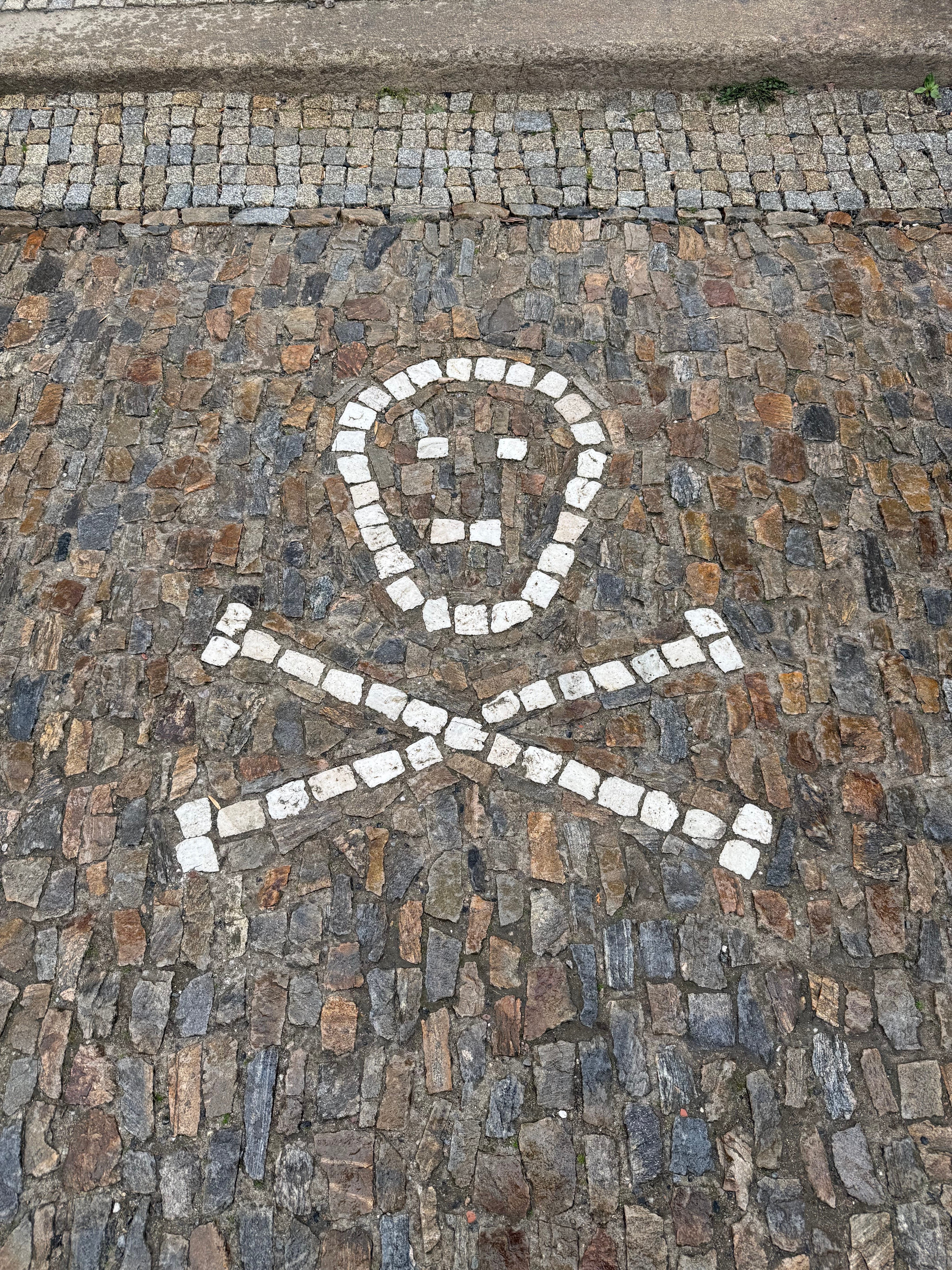
A photo of a skull and crossbones on the pathway I took outside the church (March, 2026)
As a disclaimer, all the photos of the church in this post are from Google, since photography is no longer allowed inside the church due to the large number of tourists who attempt to touch (or even lick) the bones and post those photographs online.
*Cue the phrase: this is why we can’t have nice things…*
These reactions, while juvenile and disrespectful, were probably these individuals’ attempt to cope with the single unifying force which has the ability to evoke fear in all of us…death…and what happens to ourselves, our bodies, and our souls after we die.
This is nothing new…
People have always coped with thoughts of death and the confrontation of the morbid in peculiar ways. Some of us (like the bone lickers), in our foolishness of youth, attempt to make fun of death for a laugh or get views. Others avoid it entirely and refuse to enter such places. While others become enthralled by death’s symbolism and create works of art to honor it - a memento mori or “reminder of death”.
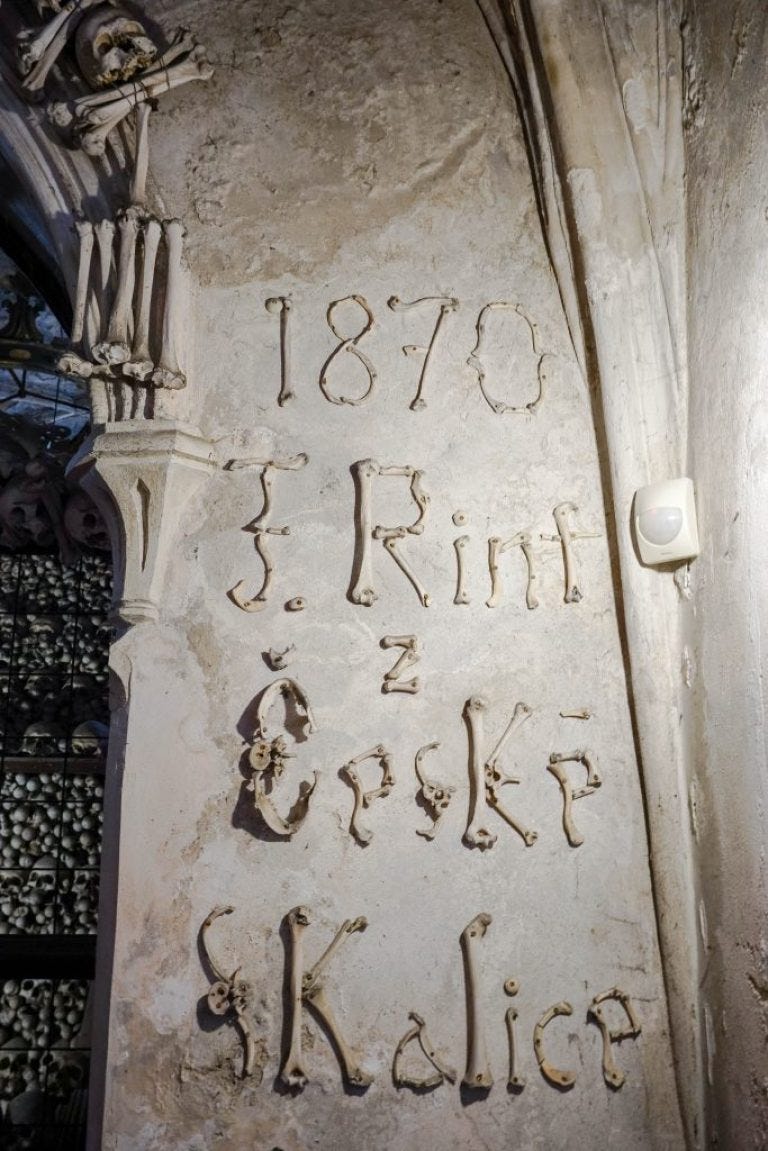
That is precisely what František Rint, a local woodcarver, did when he created his designs for Sedlec Ossuary in the 1870, using remains of between 40,000 and 70,000 people to create his works of art. Some of which he even used to sign his name.
But where did the bones come from, and how did they get there in the first place?
While it might be tempting to attribute the massive amounts of bones at Sedlec Ossuary to some sort of disaster like the plague, which did wipe out a large portion of the population in the 15th century, the original culprit of how the Bone Church got its bones is actually something we are all quite familiar with…
That answer is good old-fashioned capitalism.
“Holy Soil”: Money and the Fear of Death
Throughout the Middle Ages in Europe, as the Catholic Church grew into a powerhouse, it was not uncommon for Church officials to make “pilgrimages” to the Holy Land, Jerusalem, and bring back jars of sand or dirt from what they believed to be the site of Jesus’ crucifixion. One of these individuals was Abbot Henry of the Sedlec Cistercian Monastery, who in 1278 returned to Sedlec Ossuary (which at the time was just a cemetery) with a jar of this so-called “Holy Soil” and decided to sprinkle it over the land in order to make it a popular (and expensive) destination burial site.
Because even when contemplating death, us humans seem to be preoccupied with our own greed and desire for vanity.
Now…whether or not this “holy soil” was truly from Jesus’ crucifixion site remains unknown, since, as most of you can probably deduce from this blog, when it comes to anything having to do with the Church during the Middle Ages, I tend to always approach anything medieval Catholic Priests said with a healthy dose of skepticism given their involvement with what would become crusades and the Witch Craze…
But nevertheless, whether it was to offer dying individuals and their families “salvation” or perhaps just a nice way for the Church to make a pretty penny, the concept of being buried in a cemetery that had this “Holy Soil” for a chance to be closer to God as a way to guarantee one’s entrance into heaven spread throughout Europe. Meaning that these plots of graves were sold to those families of affluence at the highest bidder. Thus, these “Holy Sites” like Sedlec Ossuary and others throughout Europe began to attract individuals far and wide who sought to be buried in these so-called “Holy” cemeteries.
Yet soon this posed a new problem for the Church…
You see, the thing about cemeteries is that they are limited in size, and thus, when the Church ran out of land, they had to come up with a new and creative solution to keep making money.
Namely, they had to find a way to get rid of the bodies so that new ones from richer and more affluent families could be buried there.
So, in the 1400s, a Gothic church was built in the center of the cemetery, and thus older remains (i.e., bones) were exhumed and placed in a lower chapel (the ossuary) to make room for new burials. Moreover, this exhumation of bones of the previously wealthy families who had been buried in the cemetery happened to coincide with the Black Death and the Hussite Wars, which meant there would now be more bodies and, therefore, bones, which would need to be housed who couldn’t afford the newly “renovated” richer burial plots. Thus, this lower chapel served as a sort of collection ground of the dead, for both rich and poor alike.
The struggles of inflation and increased rent prices, am I right?

Over time, these bones grew into quite a large collection of human remains, so much so that when the Schwarzenberg family purchased the property in the late 1800s after the monastery was dissolved, they hired the woodcarver-turned-bone artist, František Rint (whose signature is pictured in bones as I previously mentioned), to organize the bone piles (see below).
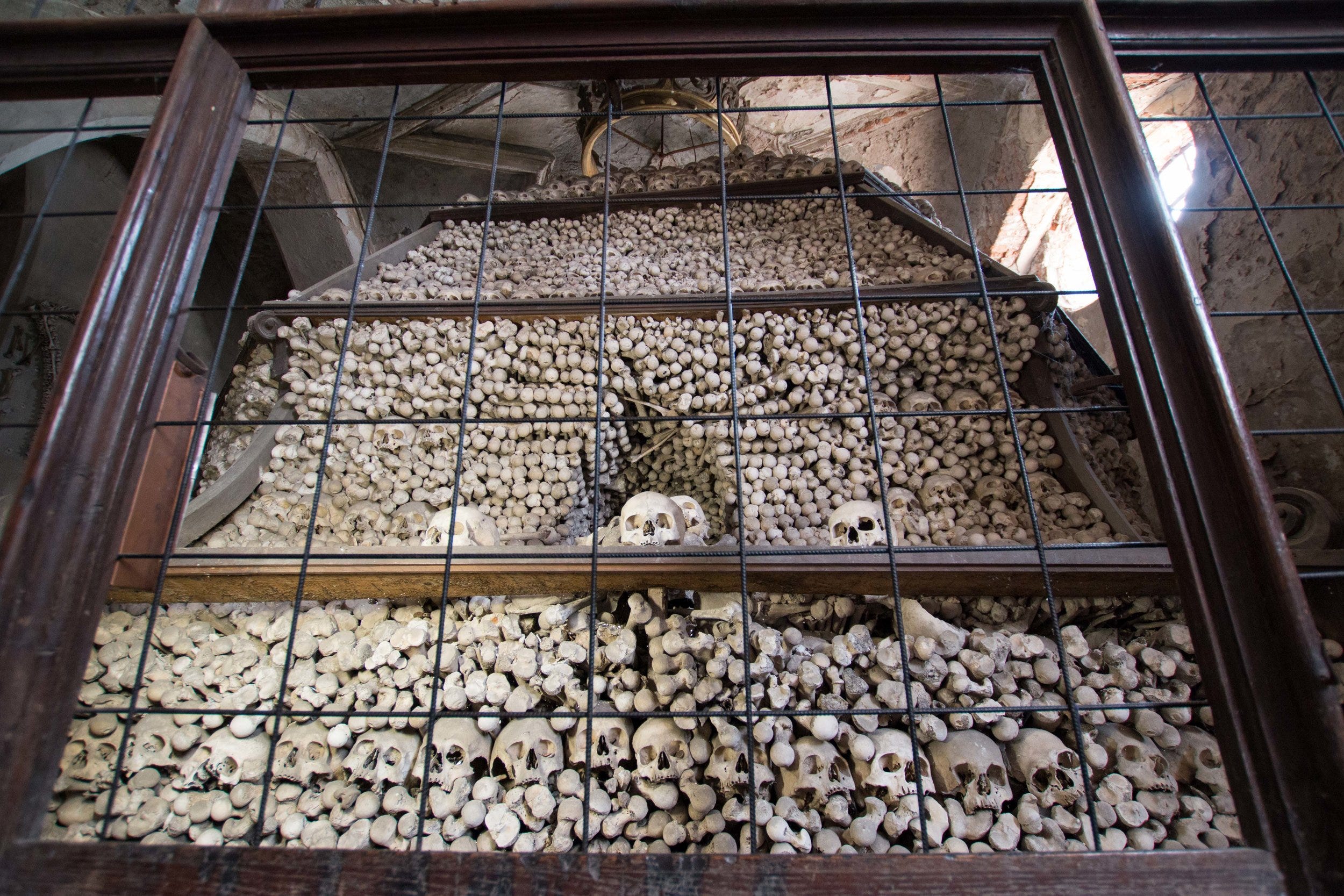
And his masterpieces can still be seen today, such as the famous bone chandelier, which supposedly contains at least one of every bone in the human body….
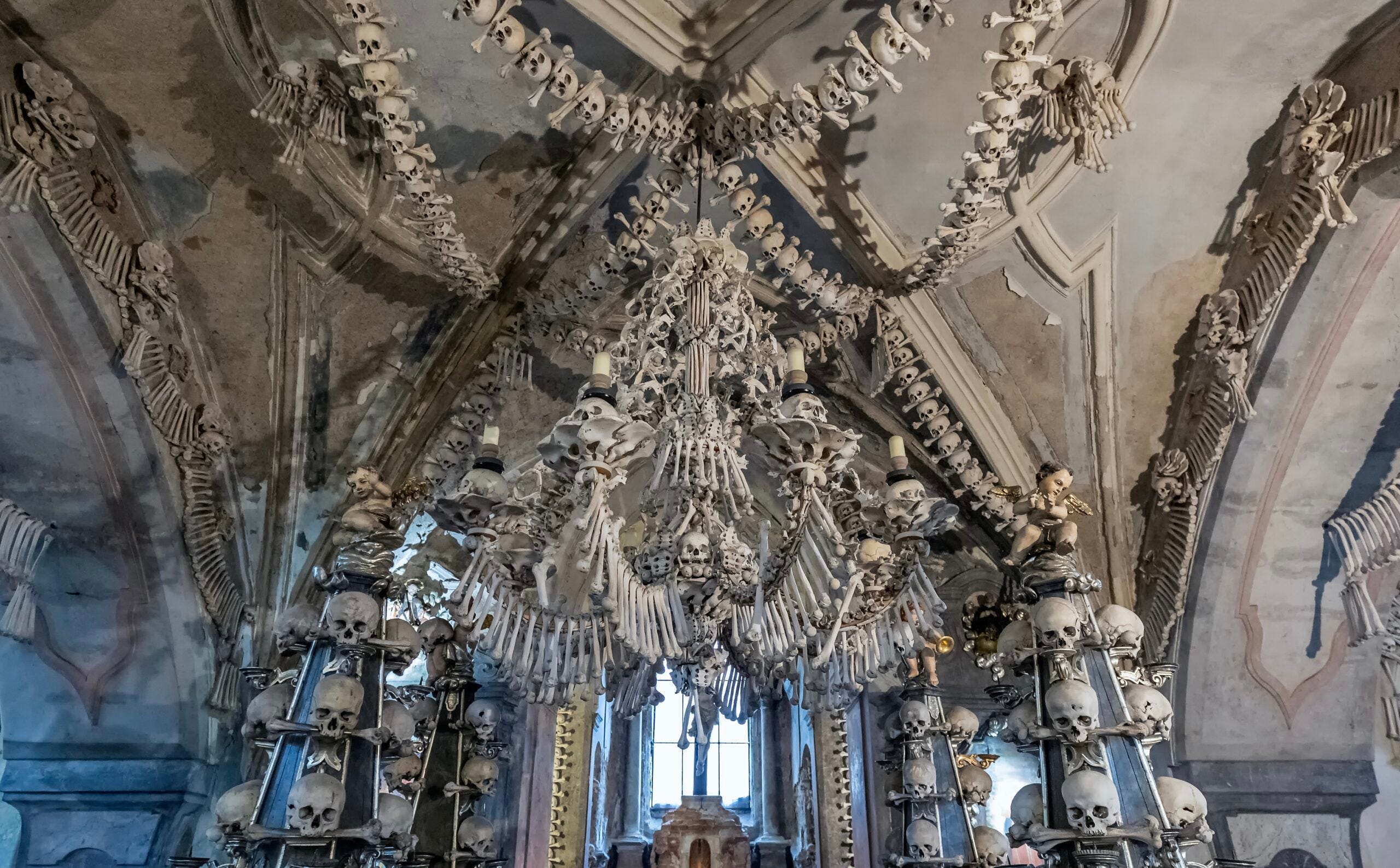
Or the Schwarzenberg Coat of Arms, the family’s crest, which, in a very on-brand morbid fashion, features a raven pecking at the severed head of a Turk whom the Schwarzenbergs defeated during their rise to power.
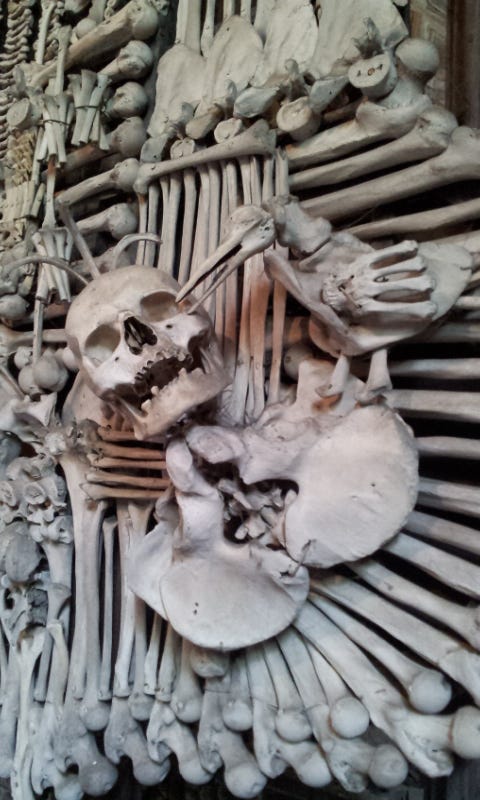
Thus, concludes the story of how the “Holy Soil”, which was once used to bury the noble and elite or Europe, became a sort of manufacturing plant for human remains, which would eventually be used to create the morbid works of art now housed in Sedlec Ossuary or the “Bone Church.” Although it should be noted that in other bone churches throughout Europe (Italy, Poland, Spain, etc.), this story is also very similar, as human ingenuity always finds creative ways to deal with an abundance of bones in limited spaces.
All that to say that while my telling of the factual account of this practice might come off as a bit cynical, the truth is I think there is a lot of beauty and wisdom in these bone churches, like Sedlec Ossuary, which can be easily overlooked.
Especially, in regard to what they can teach us about death and returning home to the dark feminine…
Church as Metaphorical Womb
A common, lesser-known fact that I remember first hearing about when I was 12 or so, during the Homily portion of Sunday mass in my family’s Catholic church, was that in the 3rd and 4th centuries, many church officials viewed the church itself not as a building but as the Mater Ecclesia or “Mother Church.”
Take, for instance, this quote by St. Cyprian of Carthage:
“You cannot have God for your Father if you do not have the Church for your Mother.” (Puchkova, 2025).
In full transparency, I had blocked this statement out of my mind until my recent travels throughout Eastern Europe and Germany reminded me of it.
Yet beyond this statement, if we consider how the Church has used a more direct metaphor of the womb throughout history, it isn’t too difficult to see how the archetype of the Church itself is not only symbolic of the womb but also of the dark feminine.
For example, Saint Augustine and others often described the baptismal font as the uterus or womb of the church (Flierman & Rose, 2019) due to its yonic nature and how the holy water within its basin might be symbolic of the inutero fluid present within the womb. Moreover, Puchkova (2025) argues that this metaphor was deliberately done by the Catholic Church to evoke the symbolic imagery of the metaphor of a mother bringing a child into the world via the process of giving birth, which these men believed was similar to how the Church “gives birth” to a believer into spiritual life through the holy water of the baptismal font. Which, of course, was a reference to Goddess-worshipping healing practices that were still used by the female folk healers of this region (i.e., the Church’s “competition”) (Puchkova, 2025).
Thus, if we look at the shape of churches, which Carl Jung even argued were quite yonic in appearance, with their traditionally thick walls, dimmed lights, and echoing acoustics, they are designed to make us feel contained or “held” within the symbolic womb of the Mater Ecclesia.
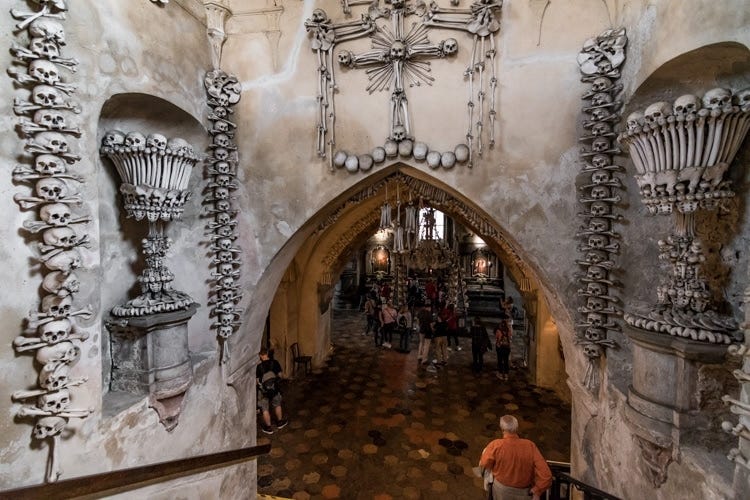
To evoke an otherworldly sensation of being connected to something divine, something greater than ourselves, by entering a womb-like space to experience this transcendent process.
Thus, in accordance with my Yonic Theory approach, which you can learn more about through my intro course on my website. This metaphor of a womb as a container is not only indicative of the technique I refer to in my theory as the Yonic Principle™ but also of the dark feminine function I refer to in my Yonic Theory approach as the Aura function. Or rather the function which one must integrate in order to access their connection to the feminine principle of Soul/Psyche, which is needed to facilitate the process of self-actualization by evoking a metaphorical “rebirth”.
Thus, when we think of these bone churches in a way, they are quite poetic since we can think of them as containing the physical remains of human souls (i.e., bones) within a womb-like container (i.e. “Mater Ecclesia”).
In other words, they serve as a reminder that no matter who we are in life, whether we are rich or poor, fat or thin, a nobleman or a commoner, we are all reduced to bones in the end.
When one visits these bone churches, it is impossible to tell which bones are that of a rich person, buried in the original “Holy Soil,” on the earth in which the church sits, or if they were of a simple background and thus just happened to be victim of the many wars or plagues that Europe has experienced across its history.
The bones all look the same, thus reminding us that even though we might encounter varying experiences in life, we ultimately return to the great cosmic womb or void of the ultimate mother, which I refer to in my theory as the Anima Mundi, or “world mother”.
Thus, while the bone churches are a symbol of memento mori or to remind us that “death comes for us all”, they also provide a beautiful metaphor for understanding death, and its connection to the womb (and therefore the dark feminine).
Because, in death, we return to the collective, back to the void and great womb from which we all derive. The Ego or “Spirit” masculine principle is released, and we become merged with the other (the “I” to the “we”).
Thus, by confronting our fear of death, we are truly facing our own awareness of our vanity and the importance of remembering our connection and responsibility to others, as well as to future and past generations.
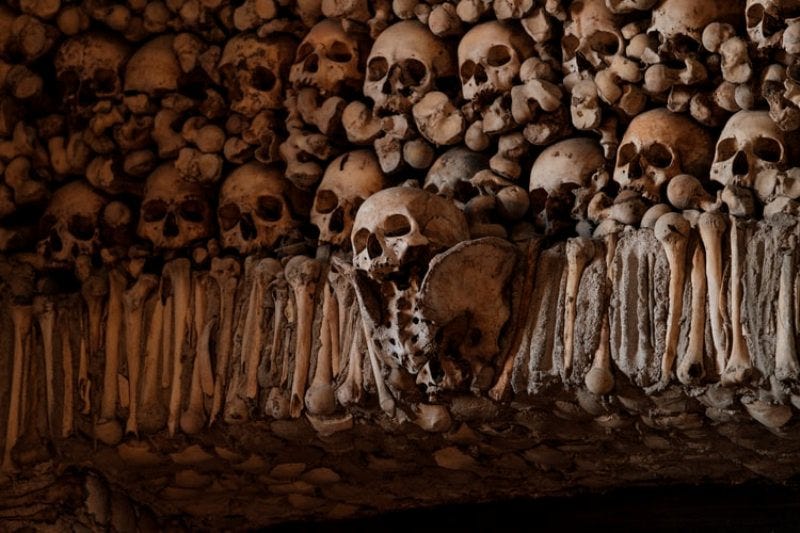
Something our pre-Christian ancestors saw the value of, and can even be found in the yonic symbolism of the bone churches throughout Europe today.
That ultimately, to remember death is to honor our return to the womb and thus surrender to the feminine.
OX
Your Dark Fairy Godmother
To learn more about my Yonic Theory approach, purchase the Yonic Theory: The Foundation course through my website or explore my Yonic Journal, which serves as my sort of living “grimoire” for my research.
Resources:
Flierman, R., & Rose, E. (2019). Banished from the company of the good: Christians and aliens in fifth-century Rome. Al-Masāq, 32(1), 64–86. https://doi.org/10.1080/09503110.2019.1682864
Puchkova, S. (2025). The womb of flame: The pre-Christian origins of a Greco-Syrian baptismal metaphor. The Journal of Ecclesiastical History, 76(3), 493–512. https://doi.org/10.1017/S0022046925000077