

Stop Calling Healthcare Workers Noble
How the Madonnainzation of Healthcare is Killing Us

Over the past decade of my career as a psychotherapist, I have heard well-meaning family members, friends, strangers on airplanes, and men I’ve been on dates with all say the same thing.
“You are so noble to do the work you do.”
And I have wanted to punch them all in the face.
*cue feminine rage*
Because let’s be real, what is actually being said covertly in that message is “Thank God, you are the one carrying the burden of taking care of others and not me.”
In other words, by madonnizing you, I get to absolve myself of my own human responsibility to care for my fellow humans. By placing the burden on you, I no longer have to feel guilty for failing to show up for my less fortunate brothers and sisters. By madonnizing all healthcare workers, I get to move through life believing that all helping professionals want to be self-sacrificing, which means if you experience any pain, suffering, or trauma from your experience, well, you choose it, so then it is all your fault and not a reflection of a larger systemic problem.
The Idealization of Feminine Sacrifice
Our society loves to praise martyrs. For fuck sake we turned the Virgin Mary, the O.G. Madonna, into one.
The Virgin Mary was praised for her endless care and compassion she extended towards her son Jesus, despite her being shamed for becoming pregnant before having relations with her husband Joseph. While Christians love to believe that it was God who magically impregnated Mary, the truth is that Mary was probably a likely participant in a ritual known as hieros gamos or the “divine marriage,” which dates back to Neolithic cultures and Goddess-worshipping traditions. Thus, during this ritual, Mary would have been seen as the embodiment of the Goddess, and a male individual, perhaps Joseph or someone else, would have been chosen to represent her male God counterpart.
In other words, Mary would have been an active participant in this ritual. She would have considered it to have been a great honor, just like her male counterpart would have. Moreover, according to Jungian Analyst, Nancy Qualls-Corbet, both the man and woman who participated in these rituals would have made sure that both parties were satisfied completely (i.e. orgasm) because it was thought that to appease the Goddess and her male counterpart, sex should be enjoyed and seen as a sacred gift.
Thus, her pregnancy, unlike what we are told in the Christian tradition, wouldn’t have been seen as a burden or something she would have had to shoulder as a martyr. In fact, it would be the opposite. A blessing from the divine powers themselves.
Yet in a patriarchal society, a society which is hellbent on keeping women in what I call their Veil functions, or those aspects of themselves which only embody the light feminine or aspects of femininity which women are praised for by men, Mary’s divine sexual act would need to be seen as something condemning, not pleasurable.
Thus, in order for Mary to still be considered a goddess, while simultaneously devaluing her feminine power, men decided to make her a martyr.
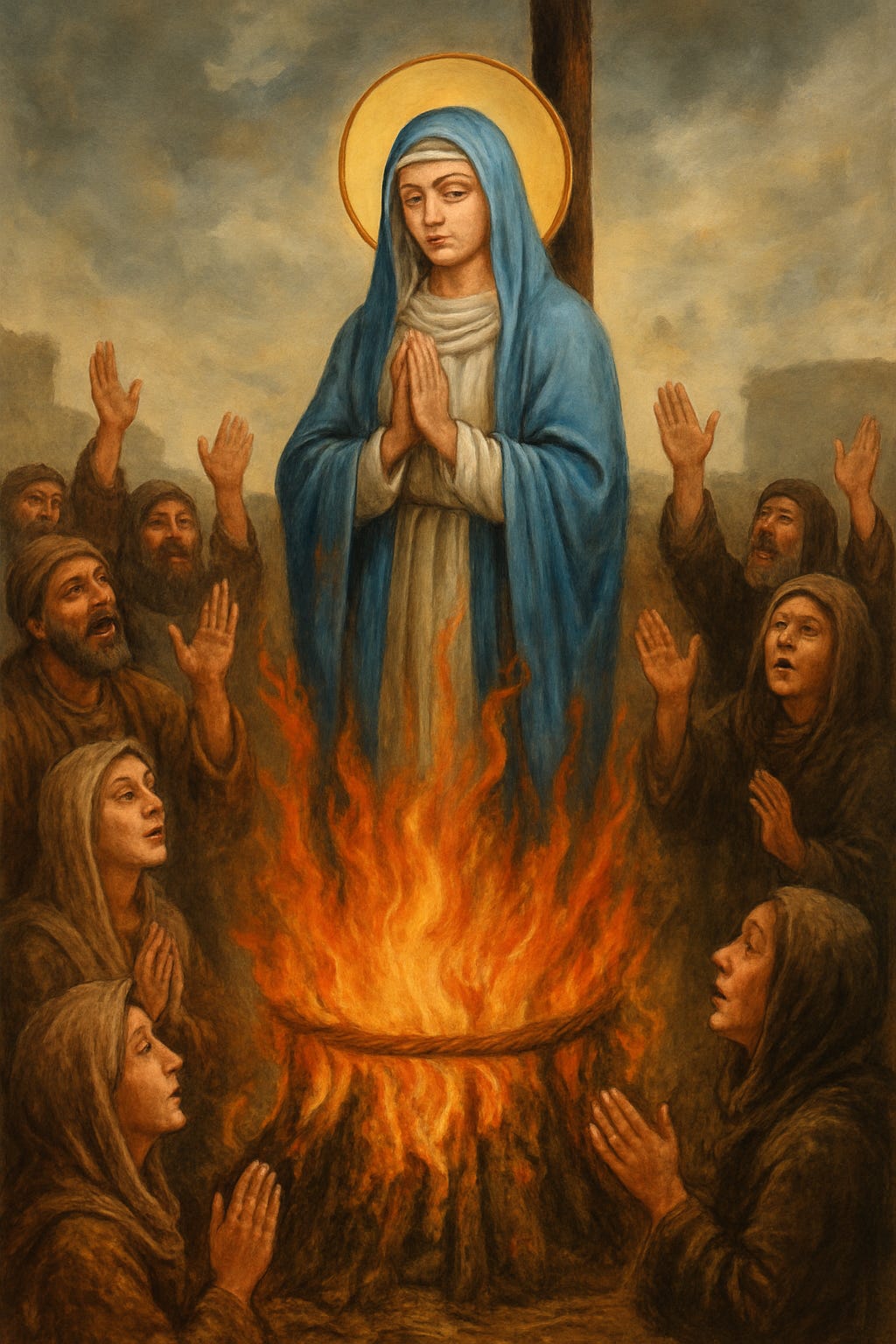
Image generated by AI
It is a tradition as old as time. Whether it is Joan of Arc being burned at the stake, or Pocahontas throwing herself on top of John Smith’s body in the Disney adaptation of the story, which glamorizes John Smith’s seduction and grooming of the young 12-year-old girl. (Though in some sources, she was said to only be 10 years old.) We also see women being praised for their martyrdom through historical figures like Queen Elizabeth I of England, who chose never to marry, staying “married to her country.”
Ultimately in our society, we love a woman who sacrifices her desires, her wants, and most importantly, her life for others.
If she doesn’t, then she will be forced to atone for her refusal to comply with the system, by society calling her a witch and burning her at the stake.
Which brings me back to the Madonnaization of healthcare workers.
Patriarchy demands feminine sacrifice; it always has and always will. If women, or those who are in fields that require feminine labor (i.e., emotional labor), don’t give it up willingly, then we will chastise them accordingly.
And this is especially true for Black women, whose bodies have been used without their permission by doctors throughout history. Moreover, during periods of enslavement, these women would be subjected to sexual assault and forced pregnancy, which would often result in their sons and daughters being taken away from them and sold off for profit.
To make matters worse, these women would sometimes become wet nurses for their white plantation owners’ children. Meaning they would breastfeed their abusers’ children and be expected to caretake them accordingly, while their own children were put to work in the fields or sold off without their permission.
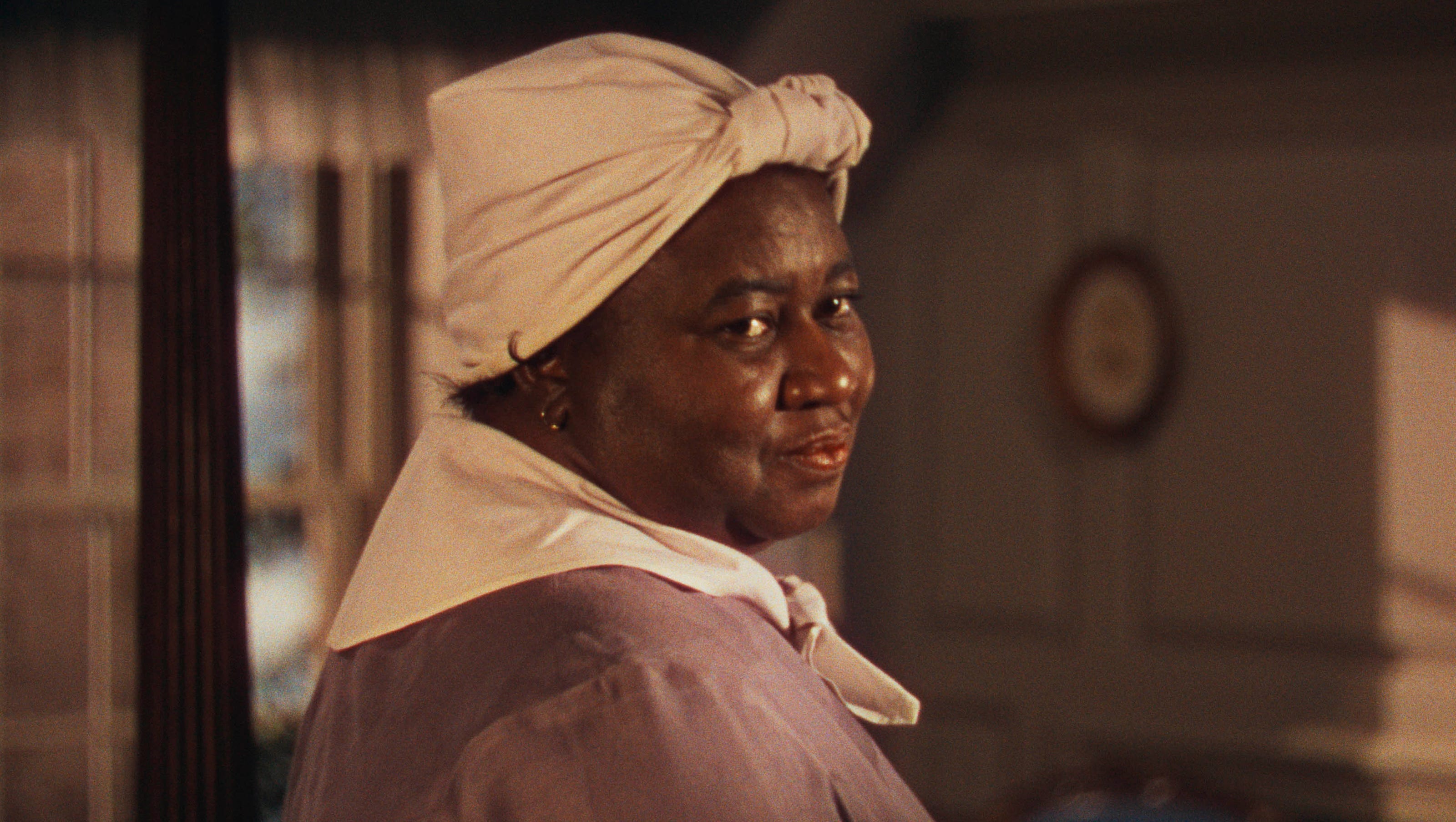
The character Mammy from the movie Gone With the Wind, played by Hattie McDaniel, is a representation of how Black enslaved women were often expected to perform feminine labor for their oppressors.
Talk about the ultimate feminine sacrifice.
But what does all this have to do with healthcare workers in our modern era? Surely, we humans have evolved past this, right?
Healthcare and the Commodification of Emotional Labor
In my most recent podcast episode, which you can listen to here:
Sex Workers, Sacred Prostitutes and the Madonnaization of Therapists

Be forewarned, listeners, this episode is a little controversial…
I referenced Arlie Hochschild’s 1983 book The Managed Heart: Commercialization of Human Feeling.
Often considered a foundational text in sociology, Hochschild examined how, within modern capitalist societies, certain jobs require employees to manage their emotions as part of the work itself. Thus, capitalizing on human beings’ ability to empathize, feel, and connect with others.
Moreover, she breaks down the difference between emotional labor, which I refer to in this blog post and others as “feminine labor,” because, in our society, we often associate emotions with the feminine or with roles primarily occupied by women.
In contrast to physical/manual labor or cognitive/mental labor (which are often seen as more “masculine” qualities) our society often views emotional labor as an invisible asset – one that comes naturally for women, who make up the majority of individuals in all healthcare professions (nurses, teachers, counselors, etc.) and well as other emotionally-labor intensive professions such as sex workers, flight attendants, customer service/receptionists etc.
Thus, I argue that many of these professions profit from these “noble” individuals’ (primarily women) ability to empathize and connect deeply with their clients. Thus, providing not only physical or mental labor when engaging with them (i.e., diagnosing, treating, documentation) but also considerable amounts of emotional or feminine labor as well (e.g., reflecting feelings, paraphrasing, building trust and connection, validating pain/suffering, etc.).
And all of this takes a toll on healthcare workers in particular, who are expected to perform this emotional labor while not being compensated adequately for it.
Hochschild, in particular, noted the difference between what she calls surface acting and deep acting when performing emotional labor.
Surfacing acting is when individuals fake emotions outwardly (smiling in a customer service job), but it doesn’t change how that individual feels internally. In other words, a customer service rep might have a bad day, but they can fake a smile without feeling like they have to completely discard their inner emotional experience.
Conversely, deep acting occurs when an individual has to genuinely feel the emotion required by the job. (i.e. empathy). For example, when a counselor is struggling with a sick child, a loved one, or is having a bad day, yet must compartmentalize their inner emotional experience to be present to their clients.
Hochschild noted that while both forms of acting predicted burnout, stress, and a sense of self-alienation, for those individuals who worked in professions that required them to engage in deep acting, these side effects were significantly worse (i.e., healthcare workers). She goes on to note that this type of heavy emotional labor has costs for the individual and for broader society, as individuals are more prone to burnout, depersonalization, and disconnection from their authentic feelings.
All factors that can be assessed for on The Maslach Burnout Inventory (MBI), which is often used to diagnose and recognize burnout among healthcare workers across disciplines.
Specifically, on the MBI, there are three factors that the inventory assesses for:
1. Emotional exhaustion
2. Depersonalization
3. Reduced persona accomplishment
Yet it should be noted that researchers believe emotional exhaustion is by far the most critical of these factors, as it leads to the development of the second and third factors in this triad.
Moreover, we have evidence to support this. A 2021 study by Cook and her colleagues noted that emotional factors were by far the most significant predictor of burnout among novice counselors.
In other words, it seems like it is not a matter of if healthcare professionals will experience burnout, but rather when, which can be directly tied to the amount of unpaid, emotional, or feminine labor they are expected to perform as part of their jobs.
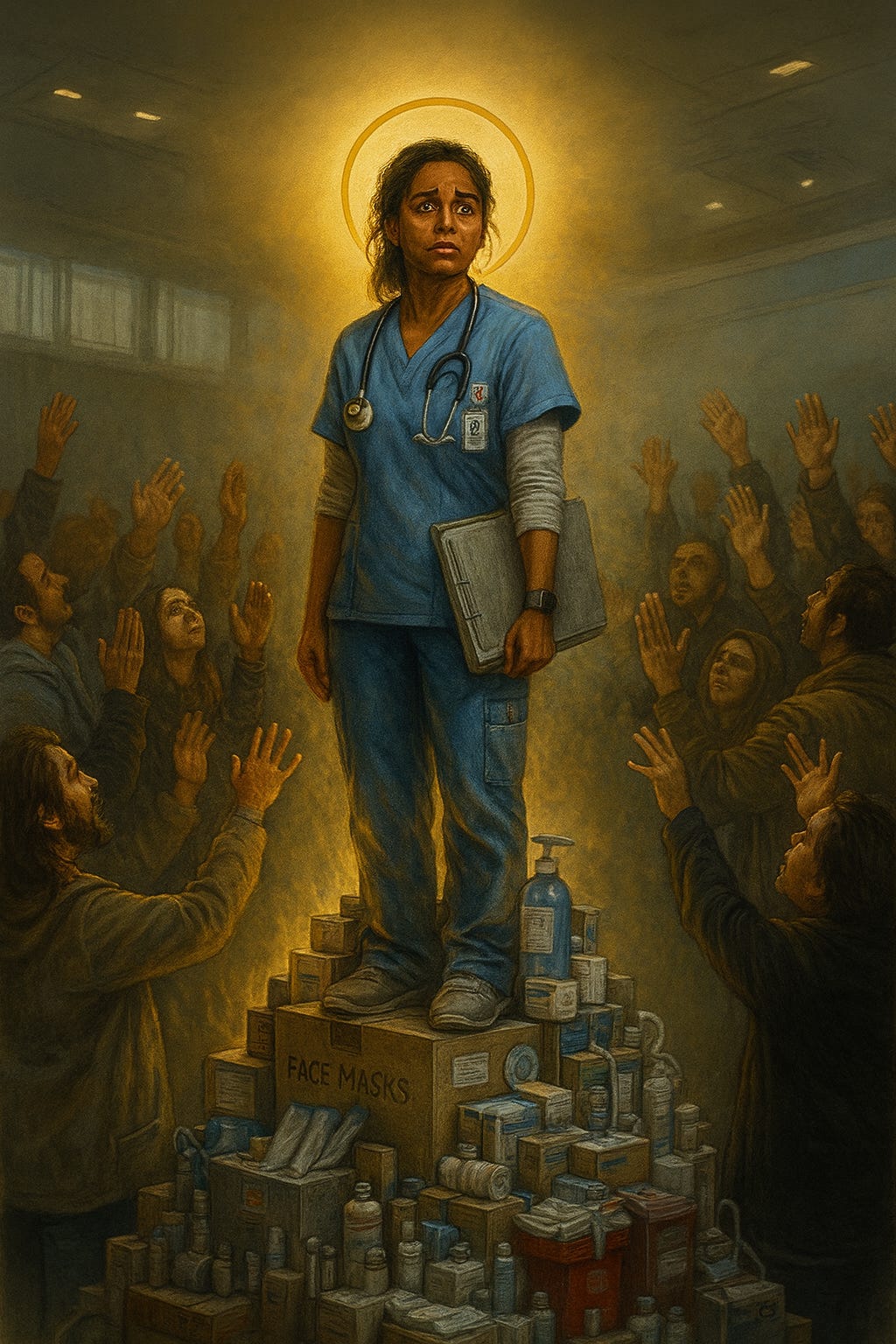
Image generated by AI
And this type of emotional labor is nothing new. Society has always expected this of women.
It’s how your wife or mother magically cleans up your dirty dishes, cups, and other items around your room or house without you having to thank her. Or how she remembers everyone’s birthday or their favorite meal for dinner. How she is expected to wake up at 1, 2, 3, and 4 AM to take care of the baby and be present for every soccer game, ballet lesson…all while wearing a smile and covering up the bags under her eyes.
We praise women, mothers, and healthcare workers for their nobility and for acting like perfect Madonnas. Self-sacrificing goddesses like we were told the Virgin Mary was, but do we ever think about the cost that comes with being so noble?
The Cost of Nobility
Over the past month, I have checked in with many of my counselor friends, and this is an overview of many of our shared experiences:
I would say that among the roughly 10 counselors I chatted with, the majority of us felt emotionally exhausted almost every day. They described feeling exhausted to the point of not wanting to get out of bed in the morning, so much so, sometimes they would even skip their morning showers or breakfast. Many of them also reluctantly disclosed to me that they might have had one too many glasses of wine or have found themselves gravitating to food or using their THC edibles/vapes to “take the edge off” after a long day of work. If they weren’t using food or substances to cope, some of them described watching TV and being unable to even remember what show they watched, or even overusing exercise as a means to avoid focusing on work.
However, by far the most common “symptom” was unexplained somatic complaints, backaches, tummy issues, IBS, and an overall sense of tension.
Yet, only a few of them were brave enough to describe their symptoms as burnout.
Instead, what I heard was the instance that they were “fine” and that I didn’t need to worry about them. They said things like:
“I might be tired, but this work is SO REWARDING”
or
“It’s really NOT THAT BAD.”
or
“I’ll take care of myself later, once things slow down. It’s just a really rough time of year for my clients, and I need to be there for them.'“
These were all the same phrases I used to use before I got diagnosed with celiac just a year ago.
Before then, I would wake up every day with crippling back pain, which to this day I am still attempting to recover from, as I spent years absorbing other individuals’ pain and neglecting my own. All because I had learned to internalize the importance of being “noble” and putting other people’s needs above my own.
And this internalized Madonnaization of ourselves is killing us.
The 2024 Women’s Health Initiative found that women who reported high levels of caretaking stress had a higher risk of developing chronic autoimmune diseases. Additionally, the JACC State Of The Art Review found that chronic psychosocial stressors, such as caregiving stress, discrimination, and negative social experiences, were strongly associated with increased cardiovascular disease risk for women. And these studies are just the tip of the iceberg.
Not to sound “dramatic” but…
In summation, women and healthcare workers are dying from carrying the emotional burden of caretaking.
Period. Plan and simple.
Women, who, according to the World Health Organization, make up around 70% of the health and social care workforce globally, are dying as a result of the chronic stress and emotional exhaustion they endure.
In my own family, I have seen this pattern as well. My aunt, who was an ICU nurse, would work herself to death. Coming home from the end of their shift to jump into their PJs and drink two bottles of wine just to be able to “relax” on her day off. This is not unlike some of the coping strategies I found myself using in my own life to manage the stress of my job as a therapist. Moreover, we see this same pattern in shows like Nurse Jackie, which give us a glimpse into how slippery the slope of addiction can be for healthcare workers.
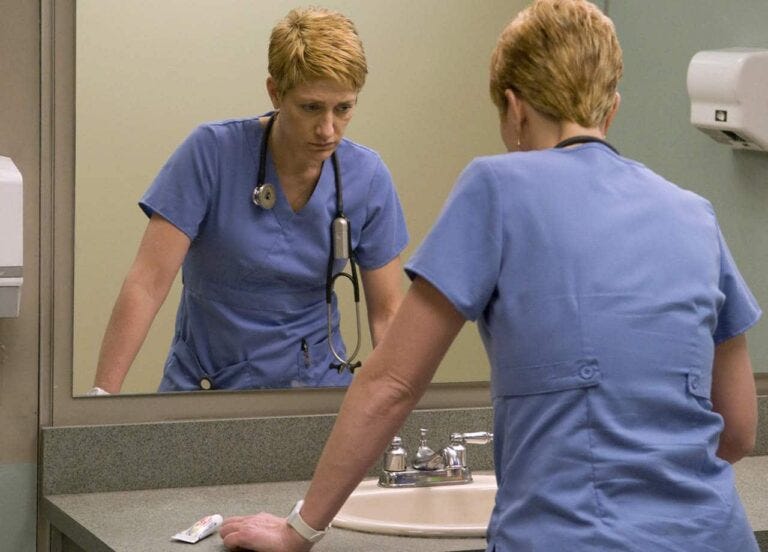
Edie Falco in Nurse Jackie
Moreover, this behavior isn’t that abnormal; we know that military veterans who experience PTSD are more likely to use drugs and alcohol to cope with their symptoms.
Yet we shame healthcare workers for attempting to cope in the same way.
During my educational training as a counselor, I was told that above all else, what I needed to avoid was burnout. the fear of being “impaired” scared the fucking shit out of me.
This is not unlike what we do to mothers when we shame them for discussing the realities of motherhood and how being a caretaker isn’t all sunshine and roses.
Often, the individuals we are “caretaking” can be disruptive children, or angry patients who spit at us, or sometimes even physically assault us, as one of my counselor colleagues noted would frequently happen to her when she worked in an inpatient unit.
I’ve heard therapists share about how they were stalked or threatened by disgruntled clients, or even their clients’ ex-abusive partners.
As if that weren’t bad enough, therapists, nurses, teachers, and all helping professionals must not only pay for their education for careers they nobly choose to pursue when no one else will do them, they also are expected to work 60 + hour weeks, be able to maintain rapport with clients while finishing mountains of paperwork, and deescalate crisis situations at the drop of a hack.
Which begs the question, if counselors and healthcare professionals are being so “noble,” who the fuck is looking out for them?
Where are the laws that protect healthcare workers? Where is our compensation?
Do we ever get to stop being the Madonna and eventually find peace?
Or are we just being tied to a new stake to be sacrificed, and we don’t even realize it?
It seems to me that the word “noble” has become the new word to madonnize healthcare workers. That society loves to put us up on a pedestal, turn us into pseudo-goddesses, yet when we inevitably fall under the crippling pressure, we are the ones who are shamed and blamed for not “being able to handle it.”
Yet in reality, the system of healthcare is failing all of us, both patients and healthcare workers.
In truth, healthcare workers, therapists, nurses, and all other helping professions are under too much stress to provide proper care to clients, and we are being crushed under the weight of this expectation.
Much like how mothers have been crushed under carrying the burden of feminine labor and attempting to be like the Virgin Mary for centuries.
Between note documentation for insurance, having to perform copious amounts of emotional labor, being overworked, underpaid, and understaffed…it is a system that is set up to burn us out and then blame us for not being able to perform.
Just like how motherhood is both a badge of honor for women and a double-edged sword.
It is clear to me that our current methods of training and supporting healthcare professionals and women are not working. Feminine labor, now more than ever, is being exploited and co-opted by major insurance companies and tech tycoons.
It makes me wonder how many more healthcare workers like myself have to develop chronic health conditions or experience PTSD, depression, anxiety, and crippling burnout before we realize what is happening. Not to mention the risk of suicidal ideation, which is a less discussed phenomenon among healthcare professionals, but is more common than non-healthcare professionals realize.
If the fact of the matter is that these systems are inevitably going to burn us out, why is it that we shame healthcare professionals when they choose to segway into alternative professions? Why do we hold women and healthcare workers to such unrealistic standards, turning them into false goddesses, only to convince ourselves that the “work” itself should be enough to satisfy them and that they don’t need proper compensation?
The biggest lie our society tells us is that women and those in helping professions don’t need reciprocity or to be cared for.
In truth, these are the individuals who need the most care and compassion, and permission, for once, not to be so fucking noble.
OX,
Your Dark Fairy Godmother
For more articles like this, please consider subscribing or donating to support my research.
For those of you interested in learning more about the concepts mentioned in this post and looking to reconcile your inner goddess-witch divide, check out my goddess-witch spectrum course here:
Resources:
Ebong, I. A., Quesada, O., Fonkoue, I. T., Mattina, D., Sullivan, S., Oliveira, G. M. M., Spikes, T., Sharma, J., Commodore, Y., Ogunniyi, M. O., Aggarwal, N. R., Vaccarino, V., & American College of Cardiology Cardiovascular Disease in Women Committee (2024). The role of psychosocial stress on cardiovascular disease in women: JACC State-of-the-Art Review. Journal of the American College of Cardiology, 84(3), 298–314. https://doi.org/10.1016/j.jacc.2024.05.016
Golden, J. (1996). A social history of wet nursing in America: From breast to bottle. Cambridge University Press.
Hochschild, A. R. (1983). The managed heart: Commercialization of human feeling. University of California Press.
Maslach, C., & Jackson, S. E. (1981). The Maslach Burnout Inventory. Consulting Psychologists Press.
Parks, C. G., Pettinger, M., de Roos, A. J., Tindle, H. A., Walitt, B. T., & Howard, B. V. (2023). Life events, caregiving, and risk of autoimmune rheumatic diseases in the Women’s Health Initiative observational study. Arthritis care & research, 75(12), 2519–2528. https://doi.org/10.1002/acr.25164
Stone, M. (1976). When God Was a Woman. New York: Dial Press
Qualls‑Corbett, N. (1988). The Sacred Prostitute: Eternal Aspect of the Feminine. Inner City Books
Washington, H. A. (2006). Medical apartheid: The dark history of medical experimentation on Black Americans from colonial times to the present. Doubleday.