

A joke I’ve been telling a few of my friends lately is that I learned the meaning of life at 6 years old, watching my Cajun grandmother cook gumbo…
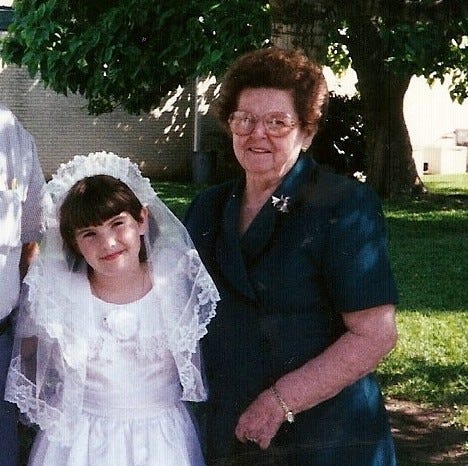
A photo of my 9-year-old self on my First Communion (like the “good” Catholic girl I was raised to be) with my grandmother, Marie.
While perhaps this may be a bit of an over-exaggeration. In truth, the practice of alchemy, which has been associated with the philosopher’s stone, ouroboros, and even Carl Jung’s notion of the transcendent function, is not so different in my experience from the art of making gumbo.
What Makes a Good Gumbo
For me, a good gumbo must have two things: Okra and what Cajuns and Creoles in Louisiana call the “Holy Trinity.”
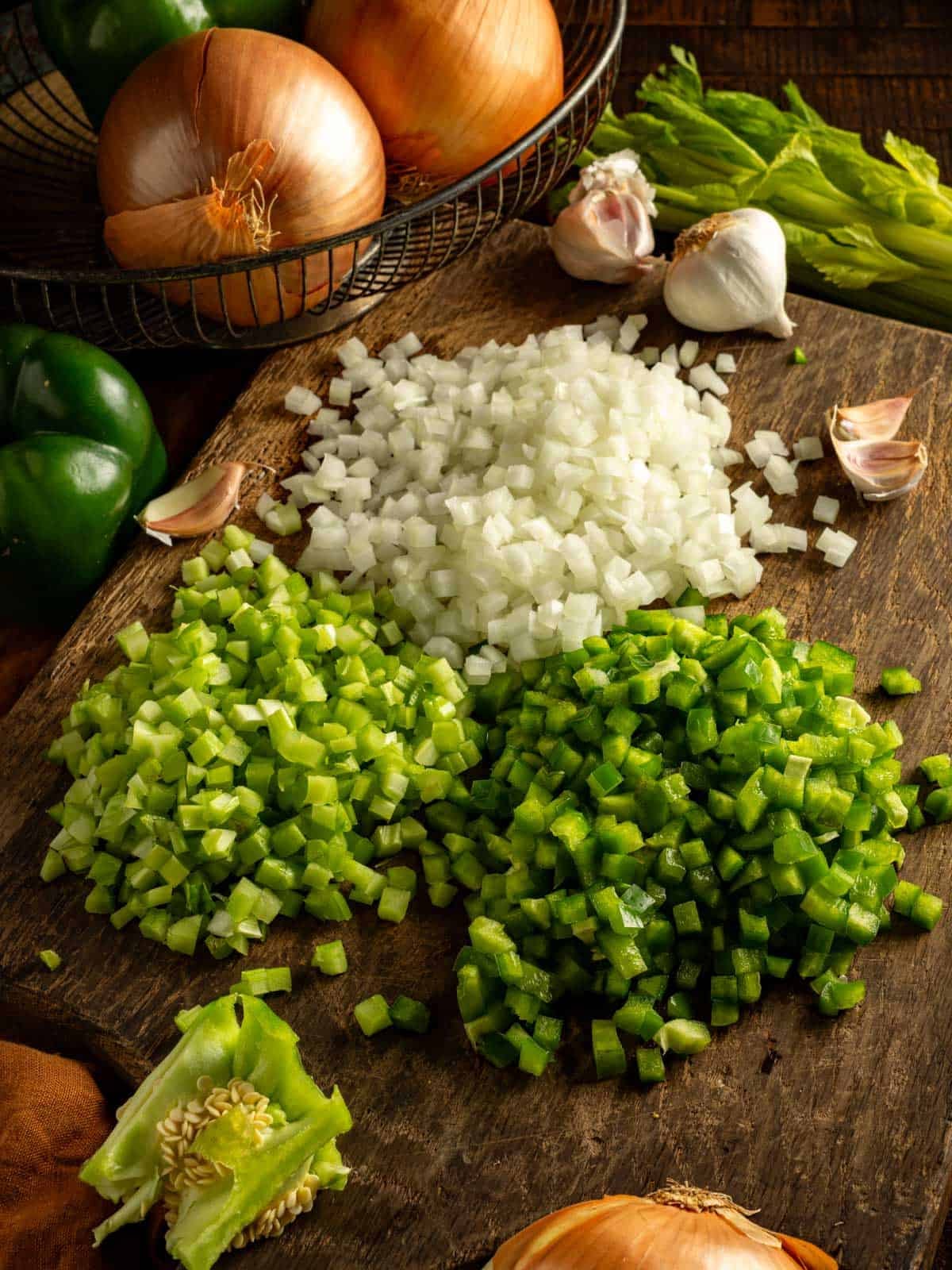
The Holy Trinity is a bit misleading because it is actually a mix of equal parts onion, bell pepper, and celery. Similar to the French mirepoix, which inspired this vegetable melody featured in many Cajun and Creole cuisines.
This is because Louisiana was largely under French rule for most of its history, aside from a brief period during which time it was owned by the Spanish, prior to its absorption into the United States. Therefore as more and more French settlers migrated from France to Louisiana they began to “blend” with the Afro-Caribbean and Indigenous peoples in the surrounding areas of New Orleans creating the “Creoles.” Thus this merging and blending of cultures and traditions created new forms of cuisine as a result of the use of local resources available to them.
Which brings me to the second ingredient, okra.
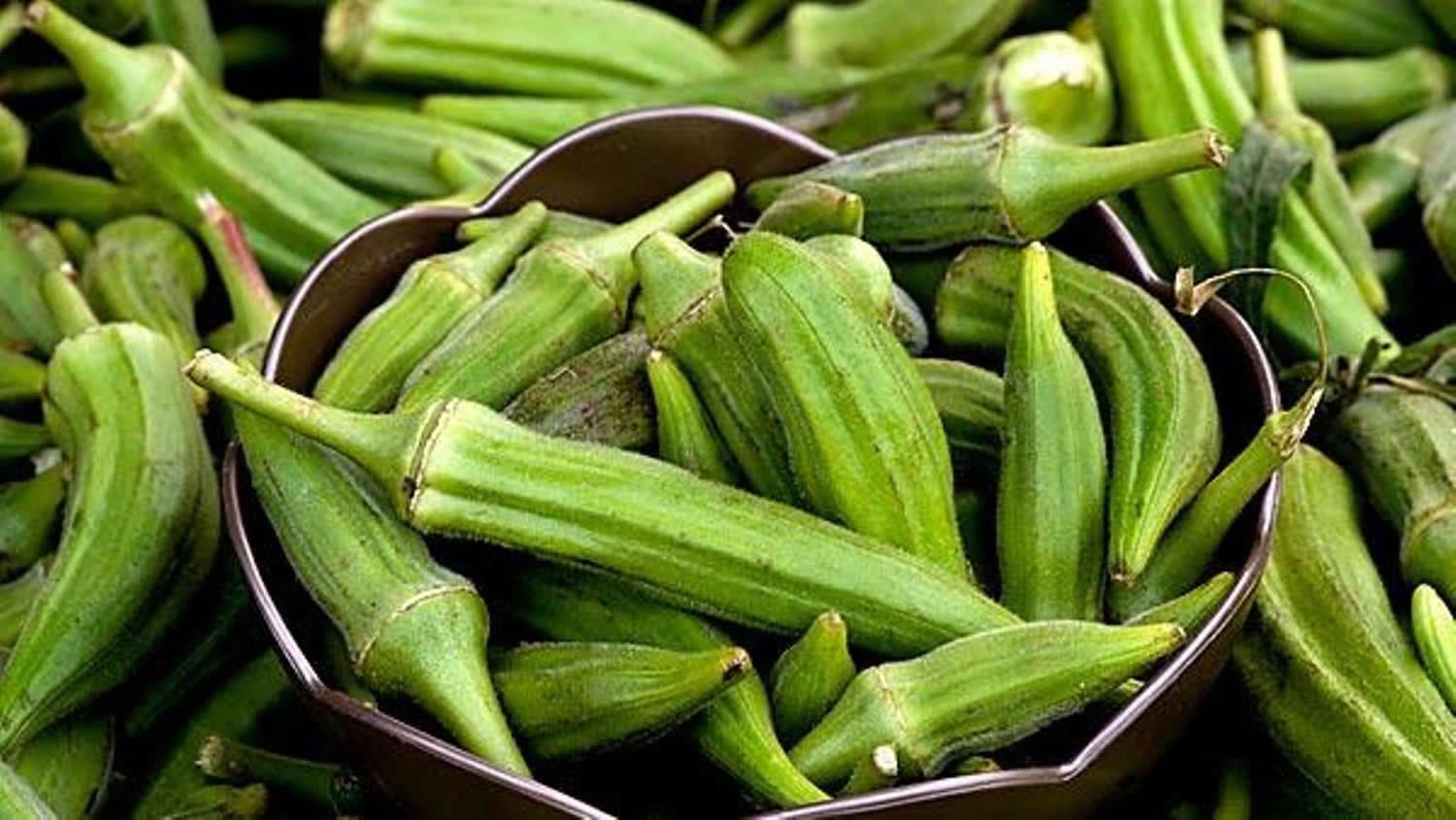
To me, gumbo is not gumbo without okra, because the word for gumbo itself is said to have derived from the African word for okra. Therefore, if one wants to properly make gumbo, they need both okra and the Holy Trinity to make it.
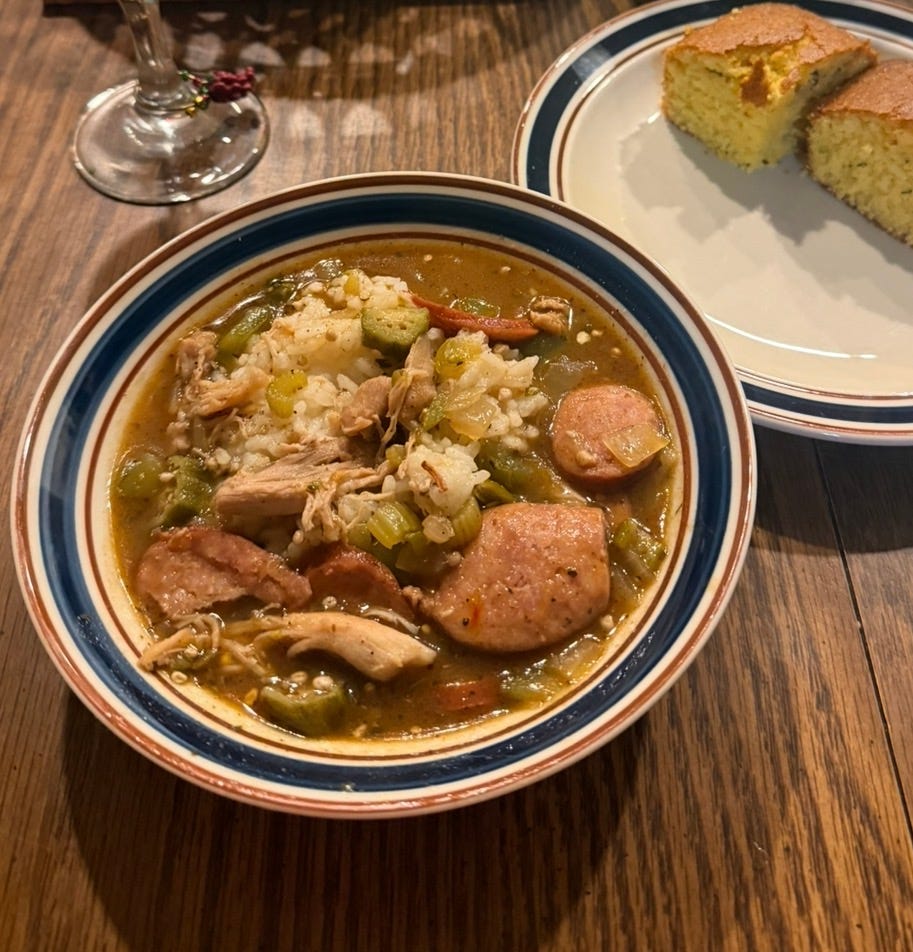
Picture of my most recent batch of gumbo during the past winter “freeze”.
When the Cajuns came to Louisiana through their own diaspora as a result of the Le Grand Dérangement during the Seven Years War, they also merged with many of Creole and Indigenous individuals within the swamplands (I.e. bayous) of Louisiana. Thus once again merging their cultural customs and traditions.
Thus, even before the process of cooking begins, gumbo teaches us a lot about life and alchemy. About how two very separate cultures (French and African) can merge together to create something new. As is true with many Louisiana-based dishes I saw my grandmother make, such as jambalaya, which is said to be influenced by the Spanish paella, and also features the Holy Trinity.
Therefore, cooking gumbo or jambalaya has always symbolized to me a connection to one’s past, roots, and heritage, and bringing together resources to create something new. Much like the Tarot card, the Three of Pentacles
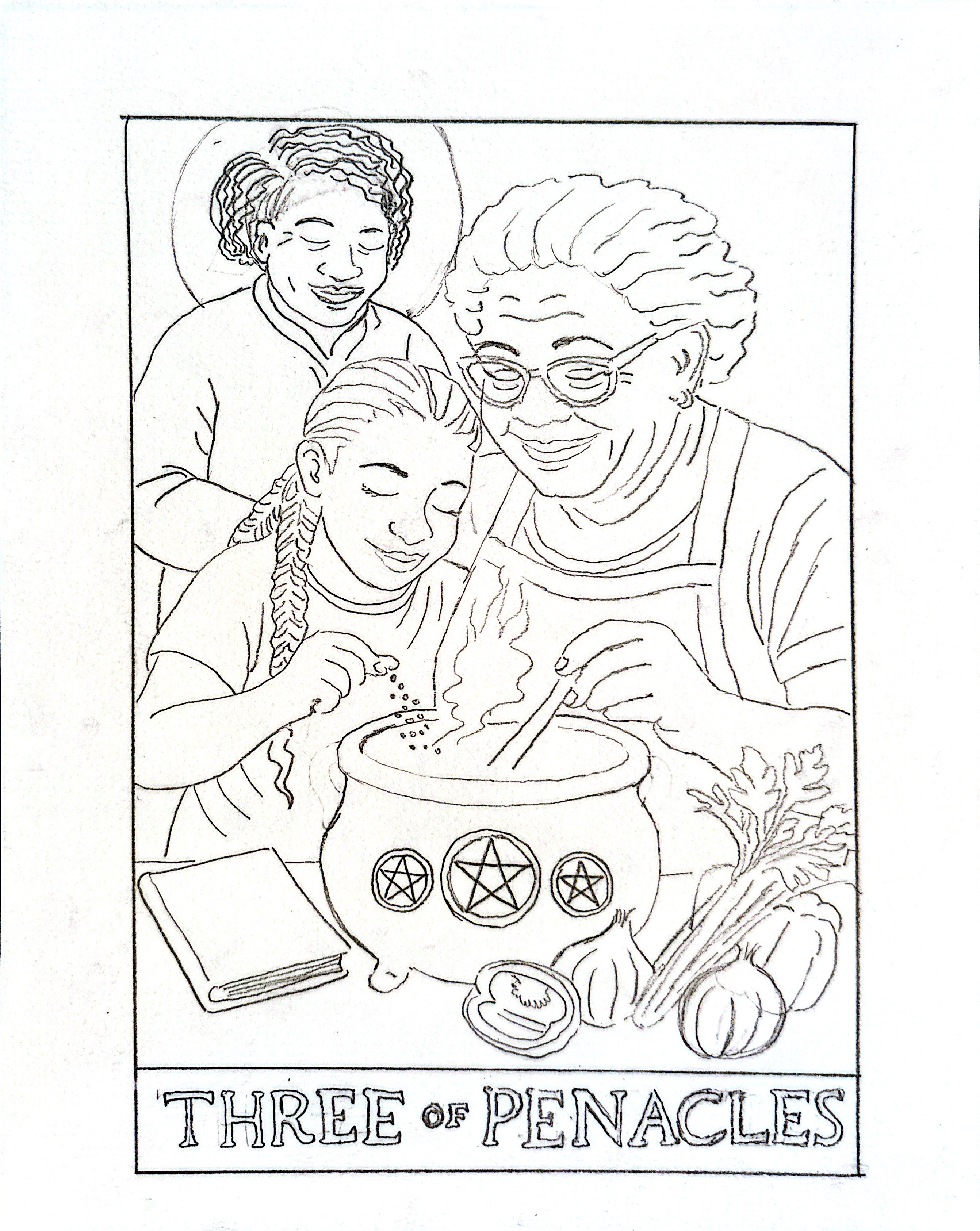
© M. Robichaux, 2026 draft of 3 of Pentacles for her Yonic Tarot™
In this image, we see a grandmother, her granddaughter, and a female “spirit” figure. (Perhaps the grandmother’s mother or another female relative.) Thus, there are 3 generations of women present. Or a maiden, a mother, and a crone.
Furthermore, to honor gumbo’s Afro-Caribbean origins, I decided to depict these women as Black or African American, which will be reflected in the final image of my design once I have added color to my cards.
Moreover, we see the Holy Trinity depicted in the bottom-right corner, symbolizing the “part” each of these vegetables plays in working together to create the gumbo, as well as the transmission of intergenerational wisdom.
Finally, in the middle of the image, where the 3 pentacles sit, we have the gumbo pot, or in this case, a cauldron, which is not only a direct reference to alchemy but to the womb or yoni itself.
The Alchemy of Gumbo
According to feminist scholar Barbara Walker (1983) cauldron’s have long symbolized women’s connection to their wombs, which I discuss in my latest journal article on my concept called the Yonic Principle™
To access this article or the Yonic Journal™ visit the link below:
Therefore, it is in the “womb” (i.e., cauldron) that opposing forces mix and merge with one another, breaking down to form something new.
Thus, if we compare the process of cooking gumbo to alchemy, it follows a similar pattern…
Feminist scholar and mythologist Sharon Blackie (2022) noted that Carl Jung was fascinated by the practice of alchemy throughout his life, which he applied to his understanding of individuation. Those three stages of alchemy Jung identified are nigredo, albedo, and rubedo.
In the first stage of nigredo, contents within the unconscious, or a gumbo pot, are “blacked.” In other words, they are “cooked down” so that they can soften and merge together. Much like how one must make a roux, by “browning” (AKA: cooking down) the flour and fat mixture to create the base for the gumbo.
In the second stage, albedo, fire and heat is used to transform the ingredients as the Holy Trinity is added to the pot. Thus, there is a breakdown of the ingredients’ old structure so that they can merge with the other ingredients. This means that instead of remaining separate from the roux, all the contents merge to create something new, leading to the third and final stage: rubedo.
This process is all done within the context of the gumbo pot, or cauldron, which reflects what I refer to as the Yonic Principle™. Thus, the womb is the vehicle through which this transformation occurs, much like the merging of opposites within a human womb might lead to the birth of a child if a woman chooses to become pregnant and carry that life to term. Or within the realm of psychology, the merging of one’s conscious and unconscious aspects to provide a symbolic “rebirth” of the Self.
Therefore, I argue, that much like the notion of the Holy Grail in many Arthurian legends, the grail or cauldron, or in this case, the gumbo pot, all symbolize the same thing – the healing powers of the feminine or the Yonic Principle™.
Therefore, as I said above, it appears that I did learn a great deal about the meaning of life at 6 years old from watching my grandmother make gumbo – only I didn’t have the words to describe what I knew at the time.
Or rather, this form of wisdom, which is inherently rooted in the feminine, wasn’t justified by the “knowledge” I was being taught to absorb through my educational training and Western male-dominated Spiritual traditions.
In truth, I think many mystics and male theorists like Carl Jung, while brilliant, spend their whole lives trying to uncover what women intuitively know. Namely, that alchemy, psychology, mysticism, the “divine” or whatever we choose to define it as, is not so different from nature itself. That it all circles back to the womb, and the merging of the opposites – the masculine and the feminine, or the conscious and the unconscious.
These opposing forces bump into one another, clash, merge, “make love,” and create something new. Something that has roots in both worlds, and yet at the same time, is unique on its own.
Just like gumbo.
Only this alchemy isn’t happening at fancy lecture halls or secret occult societies. It is happening right in the kitchens of our grandmothers. Created by the hands of the women who shaped us, who carried a piece of us when our mothers were being first formed in their wombs.
And I don’t about you, but that seems pretty damn magical to me…and perhaps we might consider that to be the purest form of alchemy.
OX
Your Dark Fairy Godmother
To learn more about the author’s Yonic Theory™ or her concept of the Yonic Principle™ purchase the article through her Yonic Journal or listen to her podcast episode on this topic below:
To support the creation of her Yonic Tarot™ please consider subscribing or making a one-time donation to her Ko-Fi account:
Reference
Blackie, S. (2022). Hagitude: Reimagining the second half of life. New World Library.
Walker, B. G. (1983). The woman's encyclopedia of myths and secrets. Harper & Row