

The End of the Melting Pot

When I was 22 years old, I spent a summer in Serbia with my former roommate and good friend, who had been a foreign exchange student during my undergraduate studies.
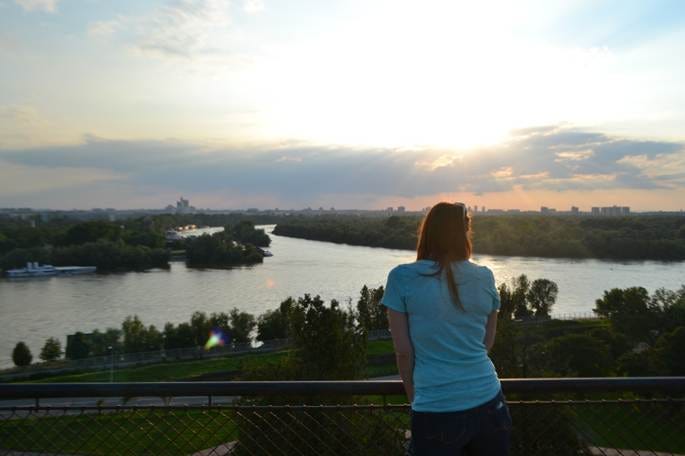
A photo of my 22-year-old self looking out at the Danube and Sava rivers from Fortress Kalemegdan in Belgrade, Serbia.
I didn’t know it at the time, but my experience in Serbia would leave me with a profound appreciation for my Eastern European roots (as I am half Croatian on my mother’s side). Thus, my friend took it upon herself to teach me not only about the customs of Serbia, but also my Slavic heritage, as Croatia, Bosnia and Herzegovina, Macedonia, Montenegro, Slovenia, and Serbia were once a part of the former country known as Yugoslavia.
While my mother’s family left Croatia in the early 1910s and 1920s to come to America, there was little discussion in my family about why they left, as I was pretty far removed from my mother’s Croatian side of her family due to her father passing away when she was in her early 20s.
Thus, visiting Serbia gave me an opportunity to not only learn more about my friend and her heritage, but also a chance to develop a connection with my ancestors, my roots, which I did by learning about the food, the language, the customs, the traditions, and yes…the tragic history of Yugoslavia. A country that, after years of being war-torn and experiencing fighting between brother against brother, finally disintegrated in 1992. The year I was born.
Yet while visiting Serbia gave me this strong connection to my past, I also remember having an eerie feeling that it was giving me a glimpse into my future - or rather - the future of the United States.
While I will not delve into the entire history of Yugoslavia or the Slavic people here, it is essential to note that, like the United States, Yugoslavia was composed of several republics, which would eventually become the six countries I listed above. The capital of Yugoslavia was Belgrade, located in Serbia, and for a time, these six republics worked together, and the country flourished. These different regions were thought to be unified, and their cultures, clothing, and foods were celebrated during festivals and national events to celebrate how they all joined together to become one.
Much like how America or the United States was seen as the “melting pot” of the world.
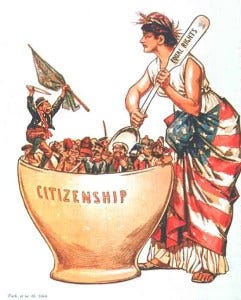
American Liberty stirs the Melting Pot. Source: http://chnm.gmu.edu/exploring/images/stir.jpg
It is important to note that the term “melting pot” comes from the play The Melting Pot by Israel Zangwill, first performed in 1908. In the play, David Quixano is a Russian-Jewish immigrant whose family is killed due to the anti-semantic attacks in Europe, which were common during the 19th and 20th centuries, leading up to what eventually became known as the Holocaust during World War II. Thus, to escape the hardship of his life, David moves to America, idealistically believing it can be a place where people of all backgrounds can “melt” together into a new, harmonious identity. Thus, as his last name suggests, David has a quixotic vision of a better world.
“Here you are all men, and in this country you may be anything you will. Here you are free. Here in America you are a man.
— The Melting-Pot, Act IV, Scene 1 by Israel Zangwill
It is this play that has inspired the notion of the melting pot, which we all grew up with in America. The belief we all deeply internalized from our school teachings, which proclaimed that we could be anything we wanted to be in America. A doctor, a lawyer, a teacher, a rock star, or even a modern influencer, regardless of our religion, color of our skin, or background.
Yet the problem with the melting pot rhetoric is that it implies that immigrants from many different backgrounds can come to the U.S. and “melt” into a common national identity. That somehow, overnight, we will all become “brothers” and be one unified front. That individual differences won’t matter anymore, and we will all be one big happy family.
Except…that didn’t happen…
Moreover, it is the exact type of rhetoric that was used to unify the republics of Yugoslavia under the rule of Josip Broz Tito, who governed the country from 1944 until he died in 1980, which soon signaled the end of the country.
Therefore, the problem with this rhetoric is that while it has good intentions, sometimes a unified country is not always a good one. What led to the fall of Yugoslavia was years of buildup and tension among different cultural and religious groups, namely the Orthodox and Roman Catholics, as well as Yugoslavia’s Muslim population in parts of Bosnia and Herzegovina, Macedonia, and Montenegro.
There was no one event that caused brother to turn on brother in Yugoslavia, yet that is what happened. Families literally fought one another, killing their biological family members during the war. The fighting between religious and cultural groups became so extreme that there were whole towns, schools, and villages of certain cultural groups that were targeted and murdered.
If that sounds like it might be far-fetched to you or even a bit barbaric, I want you to think about something…
How many mass shootings have targeted specific groups of individuals in the United States? Whether they are part of the LGBTQ+ community or the African American community. Or let us consider what ICE is currently doing to the Indigenous and Latinx communities within our country.
We in America have a serious problem. We’ve all bought into this “we’re special” belief for far too long. Believing that our country is a “melting pot” when in truth this soup has gone bad for a long time. We convince ourselves that the things that happen in other countries, especially those in Eastern Europe, which we project as “bad,” “awful,” or “disorganized,” even though in truth our current government system isn’t all that different from the corrupt politicians or rulers in Yugoslavia during the late 80s and 1990s.
We foolishly convince ourselves that what happened there won’t and couldn’t happen here. Yet it already is happening.
When I visited Serbia, one of the first places my friend took me to was the National Library of Serbia. A beautiful building filled with books, not only about the history of Serbia but also about the Slavic people and former Yugoslavia. At the museum, there was a wonderfully kind woman who, although she didn’t speak any English, gave my friend a private tour of the Library, which my friend translated for me.
While the library had many wonderful and fascinating works of art and literature, perhaps the items in the library which stood out to me the most were these:
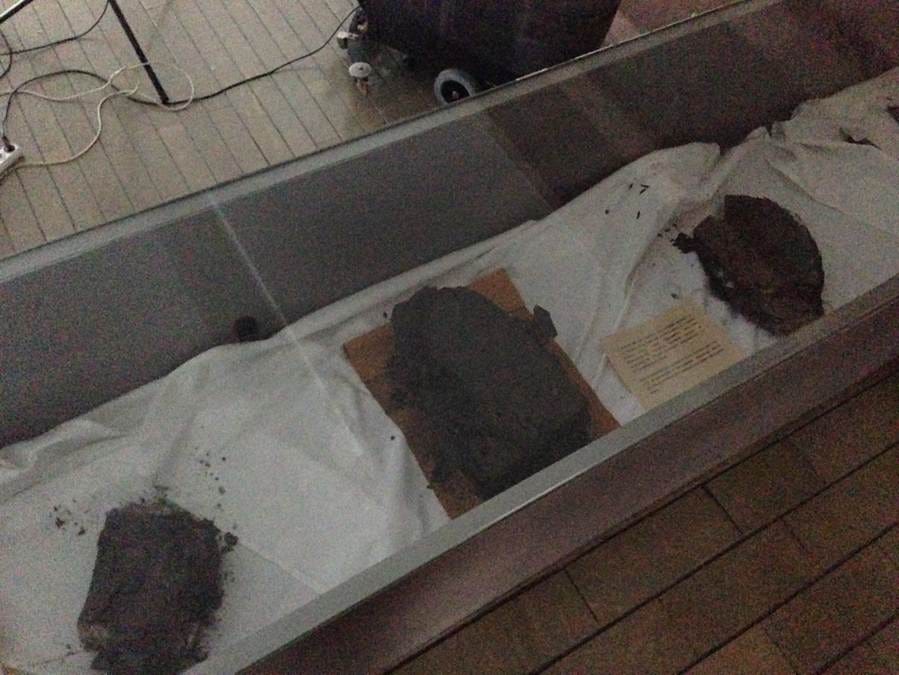
Images of burned books taken at the National Library of Serbia.
These books, the tour guide explained, were found in the rubble of the many bombings that destroyed part of the original library during the fall of Yugoslavia. I remember being entranced by the presence of the book and, somewhere in my bones, deep within me, I knew that these books were a warning of our future in America.
While I don’t want to cause panic or outrage, I felt called to share this story this week, because it is becoming clear to me that America, like the former country of Yugoslavia, is becoming divided beyond repair.
And I am terrified, as I am sure most individuals are.
This image, which we so badly want to convince ourselves can only happen in places like Eastern Europe —believed by many Americans to be a war-torn and disadvantaged country — is a glimpse into our future if we do nothing to stop it.
I want you to think of all the books, cultural artifacts, history, knowledge, voices, and yes, the people who have been and will be burned in the fire that has already sparked in this country.
Walking around Serbia and the parts of Croatia I visited, I didn’t see an impoverished country like I was told to expect through the teachings of my pro-U.S.-centric history books. In fact, I saw the opposite. I saw beautiful statues, buildings, and works of art with deep history. I toured the ruins of Kalemegdan, a Roman Fortress used throughout history, as it was positioned at the perfect location to see the merging of the two main rivers of the Danube and Sava. The Sava river extends into Croatia, i.e., the Western side of the region and therefore the Western world. Whereas the Danube, known also as the “Bridge to the East,” flows from Germany, through much of Eastern Europe (Belgrade, Vienna, Budapest), eventually leading into the Black Sea. Thus, it literally represents the connection between the East and the West. As Eastern Europe has often been the place for cultural exchange of ideas, belief systems, foods, spices, and human connection.
Therefore, I walked down cobbled stone streets much older than any street I have ever walked down in the States. I saw ruins that have existed for thousands of years before me and will exist for thousands of years after anyone reading this post on its publication date will be living. I saw the merging of thousands of years of Western and Eastern cultures clashing, coming together to create art, history, and inspire human knowledge.
My point is, why do Americans think history does not apply to us?
If Eastern Europe and Yugoslavia have taught us anything, it is that life moves through cycles. Those on top have their rise and their fall. Empires become established and then are replaced with new ones. City-states join together to fight revolutions, only to eventually break apart.
The more we push for the “melting pot” rhetoric, the more divided we become. The more our current government systems push for the worship of one type of religion, the more individuals resist it. This isn’t progress, and this isn’t what will make our country great again.
This will lead to its breaking, just like it did in Yugoslavia. The more the Yugoslavian government attempted to unify the fighting republics, the more they resisted it, eventually turning on one another and causing mass destruction.
In walking around Serbia, I would see beautiful buildings from all periods in history, and next to them would be ruins. The burned books were just one part of the legacy of damage left behind by war, and in these past few months, I have often thought about those books...The image of them comes to me frequently, reminding me that we are not too far from having our own library full of burned books. Which future generations will look upon.
So I pose this question: If the divide in the States is inevitable, just as the fall of Yugoslavia was…what do we as the younger generation want to do about it?
Do we want to resist like the government did in Yugoslavia, only to have more of our brothers and sisters killed in the process? Or perhaps, like a dysfunctional family unit, is this the signal that America’s children need to leave their parents’ home and forge a new type of government?
Maybe in truth, we were never meant to be a melting pot, which implies conformity. Thus, breaking apart the states to form our own systems of government may serve everyone best. Moreover, if we can navigate this divide effectively without turning brother against brother, perhaps we can appreciate what the United States was at one point in history. But like every great dynasty, that time has come to an end.
American needs to change and while I don’t know what the outcome will be yet. I do know that as a psychotherapist, the more we resist a change, either internally or externally, the more violent the uproar. Which builds and builds until there is no chance for mitigation or an easier transition, and when that occurs, that is often when the most damage to ourselves and others is done.
In my lifetime, I would like to avoid seeing the burning of the books of the great novelists and thinkers in America. I would like to preserve their history, their knowledge, and their wisdom, because I do think there is important history worth preserving in America, just like there are centuries of history in Eastern Europe and all over the world, worth maintaining.
The good parts, the bad parts, the triumphs, and the shameful parts of America all deserve to be told for many generations to come. Yet, the more we hang onto what was, the more we are unable to preserve that history properly, and history also teaches us that every empire must come to a close.
Perhaps it is time for us to humble ourselves as Americans. To understand that our history is not so different from our European forefathers and that, in the end, there is a chance to create something beautiful.
The beauty of creating a new and honoring what has come to pass, through the preservation of knowledge.
Yet we can only truly appreciate this knowledge if we are not hell bent on destroying ourselves and our enemies first.
When that happens, countries end up with burned books, destroyed buildings, works of art, and the lasting generational impacts of trauma, grief, and loss.
Perhaps if the ending is inevitable– as death is for us all, we should ask ourselves what books and works of art do we want our country to leave behind, and how do we want future travelers to feel when walking our streets?
Do we want to leave them with the feeling of dread and destruction? Or a chance to see how an ending can give rise to a new, more hopeful dawn instead?
OX
Your Dark Fairy Godmother
**Important Update**
In March 2026, I’ll be traveling to Eastern Europe, with plans to spend time in Vienna, Prague, and nearby regions. If any of my readers have travel tips or recommendations for Austria, the Czech Republic, or Hungary, I’d love to hear from you—feel free to comment below or message me!
During my travels, I’m also hoping to connect with scholars and researchers who study local folk healing traditions, particularly the healing practices of women in these regions. If you have expertise in this field—or know someone who does—please reach out via email or social media. I’d love the opportunity to learn more and continue my research while I’m there!
As always, if you’d like to stay updated on my research, you can read the latest edition of The Yonic Journal, where I write about my Yonic Theory™ and women’s self-actualization process as well as my research on feminine forms of healing.
For those interested in my Yonic Tarot™ project, you can support the creation of the deck by donating as little as $1— as every contribution helps bring this vision to life!
And don’t forget to follow and subscribe on Substack to stay connected with my latest writings, updates, and creative projects!
Resources:
Zangwill, I. (1908). The melting-pot: A play in four acts. Macmillan. https://www.gutenberg.org/files/23893/23893-h/23893-h.htm