


Oh oh, Ophelia, you’ve been on my mind, girl, since the flood
Oh oh, Ophelia, heaven help the fool who falls in love- The Lumineers, Ophelia, 2016
Since William Shakespeare first introduced his character Ophelia in his play Hamlet, the world has been captivated by her tragic image.
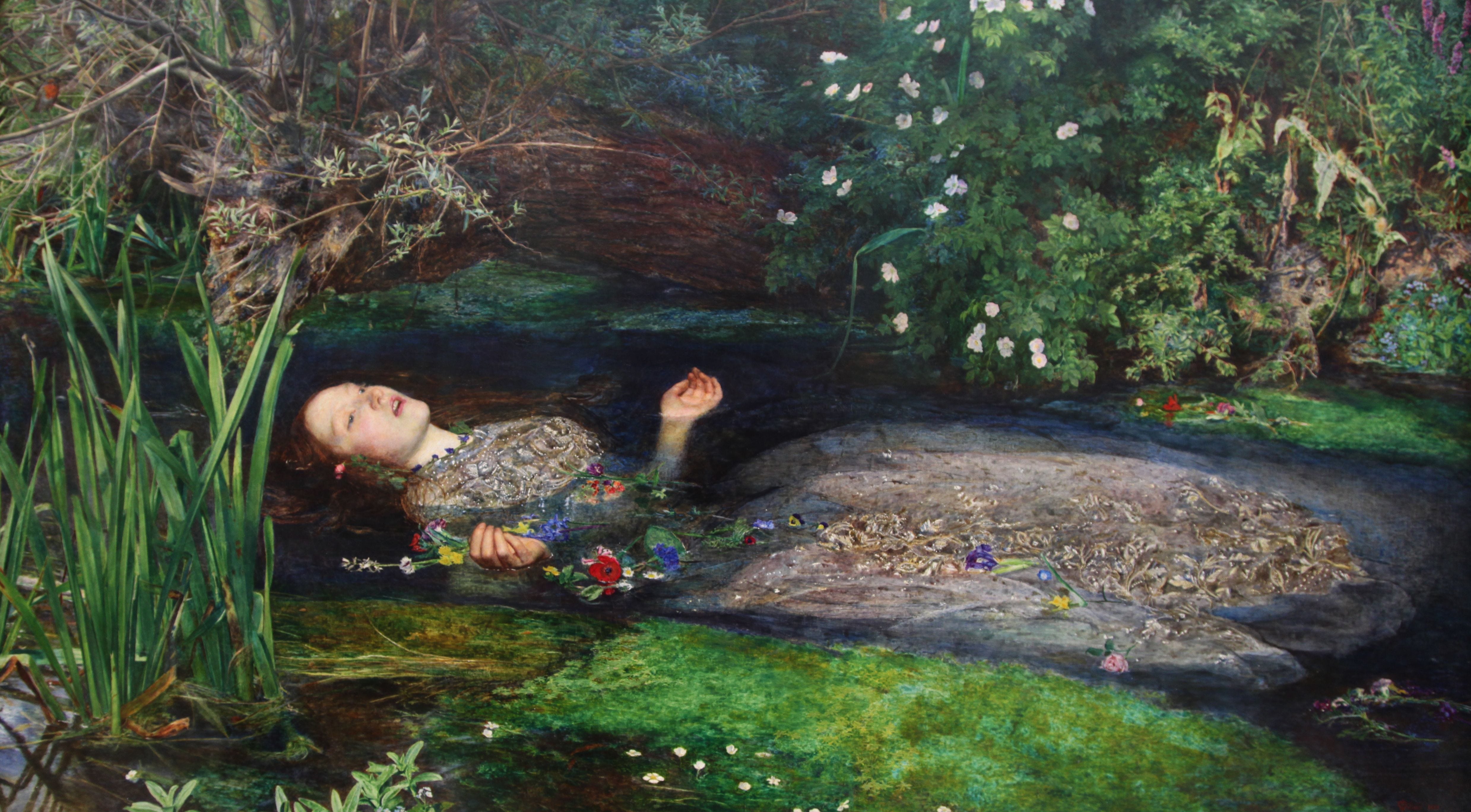
Ophelia by John Everett Millais, 1851
She’s been used as an archetype in songs, as referenced in the two lines above taken from The Lumineers ‘ sophomore album Cleopatra (another woman who met a tragic fate), or more recently in Taylor Swift’s song The Fate of Ophelia off of her most recent 2025 album The Life of a Showgirl.
And while she has served as a metaphorical muse for many musicians and artists, like the painter Sir John Everett Millais, her character has also been portrayed by many actresses and Hollywood icons over the years, such as Kate Winslet, Helena Bonham Carter, and Jean Simmons, who even received an Academy Award nomination for her haunting portrayal of Ophelia in Laurence Olivier’s classic 1948 film version of Hamlet.
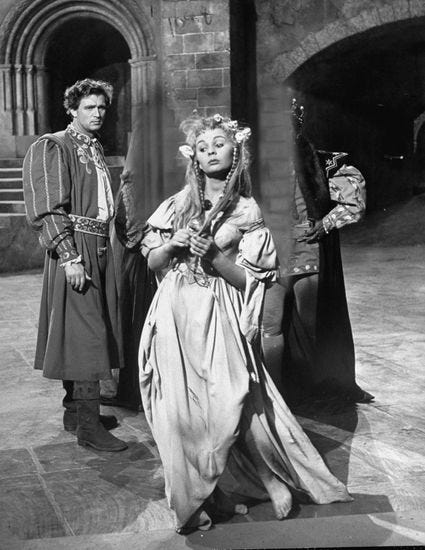
Jean Simmons as Ophelia
But what is it about the archetype of Ophelia that holds such a grip on our collective psyche for both men and women?
For men, I find they often view this figure as a tragic maladaptive representation of the High Priestess card in Tarot. A maiden figure who was overcome with her own psychic energy, which men often perceive as holding the key to their redemption arc by either viewing her as a muse or a goddess to win the favor of. (Or in many cases someone they need to “rescue” from her own misfortune.)
Yet for women, she represents both a cautionary tale and also the promise of immortality. A double-bind that often leads women to develop what some mental health professionals and psychotherapists have coined as the “Ophelia complex or syndrome,” which is used to describe women who become too fused with this archetype, unable to separate themselves from her tragic, yet somehow alluring grasp.
One such example of this is psychotherapist Mary Pipher’s 1994 book Reviving Ophelia: Saving the Selves of Adolescent Girls, in which she used the character of Ophelia to examine the external societal pressures adolescent girls’ face and how it leads to a loss of their internal sense of themselves (or locus of control) as they attempt to navigate their transition into adulthood. She and other psychotherapists such as my former professor and mentor, Dr. Laura Choate, have discussed how these pressures can lead to a host of mental health issues for women, including depression, anxiety, and disordered eating concerns, and, of course, suicide, as was such for Shakespeare’s ending of her character in his iconic play.
And while some modern adaptations of her story, such as Daisy Ridley’s portrayal of her in the 2018 film Ophelia (Which retells Hamlet from Ophelia’s perspective), or Swift’s song, attempt to provide her character with a much happier fate. We nevertheless appear to both mourn and simultaneously madonnize women who embody these tragic “Ophelian” qualities, raising them up to achieve the status of postmortem icons. As this has been the case for women like Princess Diana and Marilyn Monroe who met their death too soon or for female writers like Sylvia Plath and Virginia Woolf, both of whom, like Ophelia, chose to take their lives as a result of the pressure they felt living under a restrictive patriarchal society that refused to acknowledge their writings or literary genius. (That is, of course, until after they died.)
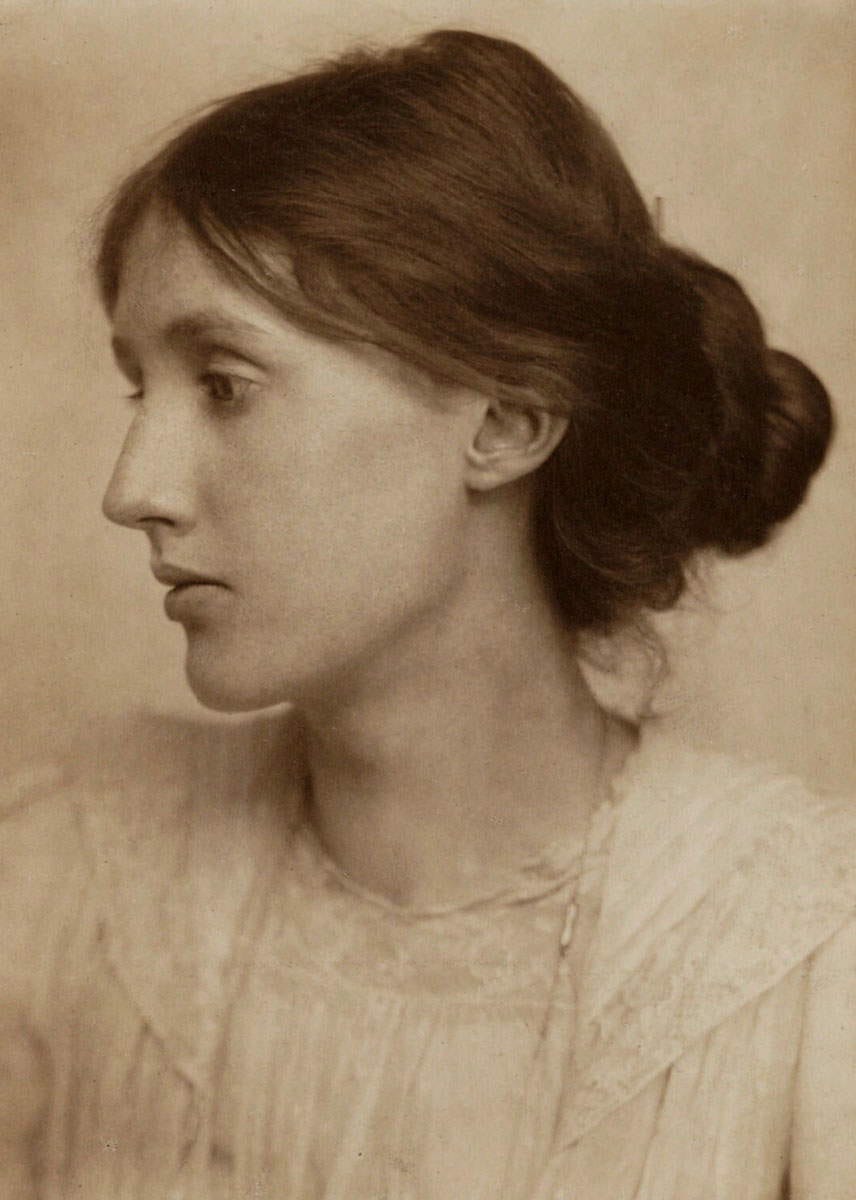
Virginia Woolf
Thus, as I stated above, the archetype of Ophelia is not only a cautionary tale for women, her image also promises something else for women as well. The chance to remain immortal – trapped forever in a state of eternal girlhood or the Puella Aeterna, often considered the female counterpart to Carl Jung’s Puer Aeternus, or “eternal boy,” which I have written about here.
Thus, this tendency to uplift her tragic image and turn her into a muse is a result of what I refer to in my Yonic Theory approach as the goddess-witch spectrum, or the process by which women and men separate themselves and other women into goddesses or witches, which results in women who embody this tragic loss of innocence being elevated to that of the status of the goddess as this maiden archetype is often associated with another puella – Persephone, who like Ophelia in Shakespeare’s play was pulled down to the depths of the underworld by a man who wanted to consume her for his own selfish gain (or at least that is one variation of the myth).
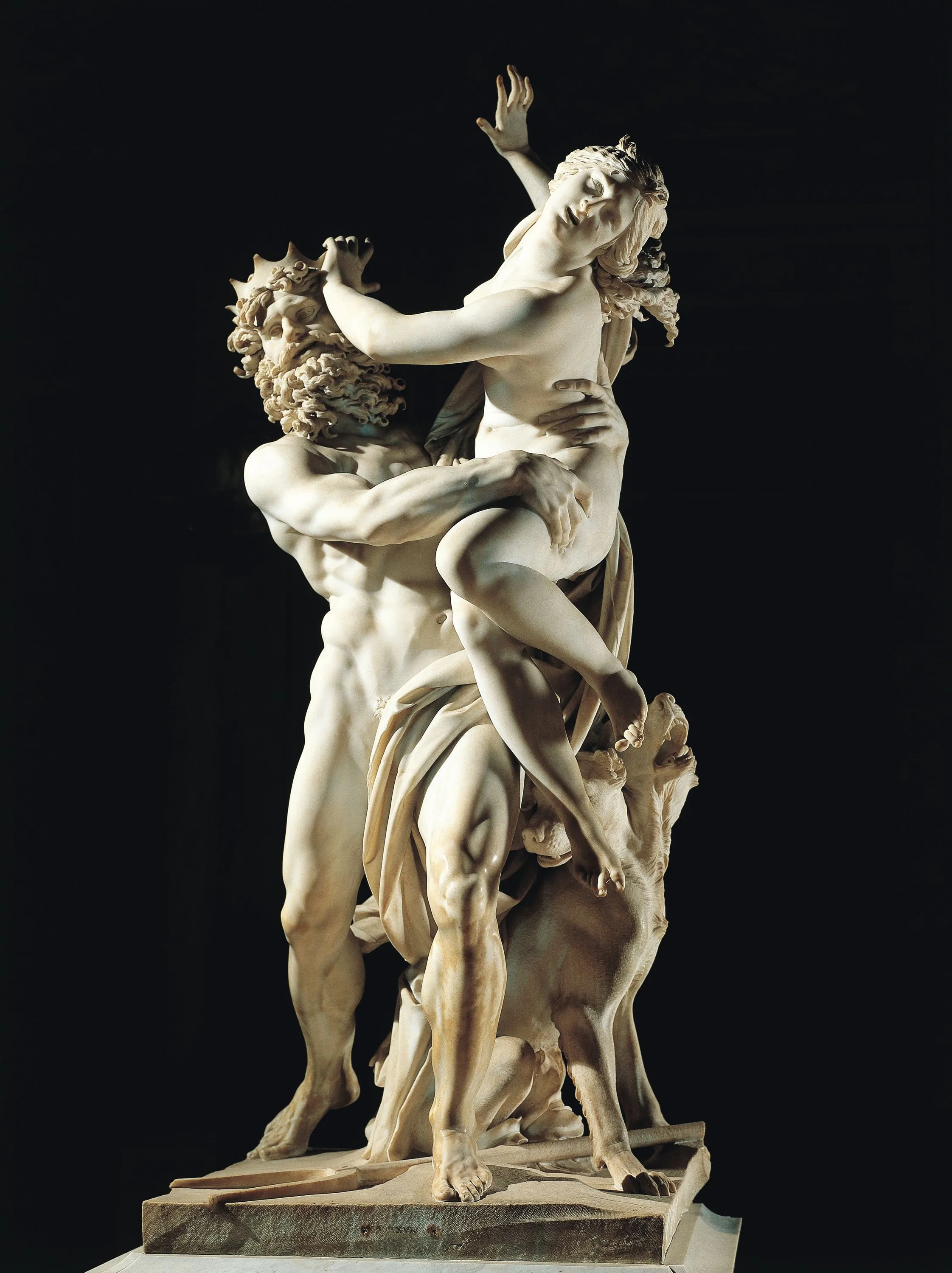
Gian Lorenzo Bernini, Rape of Proserpina, 1621-1622
Thus it becomes tricky for women to navigate the archetype of Ophelia as they enter their teen and early adult years, since on one hand, by embodying her more seductive and light feminine qualities women can receive recognition, validation and approval from men which I, Pipher and Choate have discussed at length. Yet at the same time, this tendency to seek out external recognition from men often directly results in women become “lost” from themselves and becoming fused with what I have defined in my Yonic Theory approach as women’s Veil function.
Thus, in order for a woman to self-actualize, it is imperative that she break free from the allure of the Ophelia complex, which can as stated above can also be viewed as comparable to the maiden archetype given her association with the puella and Persephone.
Yet how do women achieve this when there are so many pressures in our modern society which prevent them from listening to their inner selves? How does one separate themselves from seeking the approval of male-based validation, while also maintaining healthy relationships with men? And moreover, how do women learn to reclaim their witchy aspects, which, if Ophelia and the women who fall victim to her same archetype had been able to successfully integrate their own dark feminine (Aura) aspects, may have saved themselves from falling under her same curse?
Reclaiming the “Lost” Daughter
It is these questions and my own experience working with women and navigating my own experiences of womanhood that have led me to create my Yonic Theory approach. Though in truth I would like to acknowledge that this theory is not solely my creation, as it has been influenced by many individuals’ research and myths about women which have existed long before me or the field of psychotherapy existed.
Thus, when attempting to create a tarot deck to reflect women’s self-actualization process, I, like many of the artists I referenced at the beginning of this post, was inspired by the image of Ophelia, as I believe there is something about her image that is particularly important for women to recognize within themselves.
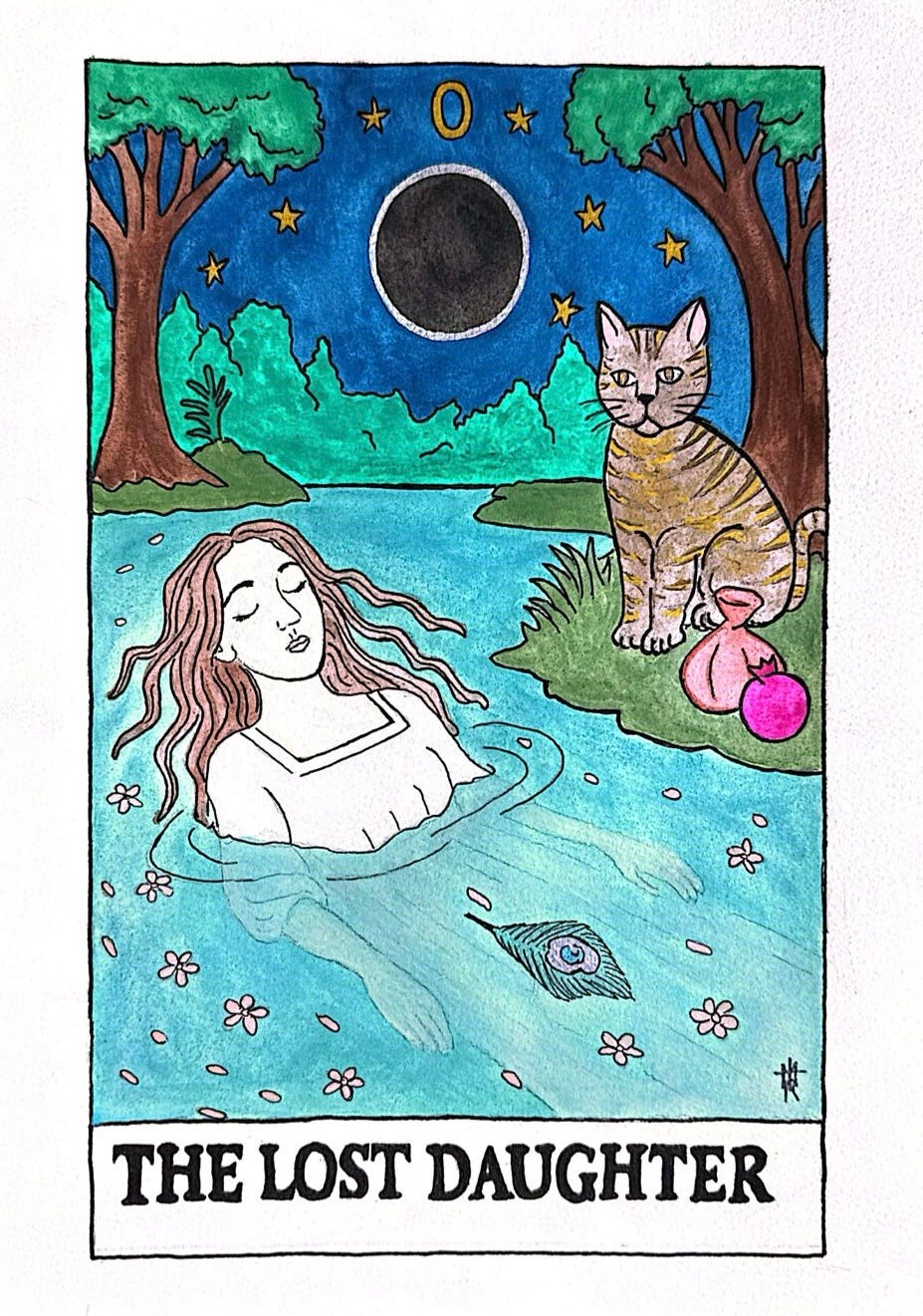
© M. Robichaux, 2026, Authentic Living, LLC
If you are enjoying this article, please consider making a donation to support my Yonic Tarot creation process through my Ko-fi account below. The completed deck and guidebook will be available for purchase through my website www.authenticlivingcc.com.
OX, DFG
Namely that she represents the archetype of the “lost daughter,” which is where I find that most women begin their process of self-actualization. Since as psychotherapist Maureen Murdock herself noted, women often begin their self-actualization process after a period of intense striving for external approval, only to discover that they have become disconnected from themselves and their internal sense of knowing.
Thus, while I believe the Fool card in most Tarot decks is a great representation of men’s self-actualization process, for individuals who identify as primarily cisgender women, this card, as it is traditionally depicted, misses a few key elements. As women’s self-actualization process follows what Murdock coined as the Heroine’s Journey, a feminine counterpart to Joseph Campbell’s Hero’s Journey, which has heavily influenced not only my Yonic Theory approach, but the construction of my tarot deck.
Therefore, while there is merit to the archetypal process of the Hero’s Journey, which the Fool’s journey in tarot is often compared to, without a deck that is truly rooted in the feminine experience, this process for women essentially becomes like trying to drive a car in a foreign country without a GPS or road map for women to guide themselves.
And while women might be able to apply many of the stages of Campbell’s work or even the work of great male psychotherapists such as Jung and Freud to their experience, there will fundamentally be a gap in these men’s knowledge or understanding of the feminine experience for they lacked the gender role socialization and lived experiences which causes women to identify with the Ophelia complex or “lost daughter” archetype in the first place.
Finding our way Home
It should be noted that just like the Fool card which can be seen in both a positive and negative (or adaptive and maladaptive) perspective, so too can the card of the Lost Daughter in my Yonic Tarot be viewed in the same way. As some modern decks such as Lisa Sterle’s Modern Witch Tarot provide a feminist reinterpretation of this card’s imagery.
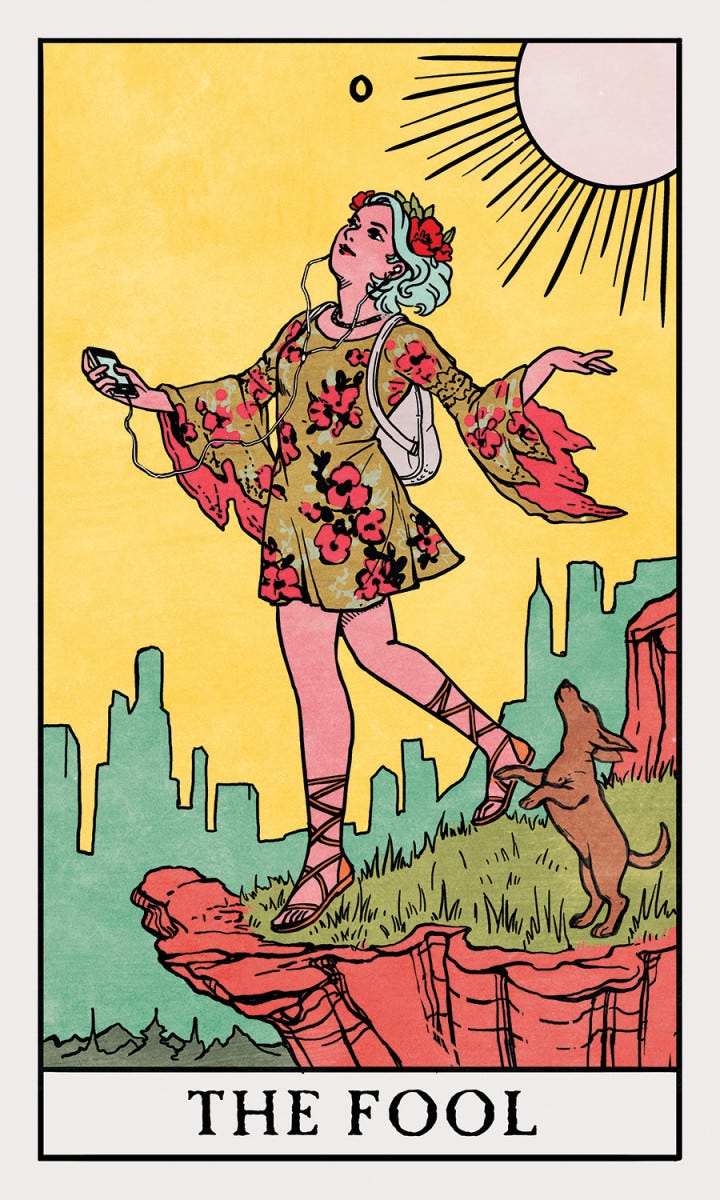
Thus, like the term “fool,” which can represent someone who is “foolish” and unaware of the dangers they face, the word “lost” is meant to represent how women must reclaim the lost aspects of themselves in order to make their journey home to themselves.
Thus, in its maladaptive representation of the card, the term “lost” describes a woman who has succumbed to her Ophelia complex, and thus she is “lost” to the world of men. Trapped in an endless cycle of seeking external validation, which could lead her to face her ultimate end if she is not careful - just as the fool’s journey could lead him to his ultimate end as well.
Hence, why I drew inspiration from Sir John Everett Millais’ depiction of Ophelia when designing my card, as the woman in my card is shown lying in a body of water surrounded by flowers just as Ophelia’s body was found.
Moreover, her white dress is meant to evoke a sense of innocence: that she is still in her maidenhood or that this has been taken from her, and thus she must discover who she is outside of this archetype of herself.
Therefore, from an adaptive perspective the term “lost,” much like the adaptive interpretation of the Fool card, might simply denote a woman who is in the process of discovering herself and does not yet realize her highest potential. For sometimes we need to become lost to realize the strength we hold within ourselves, which is done through completing the process of Anamnesis, or “coming home to one’s inner knowing.”
It’s also important to note that getting lost can be quite fun, as I have been known to purposely “get lost” when traveling and visiting other countries and finding unusual pit stops along my travels.
Thus, getting lost in life is simply part of the process, and it is occasionally through these periods of being lost that you might discover something new about yourself: a new food you enjoy, a new culture, a new language, or a conversation that sticks with you, a song, or even a dream that reminds you of some part of yourself you’ve kept tucked away. A calling to return to that source – whatever it may be.
And it is this call to return to ourselves, to source that pushes women to complete the process of Anamnesis.
A process which requires women to integrate both their masculine and feminine aspects, which is reflected in the full solar eclipse pictured at the top of the card and is often associated with periods of symbolic and astrological rebirth.
In addition, next to the eclipse there are 7 stars pictured, to represent the 7 chakras and being in alignment with oneself. Thus, like the Fool, the Lost Daughter already has everything she needs to complete her journey back home, as her loyal friend and companion (her cat, an animal often associated with embracing one’s feminine aspects) watches over her knapsack on the shore.
Thus, whether the Lost Daughter is experiencing a rebirth, a reawakening, or just simply enjoying a long swim and a moment of rest on her journey, she knows that eventually, she must begin her journey home as the number zero on this card (which has no beginning or end) represents the cyclical nature of life itself and how our journeys towards self-actualization (regardless of how we chose to identify our gender) are always evolving.
Thus, the wisdom of the Lost Daughter is not for women to fear falling victim to the Ophelia complex, but rather to see it as a natural evolution in one’s growth towards returning home to themselves.
For the tragedy of Ophelia wasn’t that she fell victim to Hamlet’s charms, who “deflowered” her and killed her father; it was that she perceived she had no other choice than to conform to his frame of reference of her.
That she had become so lost from her inner self in seeking the external approval of her father and Hamlet under the male gaze of the patriarchal court of the Kingdom of Denmark that she could not make her way back to her own unconscious feminine aspects. Her intuition, her inner knowning, all of which would have required her to disown her light feminine muse-like qualities and reclaim her darker witch-like aspects.
This means that for women, allowing themselves to fall off the pedestal of the goddess archetype, is necessary. Since ultimately attempting to constantly strive to fulfill this archetype will led to their downfall. Since as we are all too well aware of as women, none of us can always be perfect, and as history has taught us, those women who try to be, often end up meeting their graves prematurely.
And while I don’t believe it is possible for women to completely avoid experiencing the Ophelia complex, since as I said this appears to be the catalyst for women entering their self-actualization process, my hope with this deck is that it offers somewhat of a road map, so that women can reconcile their goddess and witch aspects and eventually come home to themselves.
As process which inherently requires women to turn inward and face themselves as they descend into the watery depths of their unconscious which houses the realm of the feminine for both men and women alike.
OX
Your Dark Fairy Godmother
If you would like to learn more about Dr. Roby’s courses on her Yonic Theory approach, check out the resources below:
If you would like to donate to her Yonic Tarot deck creation fund, please do so through her ko-fi account: