


With the full moon in Leo upon us, the timing of my latest edition of my Yonic Journal has never felt more synchronistic.
In this article, I introduced my concept of the Yonic Principle™ and how this technique can be used by therapists and holistic/spiritual healers alike to assist their clients in connecting to the unconscious wisdom of the feminine.
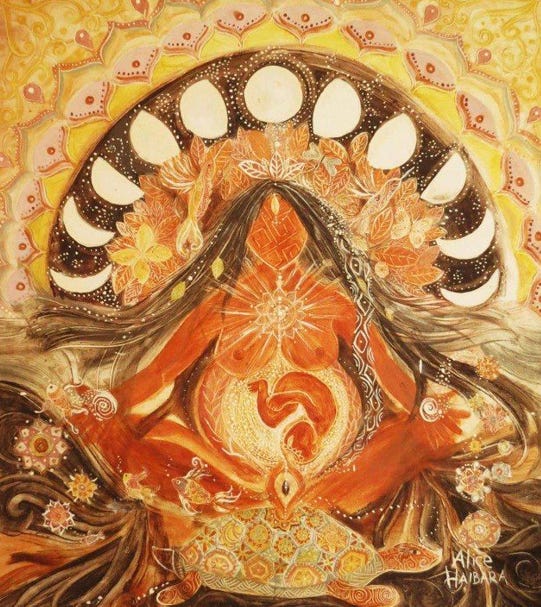
Artwork by Alice Haibara
What is the Yonic Principal™?
The Yonic Principal™ is a healing technique in which the healer or therapist embodies the principle of the yoni (aka: the womb) to facilitate the integration of the client’s unconscious wisdom creating a metaphorical “rebirthing” experience.
This approach is inherently based off the wisdom of the feminine - meaning, that it was informed through my understanding of the Indigenous/folk healing practices of female healers throughout history and how their techniques are reflected in our modern therapeutic approaches through the use of “fem-identified” skills which I explored through my dissertation research (Robichaux, 2024).
Therefore this means that psychotherapists or non-institutionally based healers can it alike. Since it is not specific to one type of healing modality.
As a sneak peek, I’ve included the first few pages of my article for my subscribers to read for free. To purchase the full article or get access to the full The Yonic Journal™, click the link below: visit my journal’s website at www.yonictheory.org
This article would not be possible without the support of my subscribers! Therefore, if you have not already done so, please consider subscribing to my Substack to continue supporting my research and stay up to date on forthcoming articles!
The Yonic Principle
This article provides readers with an overview of the concept within the author’s Yonic Theory™, which she has defined as the Yonic Principle™. While this language is specific to the author’s theory, and she has chosen to use the word yonic, to describe this concept, as it embodies principles of the feminine or yoni, which in Sanskrit refers to the womb and its many complex components (Judith, 2004, and Hazard, 2023), the author would like to clearly acknowledged that the womb itself, and therefore any principles that reflect its nature, cannot be owned or commodified. This concept did not originate with the author, as it reflects the process of birth and its cycles. A process that was intuitively used by female Indigenous and folk healers throughout history to provide healing and shamanic/spiritual experiences to their clients, who were part of their local communities or tribes, as the term “client” is a relatively new-age concept whose origins lie in the psychotherapy profession. Therefore, the author acknowledges that many healers may call this concept by different terms or describe it in more scientific or esoteric terms, depending on their background, education, and the period of history in which they lived. However, the author argues that this concept is not rooted in what can be defined as reflective of the masculine principle of Spirit/Eros in her theory, which is bounded by the realm of consciousness or Father Time/Chronos and thus constrained to liminal time-oriented ways of thinking. Therefore, the author’s term Yonic Principle itself is attempting to define that which is numinous, that which cannot be contained or quantified, and has and will endure long after this article is published and hopefully circulated throughout time. Therefore, the Yonic Principle and its wisdom reside in the realm of the feminine, the unconscious. The realm of Anima Mundi/Great Mother in the author’s Yonic Theory, which is not bound to time, space, or any of the limitations of the conscious realm of Father Time/Chronos.
Moreover, since these realms are reflected outside the individual and thus can be thought of as similar to Jung’s (1969 a/b) concept of the “collective consciousness” (i.e. Father Time/Chronos) and “collective unconscious” (Anima Mundi/Great Mother), these states can be respectively thought of as indicative of the concept of “God” and “Goddess” or perhaps said another way, the collective archetype of the Father and Mother, since we all derive from the combination of the principles of the masculine (Eros/Spirit) and feminine (Psyche/Soul) merging and forming together in the womb at the moment of conception. Thus, these concepts exist outside of us, and we therefore have conscious (i.e., light) and unconscious (i.e., dark) aspects of our inner masculine and feminine selves, which the author has used to define her four functions of the Self in her Yonic Theory (Robichaux, 2025). (See Appendix A for full outline and description of the author’s Yonic Model of the Self and its four functions.) Therefore, the role of the Yonic Principle is to serve as the womb or container for all four functions of the Self, to meld and merge, breaking down and transforming into the Self via the process of self-actualization, which the author defines specifically for women as Anamnesis.
This process, usually involved the help of a guide, a healer, or shaman throughout history, and in many ways, the role of the psychotherapist can mimic this role today, even if we do not choose to define it that way in accordance with our Western society. This is why the author has chosen to use the term “healer” throughout her article to describe an individual who engages in the process of evoking the Yonic Principle since she believes it does not belong to any one form or type of healing, since its very roots can be traced back to the wisdom of female healers in the Neolithic era (Achterberg, 1991; Stone, 1976; Qualls-Corbett, 1988; Walker, 1983). Therefore, this concept is meant to serve as a bridge not only between one’s masculine/feminine and unconscious/conscious aspects of the Self, but also within the greater collective, as the world is becoming more divided along East vs. West and gender ideology.
Therefore, the author of this article is explicit in her statement that anyone, no matter their gender expression or identity (cisgender, transgender, non-binary, male, or female) can use this approach. However, if they are going to use it, it is essential that the healer have confronted and integrated their own feminine aspects within themselves (i.e. the integration of their light feminine (Veil) and dark feminine (Aura) aspects) in order to properly embody the principles of the womb which is needed to facilitate this process through the use of light and dark fem-identified skills (Robichaux, 2024). Without that awareness, this practice runs the risk of being co-opted and polluted, as the author believes this is a sacred practice of the feminine principle of Soul/Psyche, which should be revered as such. Moreover, this practice is not to be used, exploited, or expected at the expense of unpaid or unrecognized feminine labor. For far too long, women in particular and people of Indigenous origins have been expected to cater and caretake for the majority culture in whichever form they present themselves. This is reflected within our modern society as legislation attempts to limit women’s right to ownership over their reproductive health with the overturn of the historical court case Roe v. Wade by the U.S. Supreme Court (Dobbs v. Jackson Women’s Health Organization, 2022). Therefore, the womb, the yoni, and the author’s labeling of the Yonic Principle all deserve their justice, as do women and the feminine. The principle of the feminine, that of Soul/Psyche, deserves to be respected, as do the womb-possessing individuals’ rights to their healthcare and own self-determination and self-agency, which deserve to be protected and cared for (i.e. abortion access and reproductive health).
One cannot have true unity within the Self if the world is lacking this balance, regardless of one’s gender orientation. An excess of one’s masculine functions is just as off balance as an excess of one’s feminine functions. To find true harmony within and outside ourselves in our collective, balance must be restored so that a new life can be birthed for us all.
To read the full article, click on the link below to purchase.
Or check out my podcast episode on it, which will drop this afternoon!
OX
Your Dark Fairy Godmother
To support my work so I can continue writing articles like this one, please consider making a one-time donation to my Ko-fi account or purchasing a paid subscription below!
Suggested Citation:
Robichaux, M. (2026). The yonic principle. The Yonic Journal, 2(2), 1-90.
Reference
Robichaux, M. (2024). Reclaiming the sacred feminine: A qualitative exploration of female counselors’ use of Reiki and Tarot (Doctoral dissertation, Sam Houston State University). Sam Houston State University.