

Trad Wives and Alt Girls
The new Madonna-Whore Complex?

The Madonna-Whore Complex may seem like a relic of the past due to the influence of the Feminist Movement of the 1970s in the United States. During this time period, influenced by the sexual revolution of the 1960s, women began to challenge patriarchal notions of “chastity” and “sexual purity,” which limited women’s expression of their sexuality and bodily autonomy. However, in recent years, with the overturn of Roe V. Wade by the Supreme Court in 2022, there has been a rise in this dichotomous thinking of women’s sexuality, which can be seen in modern social media content for women and men through the TikTok trend of “Trad Wives” and “Alt Girls.”
While the underpinnings of the concept of the Madonna-Whore Complex have existed for centuries, the first individual to coin this phenomenon was psychoanalyst Sigmund Freud. In the early 19th century, Freud noticed that his male patients had difficulty accessing their feelings of arousal towards their wives, whom they categorized as being similar to the “Madonna” or Virgin Mary from the Christian belief system, while their mistresses, who they could feel sexual attraction towards, were categorized as “whores”.
According to Japko, The Madonna/Whore Complex (or Madonna/Whore Constellation/MWC) is a polarized view of women where “women are either ‘good, chaste, and pure’ (Madonnas) or ‘bad, promiscuous, and seductive’ (Whores)” (p. 562, 2023). Thus, this polarization reflects men’s fantasies for domination and control over women and their sexuality, which in return results in less human-centered experiences with their female sexual partners (Japko, 2023; Freud, 1905). In other words, because cisgender, straight men are socialized to view sex as a form of power over women by which they exploit their sexual “conquests,” men view sex not as a way to create intimacy and connection with their female partners but rather as a way to “prove” their manhood. Thus, to reconcile their own discrepancies between their need for human connection and desire for sexual control, men project the Madonna-Whore fantasy onto women in their lives.
Furthermore, due to messages from purity culture, many men may feel shame for having sex, so in order to reconcile these unwanted feelings, they subconsciously project their power/control fantasies onto women who they can dehumanize or view as “sex objects”, while simultaneously viewing their wives as “good” mothers and homemakers. Thus, they are able to avoid looking within their psyches to address how they have been cut off or dissociated from their humanity through the system of patriarchy. This process of displacement was something Freud noted in great detail throughout his work. However, while Freud was the first individual to label the MWC from a psychological perspective, there have been historical references to this dichotomy throughout human history.
But perhaps I should start by describing what actually makes a woman a “whore” or “Madonna” in the eyes of the patriarchy.
The Trad Wife
In short, a Madonna is a woman who upholds patriarchal views of “femininity” or what “good women” should behave/act like. She is sweet, loving, caring. Never a hair out of place. Pearls strung around her neck. She greets her husband or partner at the door, wearing heels and a freshly made cocktail (or beer) in hand. She never yells at the children or her partner when he forgets to do the dishes. She is detached from her own anger and rage, except for the occasional passive-aggressive comment she makes about another woman’s side dish at her dinner party and how she would make it “with just a hint more salt” or by using some other exotic ingredient to set her apart from the other women she covertly competes with.
The Madonna is always thin or striving to be so since, from a patriarchal view, thin women are easier to control. However, she cannot, under any circumstances, appear to be vain or take genuine pride in herself. Therefore, she must appear effortlessly beautiful, as if she awoke looking perfect at all times. Like sleeping beauty awoken from her slumber, ready to kiss her prince. Furthermore, she must never complain or be tired because of how unattractive that would be to her husband. Consequently, in order for her to not lose her value in the eyes of her partner, she must (no matter what) be smiling, for she is a beacon of light, a whole grail, a muse or goddess for her husband to adore.
While the idea of being seen as a “goddess” might initially sound appealing, and that these conditions might make that position worth all the trouble, women should know that if, for a moment, this one does not uphold these patriarchal standards of femininity in the “purest” form, she is seen as “ungrateful, rude, selfish, and mean,” completely ruining her goddess-like status in the eyes of her husband and society. Therefore, in order to be a Madonna, women must, in fact, be cut off from their own humanity as well. This concept is reflected in Ira Levin’s 1972 book The Stepford Wives, which was later adapted into a film.
The Cost of Perfection
In his book, Levin critiques the 1950s and 1960s ideal of the housewife who, in her pursuit of youth and beauty, becomes quite literally a robot made to serve her husband (and, therefore, men’s fantasies). As the protagonist Joanna (a once successful businesswoman) moves to the town of Stepford, she becomes incorporated into the cult-like culture of the privileged suburban housewife. The book ends with Joanna’s robot version of herself finally killing her and taking over her identity. Thus, now that her humanity or human aspects have been “killed,” she finally becomes the idyllic housewife her husband has wanted all along. (Though the Nicole Kidman 2004 movie version has a much more uplifting and feminist-focused ending).
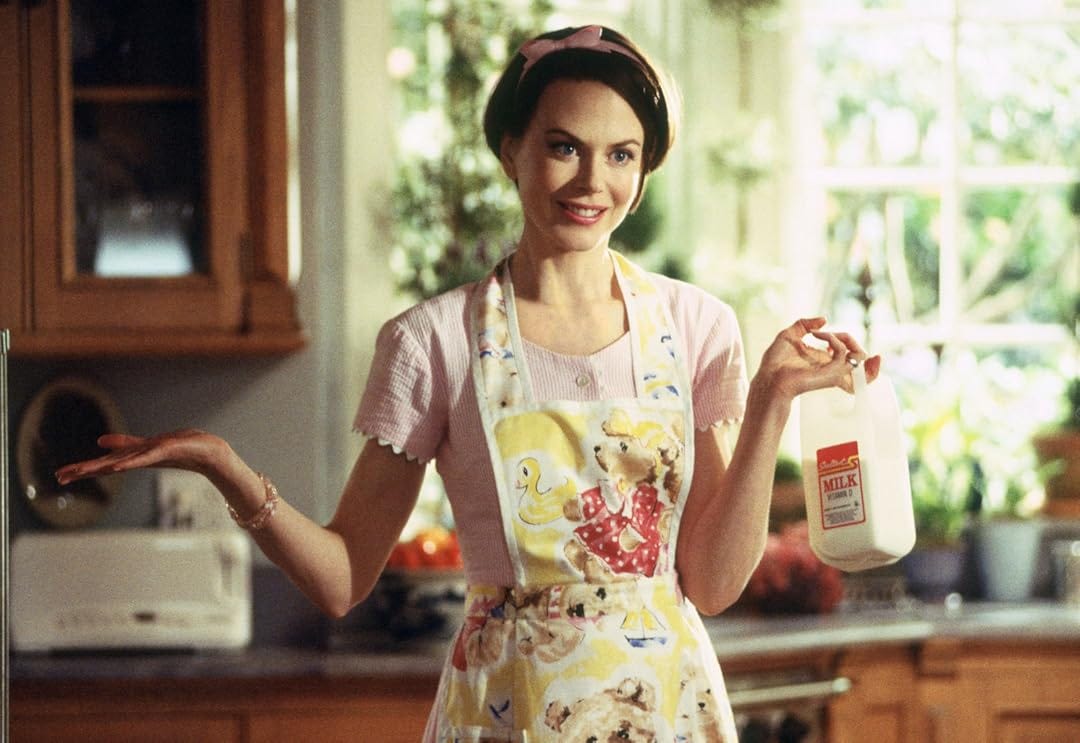
Photo Credit: The Stepford Wives (2004)
Levin’s book can be seen as a critique of American society in the 1950s and 1960s, a time when women lacked autonomy not only over their bodies but also over their sense of agency and autonomy. Furthermore, this analogy of using robots to replace the husbands’ human wives in the town of Stepford reflects the Madonna-Whore complex. While Freud, a product of his time, upheld many sexist views of women, perhaps his most helpful concept, which he contributed to the field of psychology, was the notion of the Id. Without going too deep into the psychological functions of the psyche, the Id is our animal or “sexual” impulses. Therefore, our Id represents the human/animal aspects of ourselves, which in a Victorian culture influenced heavily by the Church in Europe in the 18th and 19th centuries would have seen sex, emotion, and physical intimacy as shameful. Therefore, to kill one’s Id or animalistic nature, one must strive for purity at all costs, which is reflected by the metaphor of the robots in Levin’s book as well as the notion of the Madonna, who was inspired by the Virgin Mary has never tainted herself with since she was able to convince a child without having sex with a man.
Thus, in order to be a “perfect” woman in the eyes of patriarchy, a woman cannot take agency of her sexuality or her own human aspects. Like the Stepford housewife, her only job is to look pretty and serve her husband, which is the only thing that brings her joy in the world.
Within recent years, there has been a resurgence of the Stepford wife aesthetic, now referred to as the “trad wives” trend on TikTok and other social media platforms. These women are overwhelmingly white or appear white, presenting, and their content shows them making delicious meals for their husbands and advocating for the benefits of the “traditional” marriage lifestyle. However, what is not shown in these videos is how these women exude privilege, nor do we ever see the more human aspects of these women.
The Stepford/Trad Wife lifestyle upholds purity culture and white culture at the highest level. The lifestyle only works when your partner can make more than enough money to cover all the expenses of the home. A lifestyle that, for the majority of Americans, especially those of color or marginalized backgrounds, is very out of reach. Yet, despite the economic disadvantages so many Americans are facing today, Trad Wife content continues to gain popularity.
Why might this be? One word – patriarchy. You see, the myth of the Madonna promises women that if they cut off their human/emotional/Id like aspects and only adopt the “light” or “good” feminine qualities that have been associated with the female gender (motherhood, kindness, agreeableness, passivity, beauty, etc.), then women will be protected and cared for by the men in their lives. While, in theory, this might initially feel like a good trade-off for some women, it comes at a great cost. For starters, all those qualities associated with the “good” feminine are subject to change based on men’s perception of what a “good” woman or wife is. Thus, to be a “good woman” in the eyes of the patriarchy, you must give up your autonomy, your agency, and your sense of self, just like Joanna’s human nature had to be killed by her robot self in order to be the perfect housewife.
Now, this isn’t to say that women (or any individual regardless of gender) can’t love to cook and care for others, which do fit stereotypical “feminine” qualities associated with the Madonna. However, being all light all the time is an impossible task since we all have an Id or shadow aspect of our psyche. Therefore, no matter what, a woman who attempts to be a Trad Wife will always inevitably fail because she is not a robot, and once a women’s more human or fallible aspects emerge, she inevitably becomes a whore.
The Alt Girl
Eve, Lilith, Cleopatra, the whore has many names in our society, but her most defining feature. She is a woman who does not comply with the societal expectations that the patriarchy has determined are acceptable for women. Eve ate the apple, wanting more from the Garden of Eden. A garden created by a male father god who wanted his child to obey and listen to only him and his guidance. (This Christian myth is the perfect personification of the patriarchy, which focuses on seeking approval from the father or the “patriarch”.) Adam, God’s chosen “favorite” son was content living in the garden. How could he not be? It was a world created by a male god; for him, a “son” created in his image. Eve’s role was to serve Adam and comply with the standards set out for her by the men in her life, of which she had no agency or active part in deciding whether she agreed with them or not. Eve was loved by both Adam and God when she complied with their wishes and desires for her, but the second she ate the apple. The second she decided to act on her own agency and gain knowledge from the snake (which in many cultures represents wisdom/transformation), she was no longer loved and adored by the men in her life and was subsequently blamed for all of their misfortune. Turning her into a whore.
While the word “whore” still has a negative connotation today, another trend that appears to be growing on TikTok and social media is the rise of the “Alt Girl.” Alt girls are cool, fun, low-maintenance women who resemble some of the Manic Pixie Dream Girl qualities, which were made popular by characters such as Ramona Flowers in Scott Pilgrim Vs. The World and Summer from 500 Days of Summer. Some of these girls might consider themselves to be “goth girls” or “witches” and read tarot cards, collect crystals, or engage in more alternative practices. They usually wear heavy make-up and dark clothing. (Unlike the light clothing, flowy dresses, and “no-makeup” looks the Trad Wives wear.) In addition, these women may wear more revealing clothing, have tattoos, and usually take full agency of their sexuality or at least attempt to under the limitations of patriarchy.

Photo Credit: (500) Days of Summer
However, while one might think these women have more agency through their expression of their sexuality and more revealing clothing, the truth is they can be just as oppressed as the Trad Wives in our society.
Is the Alt Girl Really Free?
Like the Manic Pixie Dream Girls who came before, Alt Girls are heavily sexualized by the male gaze. In the movie 500 Days of Summer, the main character Tom Hansen, who is meant to represent the stereotypical cis-white man, idealizes the shit out of his co-worker Summer. Summer is alternative (an Alt Girl) with her 1950s dresses and refusal to comply with traditional gender norms. She openly tells Tom she does not want a relationship with him and that she only wants to keep things casual. In this way, she is trying to maintain agency over herself and her own sexuality despite Tom’s attempts to persuade her into wanting something more. However, when he cannot convince Summer to be romantically involved with him, Tom becomes angry with her and begins to act aggressively towards her, embarrassing her in public and shaming her for being so sexually open with him.
This is where the trap of the Alt Girl lies. She is fun, and she is cool, but she can never be valued by men unless she eventually gives herself over to patriarchy and allows a man to “save her.” Furthermore, in many of these movies, such as the example of Clementine from Eternal Sunshine of the Spotless Mind, these women are not only portrayed as being sexually open and “free” but also as “dark” and erratic. Therefore, there is an underlying message that the Alt Girl or her predecessor, the Manic Pixie Dream Girl, is mentally unstable. In a sense, her Id, or animal impulses, has taken over her lighter aspects; thus, she represents the “bad” qualities of the feminine.
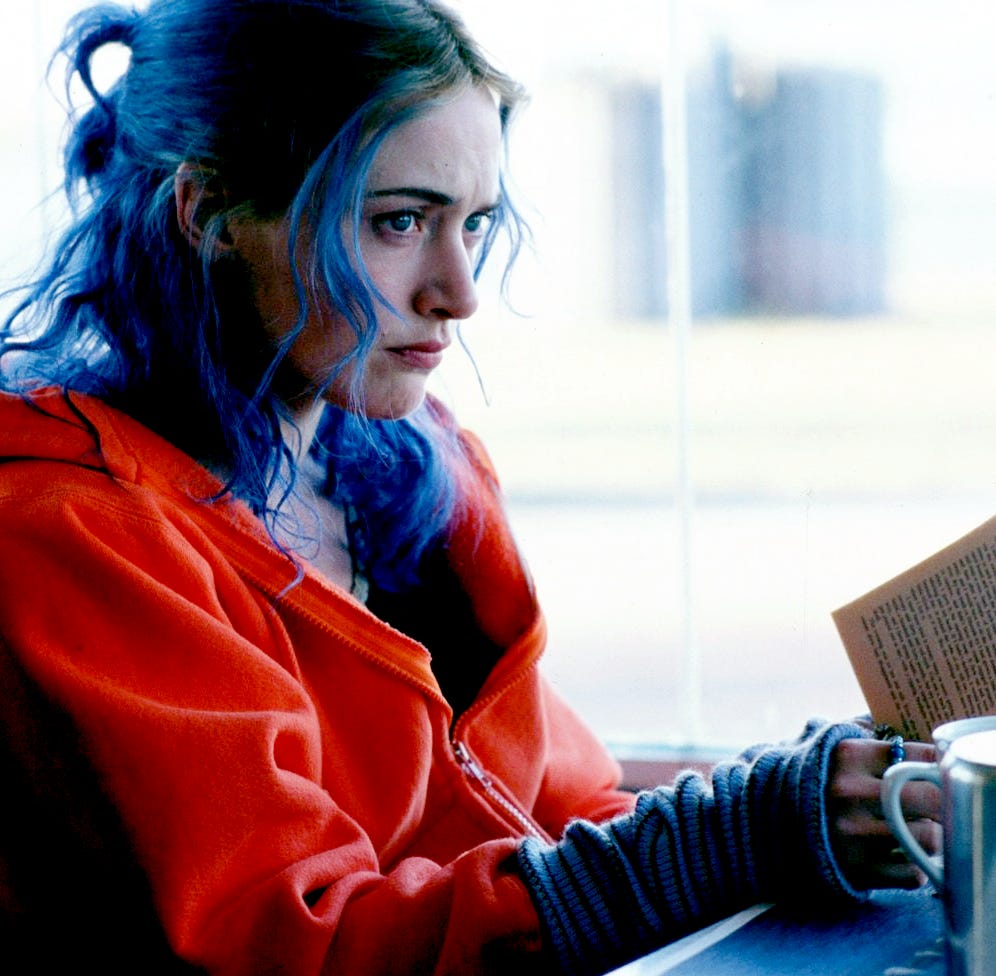
Photo Credit: Eternal Sunshine of the Spotless Mind
These qualities include feminine traits not valued by the patriarchy. This includes things like “being emotional,” or the word that is often used against women, “hysterical.” Dark feminine qualities also include feminine rage, which is a threat to patriarchal systems because if women collectively become angry, they may revolt against the institutions and systems that oppress them. Thus, while the Alt Girl may be idealized as a sexual fantasy for many men, she is still seen as different from the Trad Wife/Clean Girl aesthetic, and thus, she inherently is less desirable in the eyes of patriarchy because, like Summer, she cannot be controlled by the men in her life. While this initially might seem like a good thing for these women, it actually may place them at more risk under a patriarchal system that tends to devalue or blame women when they do not comply with the “good woman” image it has created for them.
We’ve all heard stories as women of slut shaming for survivors of SA and other horrid acts of violence against women. Therefore, Alt Girls run the risk of being fetishized by men, and it’s clear from porn videos and content on social media that this is already happening. Thus, it appears that even as Alt Girls try to reclaim their humanity and agency, many men will still try to lump these women into the “whore” category in order to silence their voices and oppress them. Furthermore, Alt Girls, in their attempts to break themselves free from the oppressive nature of patriarchy, may consequently cut themselves off from their more feminine aspects, namely the “light” feminine qualities associated with the Trad Wives. Thus, in a sense, both the Trad Wives and Alt Girls of the internet have internalized the Madonna-Whore Complex within themselves.
Accepting Our Own Internalized MWC
When we cannot accept both our light and dark aspects, we inevitably become trapped and disconnected from our true selves. Trad Wives are human and, therefore, have “dark feminine” emotions such as rage, sadness, etc. Alt Girls are also human, and while they may be more tolerant of their “dark” aspects, they are “light feminine” aspects to them as well.
As a woman, I have been on both sides of this dichotomy, and while in full self-disclosure as a Tarot Practitioner and Reiki Master, I tend to learn more on the “Alt Girl” side of the spectrum; I believe it is vital to call attention to this divide among women and how it further perpetuates the patriarchal systems which have oppressed women collectively for far too long. Within all of us, men, women, non-binary, and trans individuals, there is light and dark, feminine and masculine energy. No matter where you fall on this spectrum, it is crucial to accept and tolerate the different aspects of yourself since that is how all of us can break from the restrictive nature of the patriarchy.
This is especially true for cis-women and marginalized women who have been majority affected by the overturn of Roe v. Wade. In fact, it is not a coincidence that the rise in the divide between the Trad Wives and Alt Girl dichotomy (or Madonna-Whore Complex) began to rise at the same time that this historical overturn occurred. Furthermore, it is clear from the internet that men love both Alt Girls and Trad Wives; how could they not? They are able to get the best of both worlds while women are once again pitted against each other. Trad Wives and Alt Girls, just like the Madonna and Whore are ultimately categories made to serve male systems of power.
The true power for women lies in not placing ourselves into predefined categories but creating new categories of our own.
Towards Wholeness: Finding the Middle Ground
So, where is the middle ground? Where are the examples of women who can be both light and dark? A woman who doesn’t feel like she has to fit into either category? Can such a women exist in a patriarchal world?
I believe the first step in this process is for women, regardless of where they fall on the Trad Wife and Alt Girl spectrum, to realize that these concepts are two sides of the same coin. That we all have light and dark feminine aspects to ourselves. (Just like we have dark and light masculine qualities, but that is a conversation for another day). Trad wives are just as oppressed as Alt Girls under patriarchy and vice versa. Both become objects for men to place on unrealistic pedestals, and they limit women’s ability to access all parts of themselves, which hinders their ability to know themselves fully to decide who they are and who they wish to become.
To break out of the Madonna-Whore Complex, we have to be willing to see ourselves reflected in the other and join together to get out of the boxes we’ve been placed in. Only then can we move towards collective and individual wholeness.
So, what are your thoughts? And would you like more content like this? If so comment below!
Written References:
Japko, D. (2023). The implications of the Madonna/Whore Constellation: A common fantasy underlying misogyny? International Journal of Applied Psychoanalytic Studies, 20(3), 525–534. https://doi.org/10.1002/aps.1831
Freud, S. (1905). Three essays on the theory of sexuality. In J. Strachey (Ed.), The standard edition of the complete psychological works of Sigmund Freud (Vol. VII, pp. 125 248). Hogarth Press.
Levin, I. (1972). The Stepford Wives. Random House.
Movies:
The Stepford Wives (2004)
Scott Pilgrim Vs. The World (2010)
500 Days of Summer (2009)
Eternal Sunshine of the Spotless Mind (2004)