

West End Girl and the Goddess-Witch Spectrum
A Deep Dive into Lily Allen’s New Album

West End Girl dropped last Friday, October 24th, 2025, which is singer/songwriter Lily Allen’s fifth studio album. Prior to that, the last time Allen dropped an album was over seven years ago when she released No Shame in 2018.
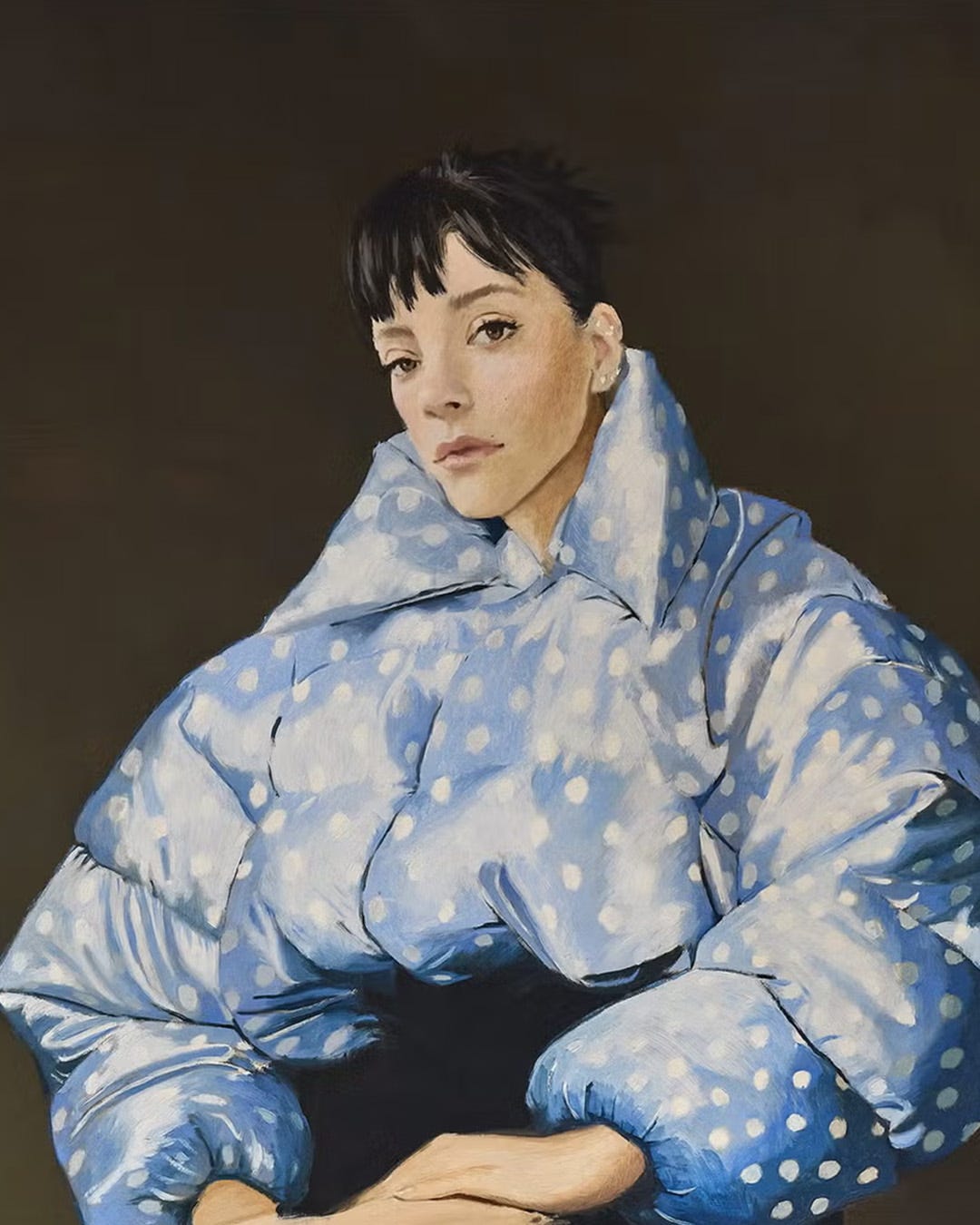
Allen’s Album cover for West End Girl
In full transparency, I am not fully up-to-date on all the details of Allen’s personal life, or rather, I should say that I wasn’t until the recent release of her new album.
In fact, I think many of us are rather shocked but can also deeply resonate with Allen’s lyrics on her latest album. Especially those women in our early 30s and late 40s, trying to navigate the dating world in a world riddled with open marriages and non-monogamy.
According to Allen, who is 40 years old, she wrote the entire album in 10 days after her life had “blown up” due to the breakdown of her marriage with actor David Harbour, known for his role as Jim Hopper in Stranger Things.
Apparently, from what one can deduce from the album Harbour was jealous of Allen’s role in the play 2:22, which was written by Danny Robins and first premiered in London’s West End (hence the name of her album) in Fall 2021.
*Side note: When I first heard the name of her new album, I wondered if it was a reference to the song West End Girls by the Pet Shop Boys. Yet that does not seem to be the case. Either way, it’s a great song that you can listen to below*
In the play, Allen played a woman named Jenny who is convinced her home is haunted despite her skeptical husband’s dismissal of her concerns. Yet one night, over dinner with friends, she convinced them all to stay up until 2:22 am (the witching hour), causing her and her husband to discover a ghostly secret. (Don’t worry, I won’t spoil that ending here, and you can learn more about the play through its website here.)
Allen ended up earning an Olivier Award nomination for Best Actress for her role in 2:22 in 2022, and she later said the play helped her rediscover her love of performing.
No doubt, this performance spark was inspired in part by the ways life often imitates art, as it appears that Allen was encountering her own form of a ghost story, navigating the end of her marriage to Harbour, who, after Allen moved back to London, requested they open their marriage while he remained in New York with her two daughters from a previous marriage.
It is clear from the text messages and voice calls Allen reads to us in her songs that this news came as quite a shock to her. Yet, in an attempt to accommodate her husband, she attempted to be his nonmonogamummy. (I.e., his mother figure or goddess archetype, who fulfills all of his child-like fantasies.)
As the song goes:
I don’t wanna fuck with anyone else, I know that’s all you wanna do
I’m so committed that I’d lose myself ‘cause I don’t wanna lose you, you, you
…
I’ve been trying to be open
I just want to meet your needs
And for some reason I revert to people pleasing
I’ll be your nonmonogamummy
I’m just trying to be open
It is clear that the line “I’m just trying to be open” is in reference to not only her sexual and relationship status, but also her desire to see her husband’s point of view from his perspective, which in turn caused her to people-please and lose herself.
This is what an overactive Veil function looks like in women.
In my Yonic Theory™, I refer to the Veil function as the aspect of women’s psyche or Self which reflects the qualities of the light or conscious feminine. Therefore, since our outer conscious world reflects principles of the masculine principle of Eros/Spirit, the Veil function reflects qualities of femininity, which support a masculine approach to navigating the outer world.
I.e., women operating in ways that reflect a masculine-centered point of view. Those qualities involve women being accommodating (i.e., people pleasing), understanding (i.e., seeing things from others’ point of view), compassionate, caring, nurturing, and above all else, fertile and mothering.
Now, these qualities aren’t inherently bad for women. Women need access to their light, feminine qualities, since they are aspects of both men and women that help us form deep and meaningful relationships, express empathy and care towards others. And for some women, this can involve having children, or even metaphorically giving birth to creative projects, as Allen has done in both respects.
Yet often women become fused to this aspect of themselves, and thus they begin to embody the archetype of the goddess in the goddess-witch spectrum™. An archetype that often causes women to abandon their more “witch-y” or dark feminine aspects in order to embody solely light feminine qualities. Thus, women learn to internalize the archetype of the goddess, which often men will project onto them. Just as Harbour did to Allen, by forcing her to become his pseudo-mother figure.
The Goddess
It is clear that the term “nonmonogamummy” is referencing this goddess archetype through Allen’s association of it with the Madonna archetype in the song Sleepwalking.
As she says:
I know you’ve made me your Madonna
I wanna be your whore
For those of you who don’t know, the term Madonna is a reference to the Italian phrase “mi donna,” which means “my lady” and was a term used mostly by Catholics to refer to the Virgin Mary.
Sigmund Freud later wrote about this term as he noted many men, including his frenemy Carl Jung, want to marry virginal “good women” whom they project onto as the ultimate mother archetype (i.e., the Madonna or what I call the “goddess”). Yet because they put these women on a pedestal, they no longer feel comfortable exploring their “shadow” or Id impulses with them, thus they coveted their mistresses or “whores” which I refer to as the witch archetype.
Thus, it was when they were engaging in sexual and romantic relationships with their “whores” that these men felt like they could remove their outward “good” conscious Ego functions with and embrace their more wildling aspects (i.e. the Daemon function). Which are essentially men’s Persona and Shadow functions in Jung’s theory of the Self.
Yet, Jung (most likely due to his own inability to reconcile his inner goddess-witch spectrum) never fully grasped how men also have a light and dark feminine aspects within them through their own possession of a Veil function and Aura function.
That is where the goddess-witch spectrum (formerly known as Freud’s Madonna-Whore complex) comes into play.
Except as Allen points out, it isn’t just men who have this spectrum. Women possess it well.
As she goes on to sing in the song Sleepwalking:
Baby, it would be my honour
Please, sir, can I have some morе?
…
I could preserve all of your fantasiеs
If only you could act them all out with me
Here she is literally begging her husband to see her as a whole human. A woman with both her Veil and Aura functions (i.e., the dark feminine aspects of women’s psyche) intact. Yet he refuses to reconcile this spectrum within himself because it is easier for him to project the archetype of the “good mother/wife” onto Allen and displace what he perceives to be his shadow aspects and sexual fantasies onto other women.
Which is exactly what he does, and I would argue most modern men do in the dating world as well.
The Witch
In the song Pussy Palace, Allen discovers that Harbour’s apartment in the West Village is basically his sex cave, where he hides away his indiscretions and secret fantasies from Allen. She is shocked and outraged at this discovery, because she realizes that her husband is not just having indiscriminate sex with sex workers as he promised he would when they opened up their marriage. Instead, he has crossed over to having full-blown emotional and romantic affairs with these women.
Which, honestly, is a common pattern that sadly I have observed in many open relationships, which tend to look good on paper, as Allen reflected in her new album. Yet over time, it can lead to potential boundary violations in part because the dynamic can be a convenient excuse for both men and women to engage in unconscious projections they have not learned how to integrate. Thus allowing them to avoid their fear of intimacy.
**Though it should be noted that not all individuals who engage in open relationships fall into this pattern.**
Moreover, this is also quite common for many men who have an internalized witch archetype and end up engaging in infidelity. As someone who has been in the position of the “other woman” before, I have noted that men tend to be more vulnerable and honest about themselves with the women whom they do not perceive as their primary romantic partner. Thus, they project that these women represent the archetype of the witch, and their role is to help men reconcile their Aura functions, or the aspect within a male’s sense of Self which is connected to mystery, intuition, the unconscious, and the dark feminine.
Therefore, men use the witch, the whore, “side chick” or whatever term they use to describe women as a way for them to confront their own unconscious or “shadow” aspects, which then forces them to reconcile their own masculine light and dark aspects (I.e., the Ego and Daemon functions).
This is because we associate the feminine with the moon, the dark, the unconscious, and all things taboo and hidden. Therefore, the unconscious or dark aspects of ourselves force us to confront our own inner feminine landscape.
I.e., this is the battle between the conscious and unconscious, as discussed by both Jung and Freud. Yet neither one of them was truly able to capture the role of the feminine principle (what I call Psyche/Soul) within the Self.
To learn more about the divide between the feminine/unconscious and masculine/conscious aspects of the Self, listen to part 2 of my Yonic Model of the Self, or purchase the article I have written about these four functions and the goddess-witch spectrum™ through my Yonic Theory™ website www.yonictheory.org.
Thus, women’s experience navigating their own self-actualization process has gone largely unnoticed. Moreover, because women are often forced to subject themselves to men’s perception of themselves, this forces women to foreclose on their Veil functions (as Allen did) or Aura functions, by embodying aspects of the light and dark feminine in extremes.
Thus, for many women who are forced into the archetype of the witch, they often appear to be seductive, alternative, taboo, promiscuous, rebellious, or filled with “feminine rage.”
And this Aura function aspect of a woman’s psyche is just as important as the Veil function, because it is how she reclaims her power. By decentering herself from men’s projections.
By realizing, just as Allen did, that she is not just a “people pleaser” or a stand-in mother figure for her husband. That she is her own person, with her own needs, desires, and wants, sexual or otherwise.
It is upon realizing that truth that Allen is finally able to end her relationship with Harbour and the two are now formally separated.
Thus, Allen has learned how to reconcile both her goddess and witch archetypes, which in truth are one and the same. Since any goddess can become a witch and any witch a goddess, depending on who is telling the story.
What Allen also learns from this experience is that, in truth, both men and women are navigating these dynamics within themselves, which they often do due to their relationships with other people in their lives, which causes them to confront aspects of themselves.
As she sings in the song Fruityloop:
You’re just a little boy looking for his mummy
Things have gotten complicated what with all the fame and money
Playing with his toys, he just wants attention
He can’t really do attachment, scared he’s gonna be abandoned
It is clear here that Allen is recognizing how her ex-husband’s inability to reconcile his own inner feminine aspects – that which he obtained through his mother and subsequently projected onto other women- which has contributed to his inability to see her as a whole human.
In truth, we all do this to each other. Which is made clear in the following stanza when she sings:
I’m just a little girl looking for hеr daddy
Thought that we could break the cyclе, thought that I could keep you happy
It is what it is, you’re a mess, I’m a bitch
Wish I could fix all your shit, but all your shit’s yours to fix
Here, Allen is owning that she also projected her own masculine divide onto her husband and used him as a pseudo-father figure, which causes her to engage in people pleasing (i.e., her Veil function) in an attempt to get validation from Harbour to build her own light masculine function, the Ego.
Yet she is realizing that is no longer her job to center men and that she has access to her own masculine functions, and the masculine principle I call Eros/Spirit within her. Thus, she can remove the archetype of prince charming she has placed on Harbour through her own prince charming-wildling spectrum. Which is the equivalent of the goddess-witch spectrum for men, which I wrote about here on this blog post.
Thus, while this isn’t a story about happily ever after, it is a story about Allen learning to come back to herself through a process I call Anamnesis, which reflects the self-actualization process for women.
Thus, Allen realizes, as I believe many modern women are starting to realize as well, that all of us men and women are a bit “fruityloop.” Which causes us to project these archetypes of the goddess, the witch, the prince charming, and the wildling onto one another to assist us in confronting all the functions of our Self.
Thus, in order for us to break out of the goddess-witch spectrum and actually find the true Goddess within, like Allen, women must learn to reconcile this dynamic, becoming both the Madonna and the whore in order to see themselves as whole.
OX,
Your Dark Fairy Godmother
If you are interested in learning more about the Goddess-Witch Spectrum™ Course I offer for women wanting to reconcile their inner goddess and witch archetypes, you can purchase that here.
To learn more about my Yonic Theory™, subscribe and consider making a donation for me to continue my research.
To purchase the article on my Yonic Model of the Self, I mentioned in the post, you can do so using the link below:
Citation:
Robichaux, M. (2025). An introduction to yonic theory and the yonic model of the self. The Yonic Journal, 1(1), 1-87.